
This guide contains affiliate links. If you book through them, the site earns a small commission at no cost to you. The opinions are mine; I only recommend places I’d actually book.
Kyoto isn’t really an onsen city. I’d rather you hear that from me than discover it after dragging your luggage across town to a hotel that turned out to have a heated tap-water tub in the basement. There are perhaps three places inside the city limits where you can soak in genuine, drilled, mineral hot-spring water, and one of them is technically a public bathhouse. Everything else with “onsen” in the name is either a day-trip away in the mountains, or a marketing term that should come with an asterisk.
That sounds harsher than it is. Kyoto compensates for the geological shortfall in two ways. The first is geography: Kurama, Kibune and Ohara sit properly in the hills but still inside Kyoto City limits, reachable in 35 to 50 minutes from Kyoto Station. A “Kyoto onsen ryokan” trip is almost always a half-day train commitment, not a flight. The second is the surrounding mountain prefectures (Arima, Hakone, Kinosaki), but those aren’t Kyoto, so they don’t belong in this guide.
What follows is the actual map: where the real onsen ryokan are, which ones are worth booking, what’s a “ryokan with a bath” rather than a ryokan with an onsen, and how to use Funaoka (a 102-year-old neighbourhood sento) as a hybrid solution if you’d rather sleep in central Kyoto and bathe somewhere with mineral water nearby. I’ll point out which famous-sounding properties are using onsen in the looser legal sense, where the chains have actually drilled real wells, and where I’d send a couple on their first ryokan night versus a returning visitor who already knows what they like.
In This Article
- Quick reference: where the actual hot-spring water is
- What counts as an onsen: and why it matters here
- Kurama Onsen: the only real ryokan onsen in north Kyoto
- Kurama Onsen Ryokan: the standalone choice
- Kurama-dera and the hike to Kibune: pair it with the bath
- Kibune: the misunderstood “onsen” that isn’t
- Kibune Fujiya: the bookable kawadoko ryokan
- Ryokan Ugenta and the smaller Kibune properties: book direct
- Arashiyama: the largest cluster of onsen ryokan in Kyoto
- Togetsutei: the riverside main pick
- Hoshinoya Kyoto: the boat-access onsen alternative
- Kadensho Arashiyama Onsen: the bigger, cheaper Arashiyama option
- Ranzan and the budget Arashiyama riverside ryokan
- Ohara: the quiet ryokan onsen 50 minutes from town
- Ohara Sansou Seryo: the better ryokan kitchen
- Ohara no Sato: the cheaper Ohara onsen option
- The Funaoka Onsen hybrid: sleep downtown, bathe at a 102-year-old sento
- Where to stay in central Kyoto if you’re using Funaoka as the bath
- The Kyoto Station “natural hot spring” hotels: what they actually are
- Onyado Nono Kyoto Shichijo: sourced-onsen budget option
- Dormy Inn Premium Kyoto Ekimae: the larger chain alternative
- What about “private onsen” hotels in central Kyoto?
- Kyoto onsen vs other Kansai options: when to leave the city
- What most guides get wrong about onsen in Kyoto
- Booking strategy for onsen ryokan in Kyoto
- Quick recommendations by traveller type
Quick reference: where the actual hot-spring water is
| Area | Reality check | Pick | From/night | Book |
|---|---|---|---|---|
| Kurama (north Kyoto) | Real onsen, drilled mountain spring, only one main ryokan | Kurama Onsen Ryokan | ¥38,000 | Check prices |
| Kibune (north Kyoto) | No real onsen, but riverside kawadoko ryokan with private tap baths | Kibune Fujiya | ¥45,000 | Check prices |
| Arashiyama (west Kyoto) | Drilled onsen since 2004, several large ryokan use it | Togetsutei | ¥42,000 | Check prices |
| Ohara (north-east Kyoto) | Real onsen at one ryokan; sourced bath at another | Ohara Sansou Seryo | ¥48,000 | Check prices |
| Central Kyoto | One historic sento, no in-town ryokan with real spring water | Funaoka Onsen + a downtown hotel | ¥490 entry | Check prices |
| Kyoto Station area | Hotel “natural hot spring” baths (drilled in town) | Onyado Nono Kyoto Shichijo | ¥18,000 | Check prices |
What counts as an onsen: and why it matters here
The Japanese Hot Spring Law (温泉法, Onsen-hō, 1948) sets the bar low on paper: water from natural sources at least 25°C at the tap, or below that if it contains specific minerals at minimum concentrations. That’s it. It doesn’t have to be naturally hot, gushing from a volcanic crater, or surrounded by snow monkeys. It just has to come from the ground.
Which is why Kyoto, geologically, ends up with onsen at all. There are no active volcanoes nearby, no obvious thermal features. But drill deep enough and you’ll find warm groundwater under the city, and several spots along the foothills have water that’s hot or mineral-rich enough to qualify legally. Arashiyama drilled a 1,200-metre well in 2004; the city’s claim to be an “onsen district” dates from that.
This matters because the word onsen on a hotel website tells you almost nothing without context. A “natural hot spring bath” at a chain like Dormy Inn or Onyado Nono is real onsen water; they ship it in by tanker if there’s no well on site, and the law allows that as long as it stays warm enough at the tap. A “private onsen room” at a city centre boutique might mean a wooden tub with regular tap water heated to 41°C, which is just a nice bath. Kyoto’s tap water is actually excellent, so the bath will still be pleasant. It just isn’t onsen.
Three legal categories worth knowing:
- Tennen onsen (天然温泉); naturally sourced from the ground, the strict version. The label most ryokan want.
- Onsen (温泉); qualifies under the 1948 law, which can include reheated and circulated water. Legal but a step down.
- “Bath” (お風呂, 浴場); any other hot bath. Heated tap water counts here. This is what most “private onsen” hotel rooms in central Kyoto actually are.
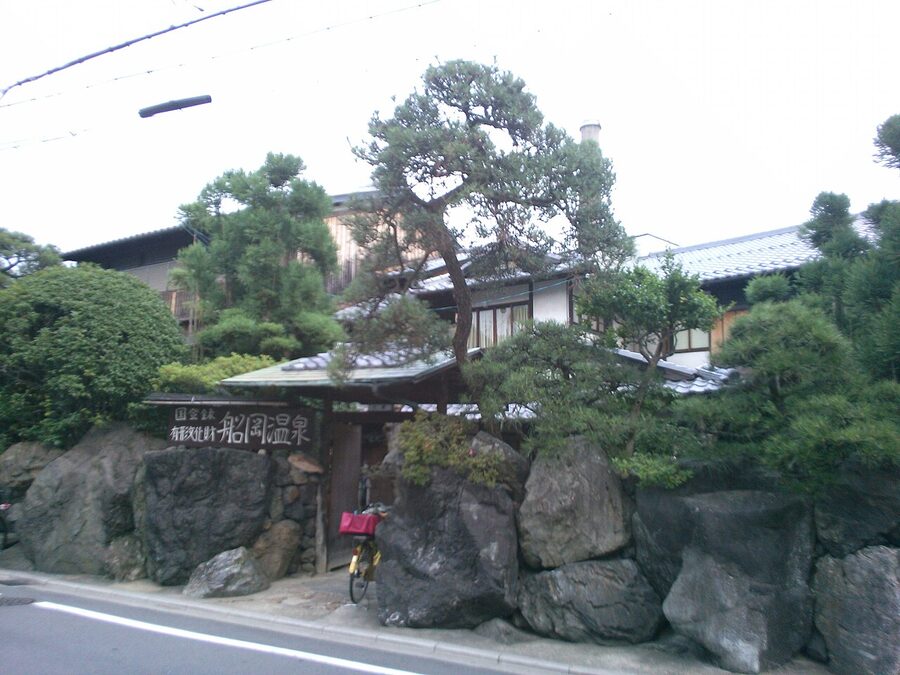
I’ve put Kurama, Arashiyama, Ohara and Funaoka under category 1 in this guide. Kibune is upfront about not having drilled onsen; its appeal is the river, not the water in the bath. The Kyoto Station chain hotels are usually category 2 (sourced onsen, but reheated). Anything in central Gion calling itself a “private onsen room” needs reading carefully; most are category 3.
Kurama Onsen: the only real ryokan onsen in north Kyoto
Kurama Onsen Ryokan: the standalone choice
Nearest station: Kurama (Eizan Railway, Kurama Line), 10 min walk or 5 min by free shuttle bus
From Kyoto Station: 35-40 min via Tofukuji + Demachiyanagi (transfer to Eizan)
Best for: Couples, returning visitors, anyone wanting a single overnight that’s actually onsen
From: ¥38,000 with kaiseki and breakfast (low season)
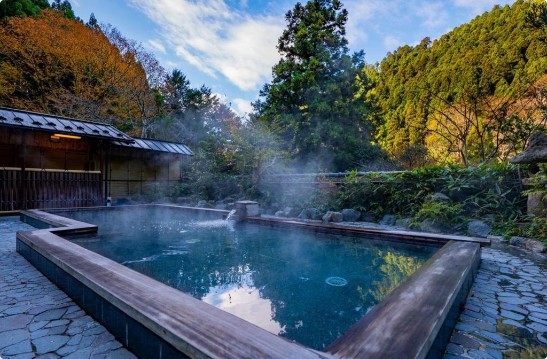
If you want to stay overnight in a ryokan with a working onsen inside Kyoto City limits, Kurama is essentially the only option. The water is sulphate-chloride, runs at about 37°C at source (so reheated to 41-42°C in the bath), and the outdoor bath looks straight onto cedar forest, the kind of view people travel to Hakone for. The ryokan side has eight Japanese-style rooms with private toilets, and dinner is the standard kaiseki you’d expect at this price.
What makes Kurama Onsen worth the trip rather than just a flag-on-the-map is that it’s been a working spring since 1923. The current ryokan was rebuilt later, but the spring is the original draw. Mount Kurama itself is what you came for. You can hike to Kurama-dera before the bath, then over the ridge to Kibune in the afternoon, then back to the ryokan for dinner. It’s the closest thing Kyoto has to a proper ryokan-and-mountain day.
Day visitors are welcome (¥2,500 outdoor bath, ¥3,500 both baths) and the ryokan runs a free shuttle from Kurama Station every 30 minutes. The day-use option is what most Kyoto travellers actually use; overnighting here is genuinely remote at night, and if you’ve already got a hotel in central Kyoto you’d rather stay there for shopping and food.
What’s good:
- Genuine, drilled mineral spring water in a forest setting
- Outdoor bath looking into cedar trees with no road, no buildings, no pylons
- Free shuttle bus from Kurama Station means you don’t need to walk back uphill after dinner
- Tattoo-friendly (one of the few in Kyoto)
What’s not:
- The eight ryokan rooms book up months ahead in autumn; start checking dates a year out for foliage season
- The day-bath area gets full of bus-tour visitors between 11:30 and 14:00; aim for early morning or after 16:00 if you’re day-tripping
- Dinner is decent kaiseki but not three-Michelin territory; if food is your main reason to ryokan, there are better choices in town
Check prices: Booking.com | Direct via Kurama Onsen official site
Kurama-dera and the hike to Kibune: pair it with the bath
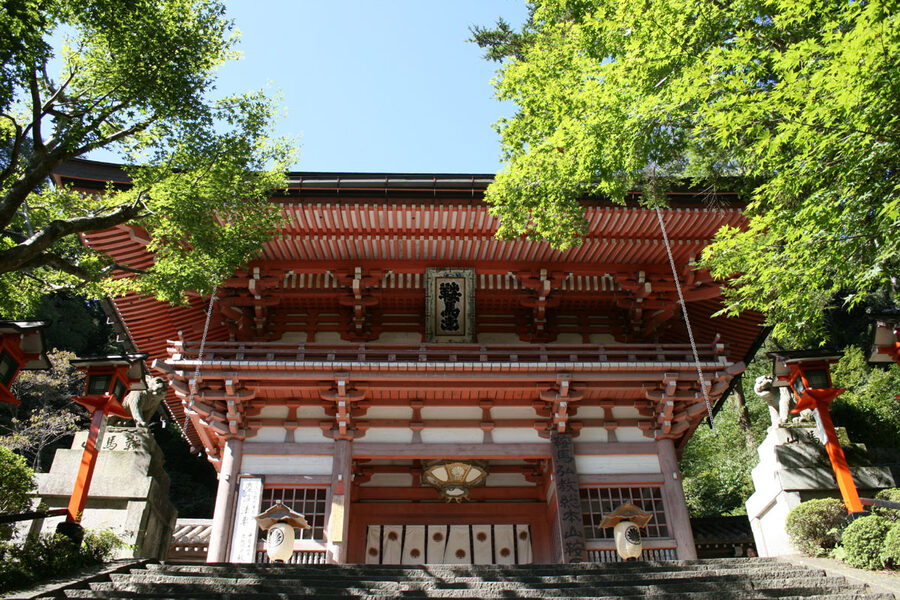
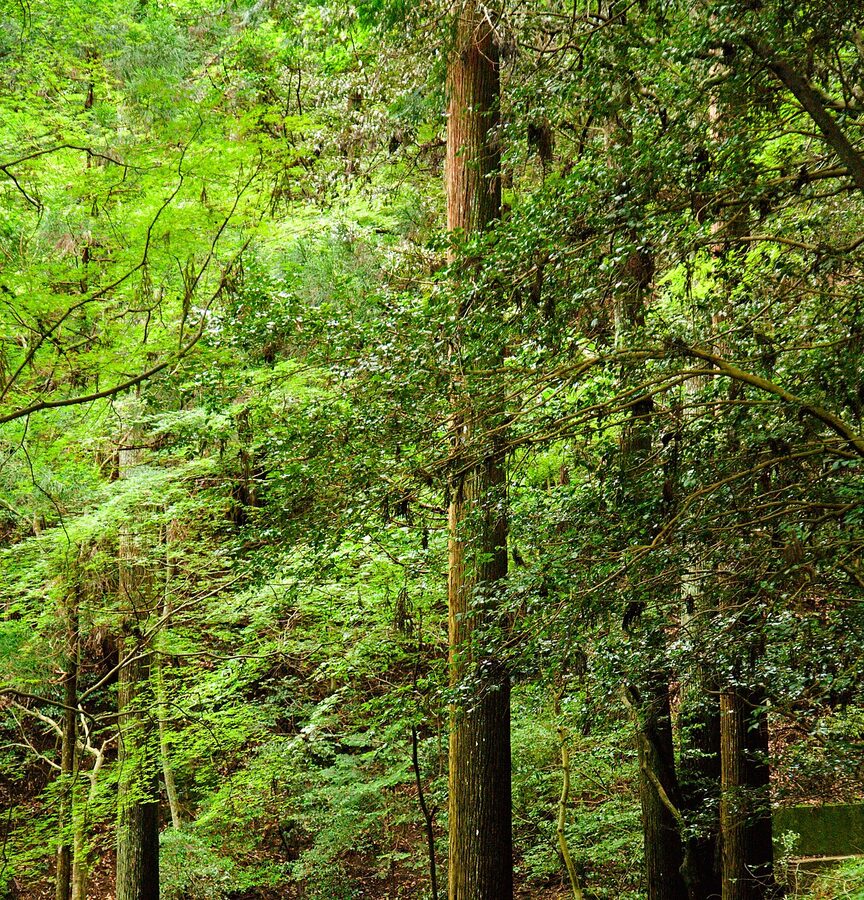
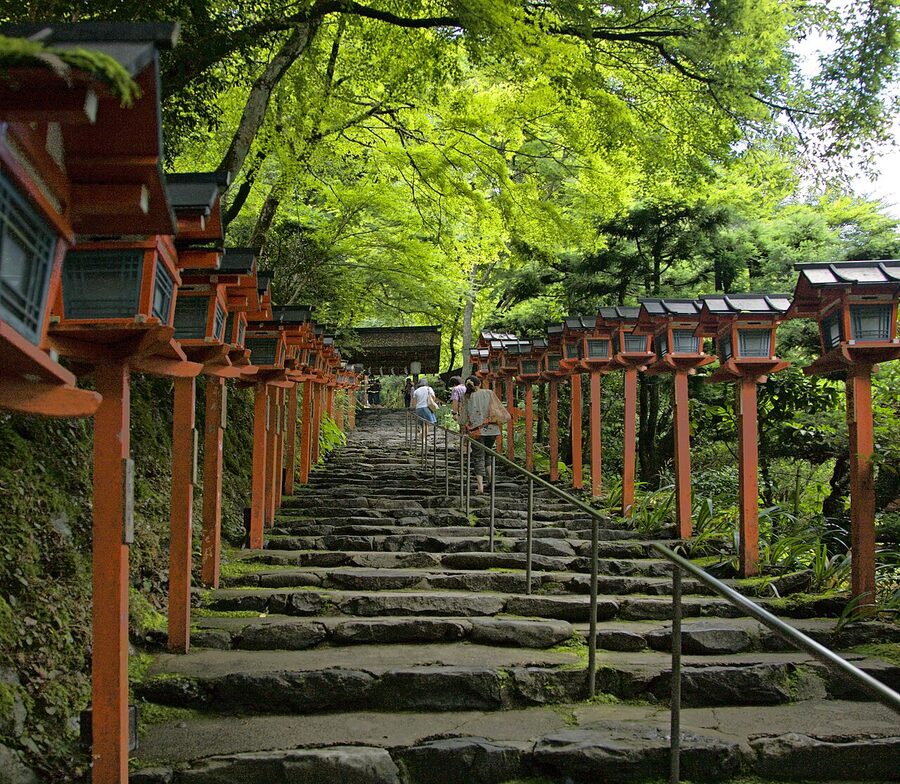
The reason a lot of Kyoto travellers actually end up at Kurama Onsen isn’t the bath itself; it’s the hike. Kurama-dera sits on the mountain above the station; you can walk up through the temple grounds, over the ridge, and down to Kibune in about 90 minutes if you’re not stopping for tea. The path is well-maintained, mostly stairs and forest track, and the elevation change is around 200 metres. Bring water; there’s nothing on the trail.
The pattern that works: arrive Kurama Station around 10am, hike up Kurama-dera, over the ridge, down to Kibune by 13:00, lunch at one of the kawadoko ryokan (more on those below), then walk back along the road to Kibune-guchi Station and the Eizan back to Demachiyanagi. If you’re staying overnight, do the hike in reverse and finish at the onsen. It’s the structure that makes the day work.
Kibune: the misunderstood “onsen” that isn’t
Kibune is the small village down the valley from Kurama, on the same Eizan Railway line. Its reputation in English guides is murky; half of them call it an onsen district. It isn’t. There’s no drilled onsen in Kibune; the ryokan baths are heated tap-water or, in a few cases, water trucked in from the Kurama spring. What Kibune does have is the river, which is the real reason to come.
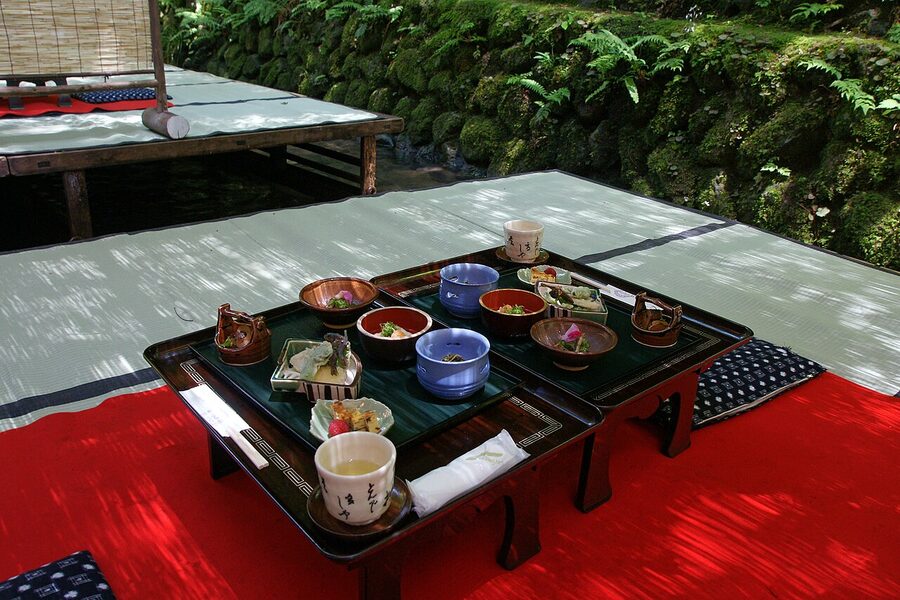
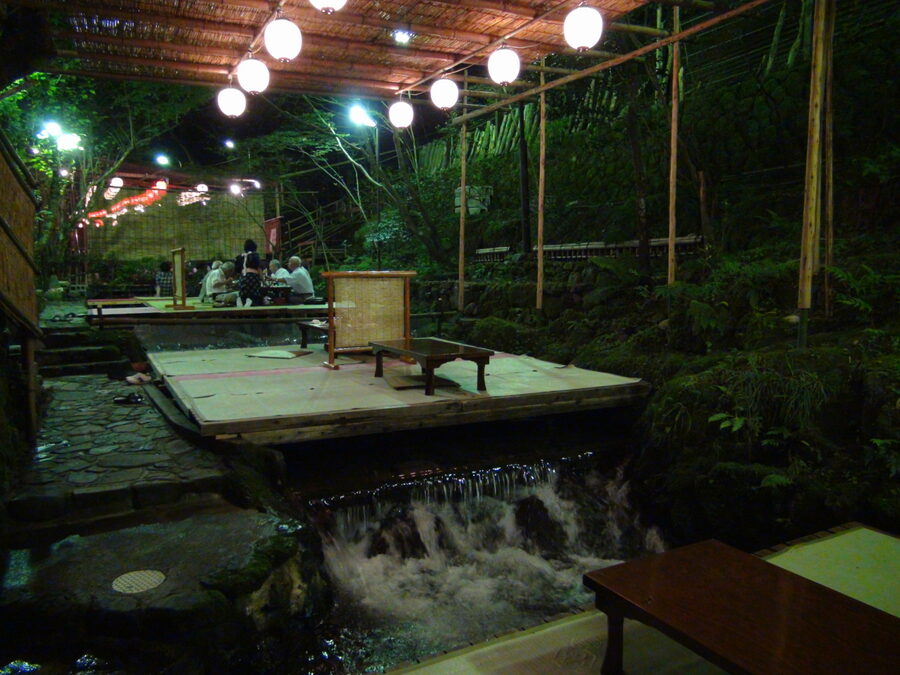
From May through September, ten or so ryokan and restaurants set up kawadoko dining platforms; wooden decks built directly over the rushing Kibune River, sometimes literally inches above the water. Kaiseki dinner served on a platform with the river running underneath you is one of the things you’d actually book a Kyoto trip for. It’s not an onsen experience. It’s its own thing, and worth being clear about.
The downside of Kibune ryokan is that they’re small, expensive, hard to book, and most don’t list on Booking. Kibune Fujiya is the main exception; it’s the only one with a Booking presence, and the bath is heated tap water with a private terrace. If you want one of the standalone ryokan like Hiroya or Ugenta, you book by phone or via the ryokan’s own English email page, not through an aggregator.
Kibune Fujiya: the bookable kawadoko ryokan
Nearest station: Kibune-guchi (Eizan Kurama Line), 5 min by Kyoto Bus #33 + 5 min walk, or 25 min walk uphill
From Kyoto Station: 50-55 min via Demachiyanagi (Eizan transfer)
Best for: Couples in summer, kawadoko first-timers, travellers who want a Kibune room they can actually book online
From: ¥45,000 with kaiseki and breakfast (low season); ¥85,000-120,000 in summer for a full kawadoko dinner
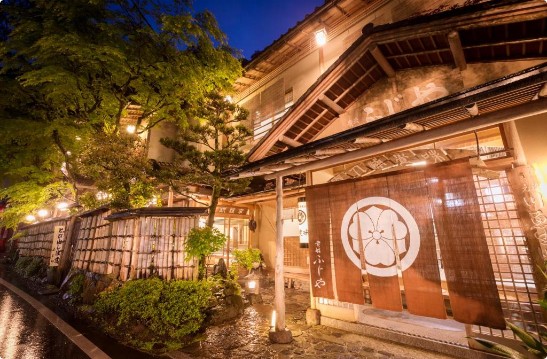
Kibune Fujiya has been running on the same site since 1830-something. The current building is post-war but built in the kawadoko-house style; split-level wooden, with a covered terrace right over the river. The rooms are tatami with futon, the dinner kaiseki includes river fish (ayu in summer), and the in-room bath is private but tap-water, not onsen. They don’t pretend otherwise on the website.
The reason to book Fujiya is the river, not the bath. From May to September the dinner is served on the kawadoko platform and the rooms have open windows; the sound of the water replaces the sound of the city. In December and January the place mostly closes; the road into Kibune ices up and the platforms are dismantled.
What’s good:
- The kawadoko dinner platform is the real attraction; if you only do this once, do it here
- The valley is roughly 5°C cooler than central Kyoto in summer, which is a meaningful difference in August
- One of the very few Kibune ryokan that takes Booking and Agoda reservations
What’s not:
- The bath isn’t onsen; if onsen is your priority, Kurama is 10 minutes back up the line
- Kawadoko season only runs roughly mid-May to late September; in autumn and winter the place is just a riverside ryokan
- Kibune is dead at night; there’s nothing open after 21:30, and the last train back to Demachiyanagi runs around 22:00
Check prices: Booking.com | Agoda
Ryokan Ugenta and the smaller Kibune properties: book direct
If you’ve been to Japan before and want the really good Kibune ryokan, you’re looking at Ryokan Ugenta (two-room property, recently picked up by Michelin’s hotels guide), Hiroya, Beniya, and Sansou Kawaakari. None of them list on Booking. Most have a one-page English contact form on their own website; some only take Japanese-language phone reservations. Expect ¥80,000-180,000 per person, kaiseki included, and waiting lists running 6-12 months in summer.
I’m not going to pretend I’ve stayed at all of these. Ugenta, twice. The two-room rule is real; you don’t share the property with anyone else, and the river view from the bath is straight down at the kawadoko platform. It’s beyond the price most travellers want to consider, but if you’ve already done a standard Kyoto ryokan and want the next step up, this is where to look.
Booking these the right way: ask the hotel concierge if you’ve booked a luxury hotel in central Kyoto first (Aman, Park Hyatt, Banyan Tree), or use a booking specialist who deals with traditional ryokan in English. Don’t try Booking; they’re not on it.
Arashiyama: the largest cluster of onsen ryokan in Kyoto
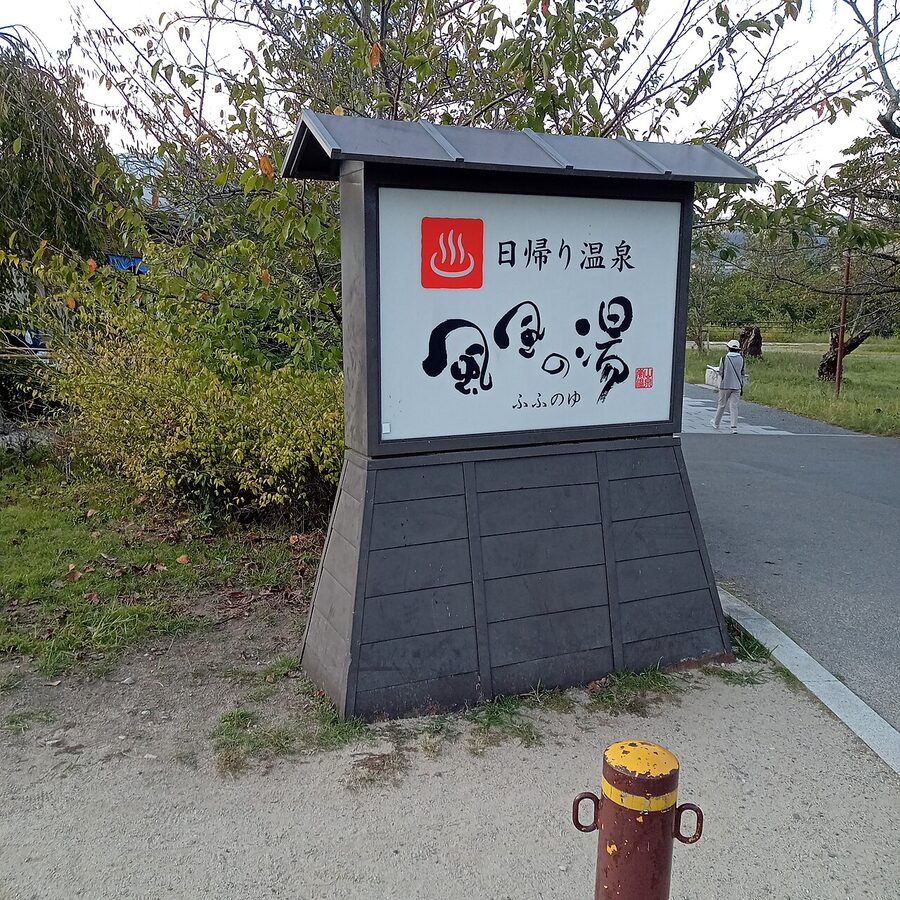
Arashiyama is the most accessible onsen district in Kyoto and the one with the most options. The water comes from a 1,200-metre well drilled in 2004, certified as tennen onsen, and piped to the ryokan and the day-use Fufu no Yu bathhouse. It’s not naturally hot at source; it’s reheated to bathing temperature; and the mineral content is on the lower end of Japan’s hot springs. But it is real onsen by law.
What Arashiyama gives you that Kurama doesn’t: more rooms (so it’s bookable closer to dates), more food options, more neighbourhood, and a riverside setting (the Hozugawa) instead of mountain forest. What it lacks: the genuine remoteness. You’re surrounded by other tourists. The bamboo grove is two minutes from your door; depending on your trip, that’s a feature or a problem. For a wider walk through Arashiyama as a place to base a Kyoto trip rather than a single-night onsen stop, see our where to stay in Arashiyama guide.
Three Arashiyama ryokan I’d actually recommend across price tiers:
Togetsutei: the riverside main pick
Nearest station: Arashiyama (Hankyu) 8 min walk, or Saga-Arashiyama (JR Sagano) 15 min walk
From Kyoto Station: 17 min on JR Sagano Line
Best for: Couples, mid-luxury travellers, anyone wanting a riverside view at moderate cost
From: ¥42,000 with kaiseki and breakfast (low season); ¥85,000-110,000 in autumn
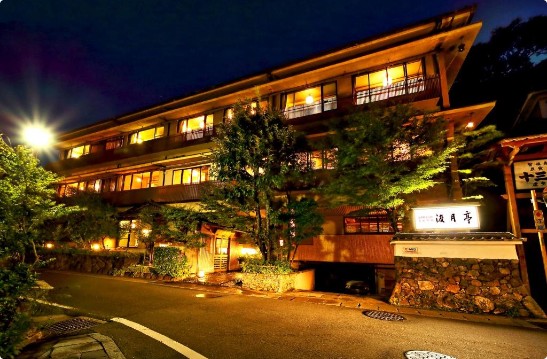
Togetsutei is the established Arashiyama Onsen ryokan, built in the 1960s, renovated several times, with an outdoor bath that looks straight onto the river. The Shuzakaku building has the better rooms; the original Tougetsutei building is older and slightly cheaper. Both use the same Arashiyama Onsen water, piped to indoor and outdoor baths.
The kaiseki dinner is a notch above what you’d expect at this price. Breakfast is the standard ryokan spread; grilled fish, miso, tamago, rice; but they take orders for the rolled-egg dish in advance, which means it arrives still warm rather than the lukewarm version you get at busier ryokan.
The location is the real win. You’re on the river, two minutes from Togetsukyo Bridge, ten minutes from the bamboo grove, fifteen from Tenryu-ji. If your only morning plan is “walk along the river before the buses arrive,” you’re already there.
What’s good:
- Riverside outdoor bath that genuinely looks at the river, not a wall garden
- Closer to JR Saga-Arashiyama than the bus-tour ryokan further west
- The cheaper rooms in the older Tougetsutei building still get the same bath access; budget option without losing the soak
What’s not:
- The water is reheated; if you’re a serious onsen person who can taste the difference between recirculated and free-flowing water, you’ll know
- The lobby and corridors look their age; this is not a stylish boutique experience
- Wi-Fi in the older building is patchy
Check prices: Booking.com | Agoda | Direct (English page)
Hoshinoya Kyoto: the boat-access onsen alternative
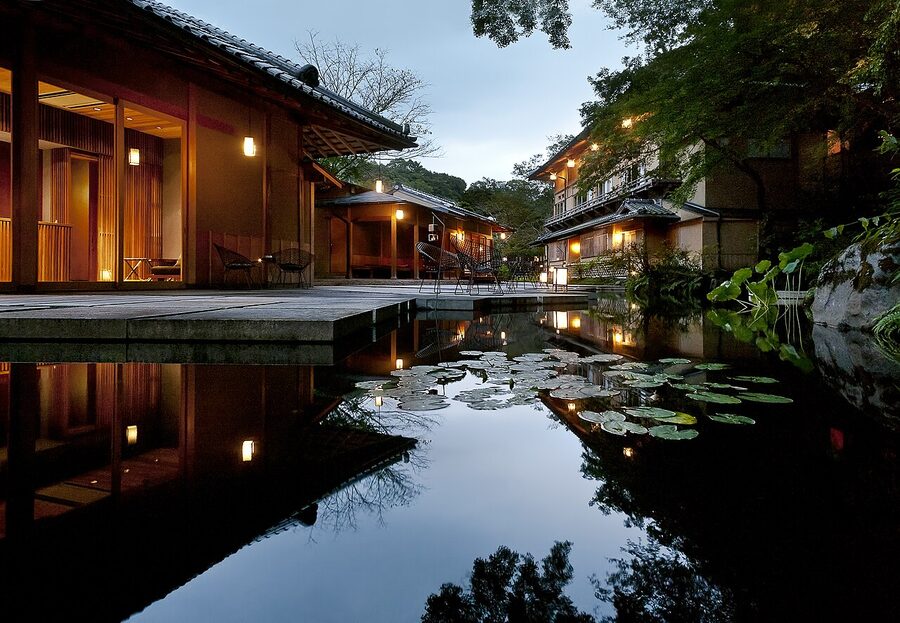
Nearest station: Saga-Arashiyama (JR Sagano), then boat from the public pier (no road access)
From Kyoto Station: 17 min on JR + 15 min boat
Best for: Special-occasion stays, travellers willing to pay for novelty
From: ¥110,000 room only (low season); ¥200,000+ in autumn
Hoshinoya isn’t strictly an onsen ryokan: the bath is heated water, not certified tennen. But it’s the most-cited “luxury Kyoto with bath” option, so worth being explicit about. The property is upstream from the main Arashiyama tourist zone, accessible only by private boat from a pier on the east bank. Twenty-five rooms, all with private terraces facing the river.
I rate Hoshinoya more highly for the location and the boat access than for the bath itself. If onsen is your priority, Togetsutei beats Hoshinoya on water quality at half the price. If “private river-canyon hotel reachable only by boat” is your priority, nothing else in Kyoto compares.
What’s good:
- Genuinely the most secluded major hotel in Kyoto; the boat ride is not a gimmick, you really can’t drive in
- Rooms have private terraces over the canyon; the riverbank is wild, not paved
- The Nanzan-so kaiseki restaurant inside is one of the few in Kyoto where you can do dinner without leaving the property
What’s not:
- The bath is not real onsen; if you booked Hoshinoya thinking you were getting hot-spring water, that’s a mismatch
- The boat shuttle stops at 22:00; once you’re back at the property you’re effectively trapped till morning
- Even the cheapest room is ¥110,000 in February; in autumn it’s into supercar money
Check prices: Booking.com | Agoda | Direct (Hoshinoya site)
Kadensho Arashiyama Onsen: the bigger, cheaper Arashiyama option
Nearest station: Arashiyama (Hankyu) 12 min walk, or Randen Arashiyama 8 min walk
From Kyoto Station: 30-40 min via Hankyu or Randen
Best for: Families, larger groups, travellers wanting the onsen + buffet model at a lower price
From: ¥18,000-24,000 per person with buffet dinner and breakfast
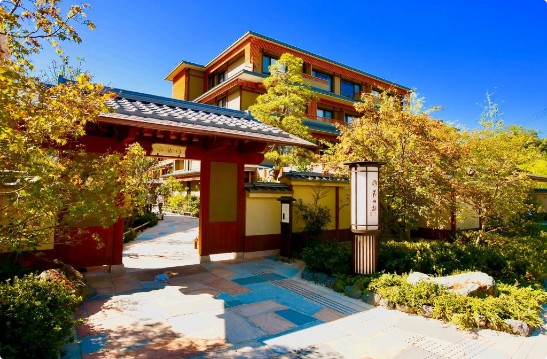
Kadensho is run by the Kyoritsu Maintenance group (the same company behind Onyado Nono) and operates more like a hotel-with-onsen than a traditional ryokan. Rooms are mostly Western beds in tatami-floored rooms; the bath uses the same Arashiyama Onsen water as Togetsutei; dinner is a buffet rather than kaiseki.
The buffet is the polarising bit. Travellers who came for ryokan kaiseki will find it disappointing; it’s hotel breakfast quality, scaled up for 200 people. Travellers who came for the bath, a futon, and a price under ¥25,000 each will find it perfectly fine, with more variety than they’d get at a small ryokan. Pick your category before you book.
Kadensho is also the easiest Arashiyama Onsen to book on short notice; they have rooms when Togetsutei is sold out; and the easiest with kids, since the buffet works for fussy eaters and the rooms are larger.
What’s good:
- By far the cheapest way to combine an Arashiyama Onsen overnight with full board
- Family rooms (4-person) are sized for actual families, not “two adults and a child” Japanese-spec
- Free shuttle from JR Saga-Arashiyama and Hankyu Arashiyama on a half-hourly schedule
What’s not:
- The buffet is buffet; you’re not getting ryokan-grade dinner
- Lobby and check-in feel coach-tour-hotel rather than traditional inn
- The bath is fine but more crowded than at Togetsutei because of the larger room count
Check prices: Booking.com | Agoda
Ranzan and the budget Arashiyama riverside ryokan
If Togetsutei is full and Kadensho doesn’t appeal, Ranzan is the next-best riverside option. Built in the 1970s, last renovated in the 2010s, with the same Arashiyama Onsen water and a riverside outdoor bath. The kaiseki is closer to Togetsutei’s quality than Kadensho’s, and the rate is roughly ¥30,000-50,000 a person depending on season.
It’s a solid middle option that doesn’t appear on most English-language Kyoto luxury lists because it’s not a brand and the website is mostly Japanese. Booking and Agoda both list it; the Booking listings are usually 5-8% cheaper than Agoda for this property specifically.
Check prices: Booking.com | Agoda
Ohara: the quiet ryokan onsen 50 minutes from town
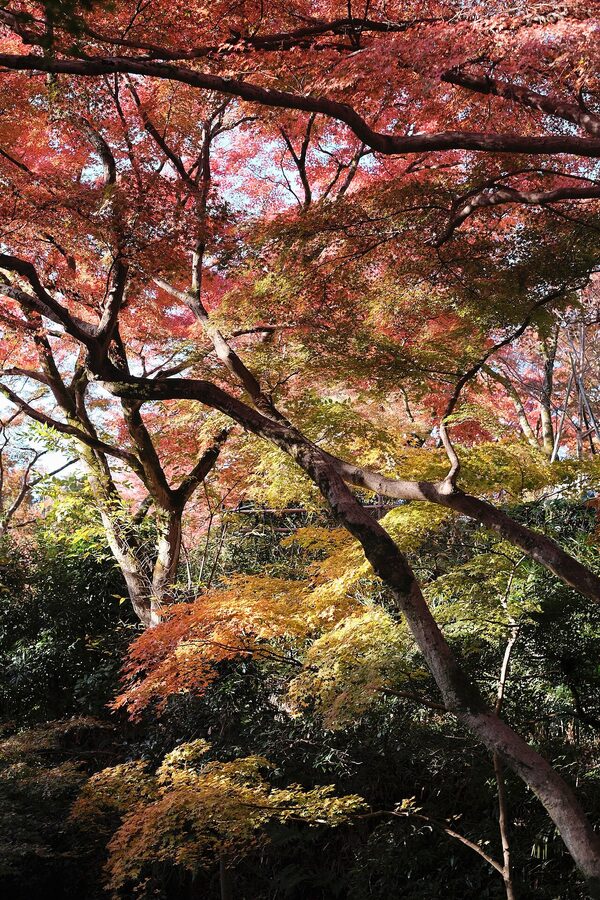
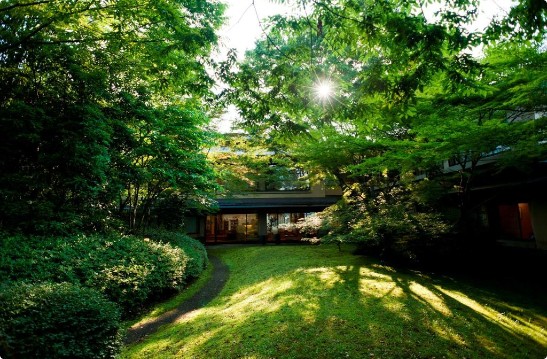
Ohara is the quiet ryokan-with-bath option in the north-east hills. Technically inside Kyoto City limits but a different world; the bus from Kyoto Station takes 50 minutes through the foothills, and once you’re there, the village is small enough to walk in 20 minutes end to end. The two famous temples (Sanzen-in and Jakkō-in) are the standard attractions; the onsen ryokan are the reason to stay overnight.
The water situation in Ohara: there’s a real, drilled spring at the source (Ohara Onsen) and two ryokan use it. Ohara Sansou (also called Seryo) has its own well; Ohara no Sato uses sourced onsen water trucked in. Both qualify legally as tennen onsen. A handful of guesthouses have heated tap-water baths and call them “onsen-style”. If you want the real thing, stick to the two main properties.
Ohara Sansou Seryo: the better ryokan kitchen
Nearest stop: Ohara bus stop (Kyoto Bus #17 from Kyoto Station, #16/#17 from Demachiyanagi)
From Kyoto Station: 50 min by bus
Best for: Returning visitors, food-focused travellers, travellers wanting Kyoto countryside without crowds
From: ¥48,000 with kaiseki and breakfast (low season)
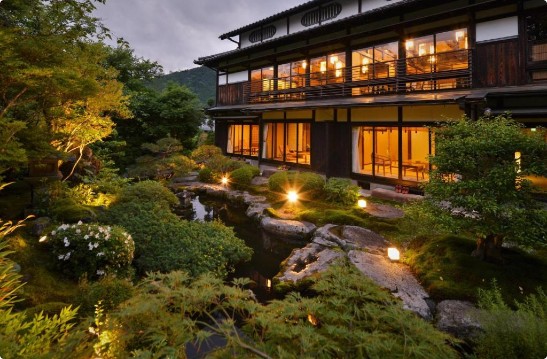
Seryo (the operating name for Ohara Sansou) is the ryokan with the better kitchen. The kaiseki uses Ohara mountain vegetables; pickles you only see in the village, mountain greens, mushrooms in autumn; and freshwater fish from the local streams. It’s more grounded in the place than the Kobe-beef-and-sashimi standard kaiseki you’d get at an Arashiyama ryokan. The bath is small but uses real on-site spring water, and the rotenburo overlooks the stream.
Sanzen-in is a four-minute walk from the front door, which means you can walk to the temple at sunrise before the buses arrive; the best time to see it, and only really practical if you stay overnight in Ohara.
What’s good:
- The kaiseki is the most distinctive in this guide; you’ll eat dishes you won’t find at any other Kyoto ryokan
- Sanzen-in walkable before the day visitors arrive; significant if you’re visiting in autumn
- Genuine on-site onsen well, not piped or trucked
What’s not:
- The journey is long; there’s no train, only the #17 bus, which is reliable but takes 50 minutes
- Once you’re at the ryokan, you’re 50 minutes from anywhere; go in committed to staying put
- The bath is small (one main tub plus the rotenburo); if you’re used to large hotel onsen, this is a different scale
Check prices: Booking.com | Direct via Seryo official site
Ohara no Sato: the cheaper Ohara onsen option
Nearest stop: Ohara bus stop (5 min walk uphill)
From Kyoto Station: 50 min by bus
Best for: Travellers wanting an Ohara onsen overnight at a lower price point
From: ¥22,000-32,000 with dinner and breakfast
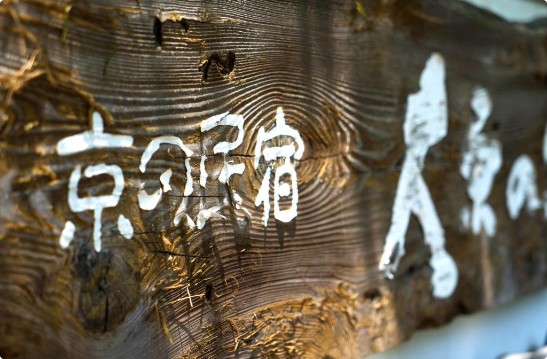
Ohara no Sato (大原の里) is the bigger Ohara ryokan; 30 rooms versus Seryo’s 13; and uses Ohara onsen water trucked from a nearby source. The bath is genuinely larger, with both an indoor and outdoor section, and the price is roughly half of Seryo’s. The kaiseki is solid but standard; Kyoto vegetables, river fish, beef hot pot; without the Ohara-specific edge that Seryo has.
I’d send someone here if Seryo is full or out of budget, or if the bath itself is more important than the food. The location near the Ohara river bend is pleasant; the property has its own small garden.
Check prices: Booking.com | Direct via Ohara no Sato
The Funaoka Onsen hybrid: sleep downtown, bathe at a 102-year-old sento
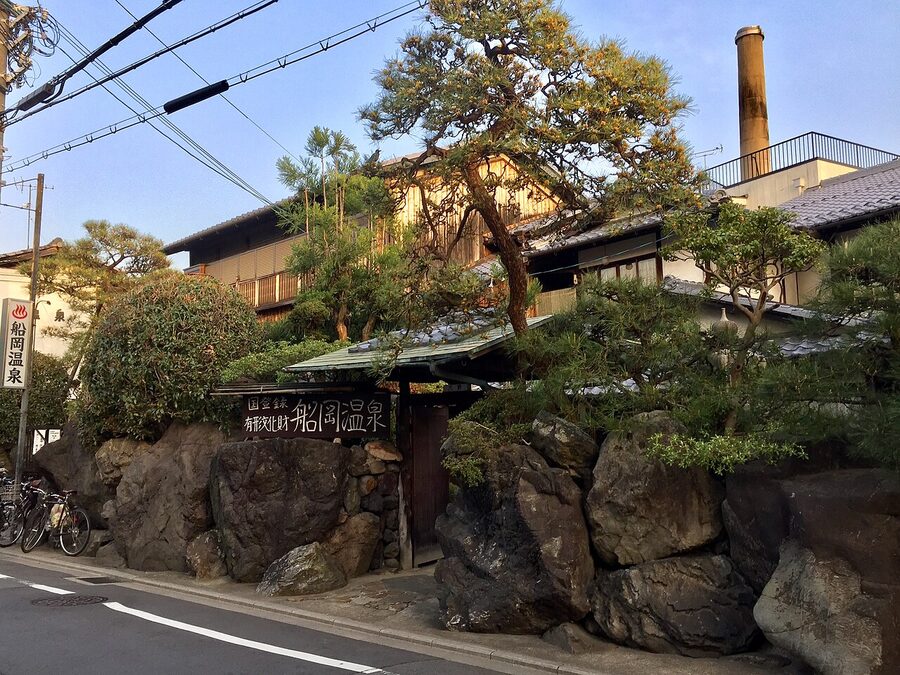
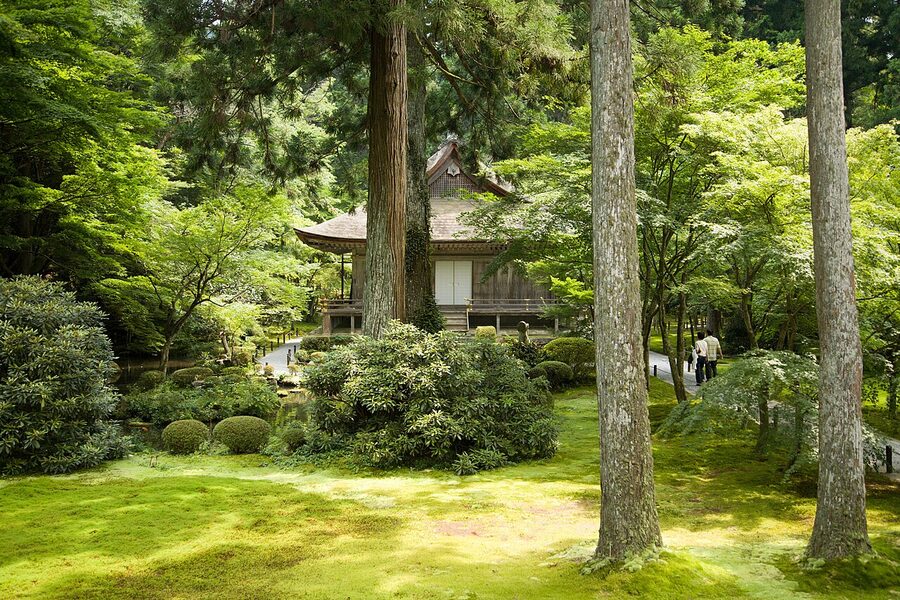
If staying out in Kurama or Ohara doesn’t fit your trip, the alternative I’d suggest is using Funaoka Onsen as a day or evening visit while staying somewhere in central Kyoto. Funaoka is technically a sento; a public bathhouse; but pumps real, certified onsen water. The 1923 wooden building is a registered cultural property, the bath complex is unusually large for a sento (eight separate baths plus a tattoo-friendly outdoor area), and entry costs ¥490.
That ¥490 is not a typo. It’s the standard sento entry rate set by Kyoto City. For an actual onsen experience inside the city limits, with mineral water and a building older than the 1925 main hall of Heian Shrine, ¥490 is the most underpriced thing in Kyoto. Bring your own towel or rent one for ¥30. Soap and shampoo aren’t provided; buy a single-use sachet at the bathhouse for ¥80, or bring your own.
The hybrid trip works like this: book a downtown hotel with a private bathroom you don’t really use as the main soak, walk or take a short taxi to Funaoka in the early evening (it opens at 15:00, latest entry 25:00; yes, 1am; except Tuesdays when it’s closed). Spend an hour at the bath. Walk back via Kitano Tenmangu and Nishijin if you want to see real Kyoto neighbourhoods that aren’t tourist-stamped.
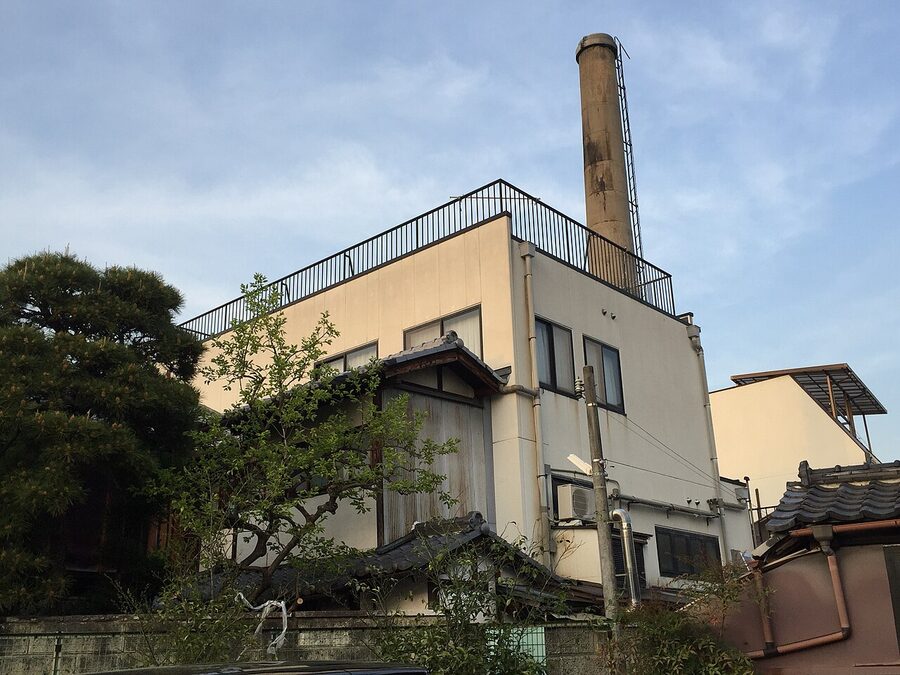
Funaoka is tattoo-friendly (one of perhaps three onsen in Kyoto that explicitly are), takes drop-ins without booking, and has a genuinely working-Kyoto neighbourhood feel; most other patrons are local pensioners and Kyoto University students. The reception staff speak basic English; the etiquette signs are in English/Korean/Chinese.
Practical: Closed Tuesdays. Open 15:00-25:00 (1am) other days. ¥490 entry. Bring 100-yen coins for the locker (refundable). Cash only; the older sento don’t take cards.
Where to stay in central Kyoto if you’re using Funaoka as the bath
The hotels I’d pair with a Funaoka evening, all 15-25 minutes by taxi or bus from the bathhouse:
- Solaria Nishitetsu Kyoto Premier Sanjo Kamogawa; modern, efficient, riverside Kamogawa setting, ¥35,000-50,000. Booking.com
- Hotel Granvia Kyoto; directly above Kyoto Station, easy if you’re using the city as a base for day trips, ¥30,000-45,000. Booking.com
- Onyado Nono Kyoto Shichijo: also a “natural hot spring” hotel, with in-house bath using sourced onsen water. The most direct alternative to Funaoka if you want the bath in the building rather than across town, ¥18,000-25,000. Booking.com
The Kyoto Station “natural hot spring” hotels: what they actually are
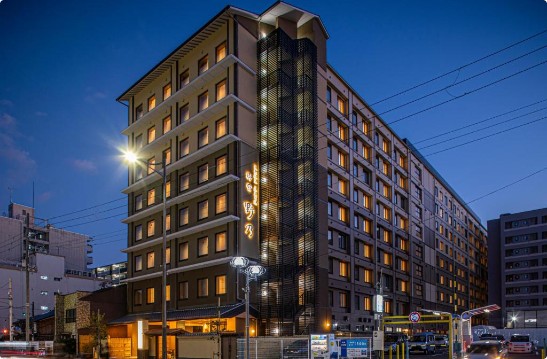
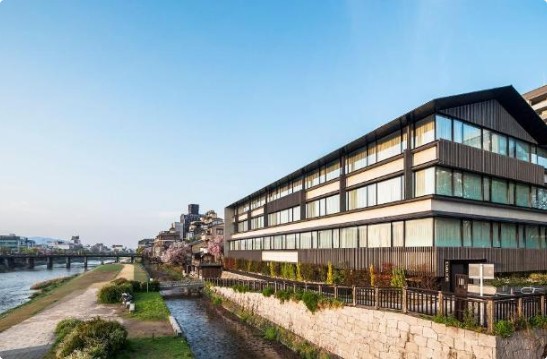
Several budget and mid-range chain hotels near Kyoto Station advertise “natural hot spring” baths. They’re not lying; but they’re not strictly onsite onsen either. The water is shipped in by tanker from sources further out (usually Yumura or Kinosaki direction), reheated, and pumped into the basement bath. Legally it’s onsen. Experientially it’s a reasonable substitute when the alternative is no soak at all.
The two I’d actually recommend in this category:
Onyado Nono Kyoto Shichijo: sourced-onsen budget option
Nearest station: Kyoto Station (any line) 8 min walk, or Shichijo (Keihan) 5 min walk
From Kyoto Station: 8 min walk
Best for: Budget travellers, solo travellers, anyone wanting a real bath after a day of shrines
From: ¥18,000 in low season; ¥28,000-35,000 in autumn
Onyado Nono runs the most consistent budget onsen-hotel chain in Japan, and the Kyoto Shichijo property is one of the better-performing ones. The bath is on the top floor (rare for this category), large enough for 15 people, with both indoor and small outdoor (rooftop) sections. The water is sourced onsen, reheated to 41°C, with a chemical analysis posted at the entrance like a proper onsen.
Rooms are small (12-14m² for a single, 16-18m² for a double) but well-organised; Western beds, en-suite shower-toilet, no tatami. Dinner is buffet, breakfast is buffet, both adequate. Free hours-of-operation soba noodles in the lobby in the evenings, which sounds gimmicky and is, but a midnight bowl of soba after the bath is one of those things.
Check prices: Booking.com | Agoda
Dormy Inn Premium Kyoto Ekimae: the larger chain alternative
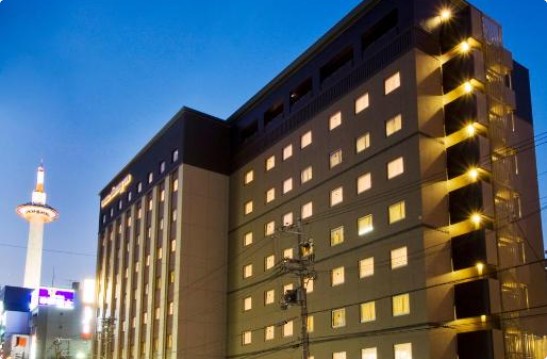
Nearest station: Kyoto Station (any line) (5 min walk)
From Kyoto Station: 5 min walk
Best for: Returning Japan travellers familiar with the Dormy chain, business travellers extending into leisure
From: ¥22,000 in low season; ¥35,000-45,000 in autumn
Dormy Inn Premium is the bigger sibling of the standard Dormy chain; slightly nicer rooms, the same top-floor public onsen, the same “free ramen at 21:30” gimmick that the chain is famous for. The bath uses sourced onsen water (reheated) and the small outdoor rotenburo on the 13th floor catches the Kyoto Tower at sunset.
I’d pick Dormy over Onyado Nono if you’ve stayed at Dormy elsewhere in Japan and like the format, or if you want a fractionally bigger room. The bath at Onyado Nono is slightly better; the rooms at Dormy are slightly better. Pick on what matters more.
Check prices: Booking.com | Agoda
What about “private onsen” hotels in central Kyoto?
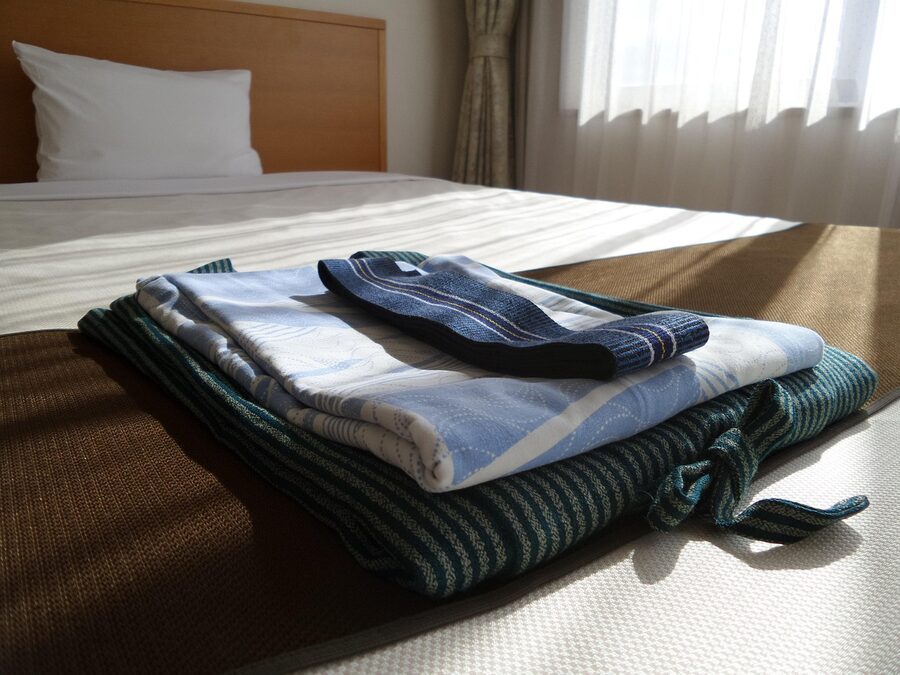
You’ll see a category of central-Kyoto small hotels marketing “private onsen rooms” or “rooms with private onsen”. Most of them aren’t using onsen water in the legal sense. The bath is a private wooden tub (often ofuro-style hinoki cypress) filled with heated tap water, run by an automated mixer.
That’s not a scam; it’s a perfectly nice in-room bath. The wood smells good, the water’s clean (Kyoto’s tap water comes from the Kamogawa watershed, it’s drinkable as-is), and the privacy is real. But if you booked thinking you were getting mineral spring water in the room, you weren’t.
For a separate guide on which Kyoto hotels actually have private bathing rooms with real or near-real onsen water (and which are using the term loosely), see our guide to hotels with private onsen in Kyoto. For the wider district-by-district view of where to stay in Kyoto for any reason, including when not soaking, see our main Kyoto accommodation guide. If onsen isn’t your top priority and you want the broader ryokan picture (Tawaraya, Hiiragiya and the in-town heritage inns), the best ryokan in Kyoto is the companion piece.
Kyoto onsen vs other Kansai options: when to leave the city
The straightforward truth: if onsen is your main reason to come, you’re not coming to Kyoto. The actual onsen-rich part of Kansai is northern Hyogo; Kinosaki Onsen, Yumura, Kasumi; about 2.5 hours west by train. Arima Onsen near Kobe is 90 minutes south-west. Both have what Kyoto doesn’t: dense clusters of working onsen ryokan in walking distance of each other.
The case for staying onsen-curious in Kyoto rather than going to Kinosaki:
- You came to Kyoto for temples and food, with the bath as one element of a wider trip. Kurama or Ohara as a one-night pause
- You’re a couple wanting kaiseki + bath without the logistics of two separate Japanese destinations
- Your trip is short (under a week) and you don’t want to build in a 2.5-hour each-way detour
The case for taking 2.5 hours to go to Kinosaki:
- You actively want to spend two or three days bathing in different waters with yukata-and-geta walks between bathhouses
- You don’t mind that food and shopping options outside the bathhouses are limited
- The mineral profile and the walking-bathhouse-to-bathhouse experience matter more than the city you’re using as a base
Both are reasonable answers. Most Kyoto trips I’d recommend the Kurama or Ohara overnight rather than the Kinosaki detour, because the time cost is lower and the experience is genuinely different from a central Kyoto night. But if onsen ranks above temples in your priority list, you shouldn’t have booked Kyoto.
What most guides get wrong about onsen in Kyoto
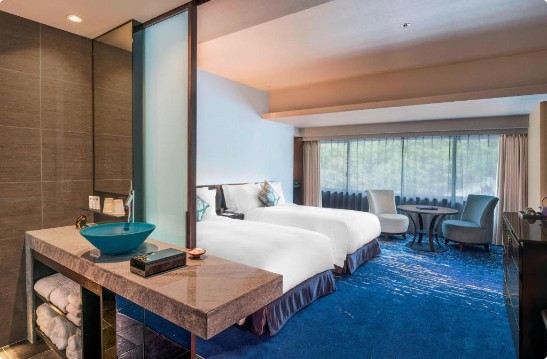
The thing every “Kyoto onsen ryokan” guide gets wrong: they list ten properties, half of them in central Kyoto, and don’t tell you which actually use onsen water. The reader books a “ryokan with onsen” expecting a Hakone-grade outdoor mineral bath and gets a wooden indoor tub with city tap water. Then writes a one-star review.
The other recurring mistake: putting Hoshinoya Kyoto at the top of a Kyoto onsen list. Hoshinoya is a great hotel (the boat ride alone is worth the price for some travellers) but the bath is heated tap water. If you’re optimising for actual onsen, you’d pick Togetsutei or Kurama Onsen at less than half the price. Hoshinoya is a luxury experience that happens to have a bath. It isn’t an onsen ryokan.
Three opinions I’d flag where most guides hedge:
- Kibune is a kawadoko destination, not an onsen one. Stop calling Kibune ryokan “onsen ryokan” in English-language guides. It misleads readers and the ryokan themselves don’t usually claim it. Read the Kibune Fujiya site; they describe the bath as a private terrace bath, not as onsen.
- Funaoka at ¥490 is the highest-value bath in Kyoto. If you’re already in Kyoto for any other reason, blocking out 90 minutes for Funaoka one evening will do more for your trip than picking a hotel based on its in-house bath. The exception is if you’re physically uncomfortable with public bathing; Funaoka is a real Japanese sento, not a tourist version, and that includes shared changing.
- The Kyoto Station chain “natural hot spring” hotels are fine, not great. Onyado Nono and Dormy Inn deliver a real if reheated onsen experience at a real budget price. Don’t expect them to feel like a ryokan. They feel like an efficient hotel with a better-than-average bath.
Booking strategy for onsen ryokan in Kyoto
A few things I’ve learned about how the Kyoto onsen ryokan market actually works:
Booking direct beats Booking.com for the small ryokan. Kibune’s Hiroya, Ugenta, Beniya and the Kurama main ryokan often run direct rates 5-15% below the OTA price, and the email English is usually adequate. The exception is Booking’s last-minute discounts inside 7 days; those can undercut direct.
For the chain onsen hotels (Onyado Nono, Dormy), Booking and Agoda are routinely cheapest. The chains use OTA pricing strategically and direct rates are essentially the same.
Autumn 2026 is going to be expensive. Kyoto Hotel Tax is rising for accommodation over ¥100,000/night (10× from 2025); peak November rates at the better ryokan will be ¥120,000-180,000/person up from ¥80,000-110,000 last year. Book by July if you want November dates at top properties.
Cancellation policy at small ryokan is strict. Most charge 50% from 7 days out, 100% from 3 days. Larger chains and Hoshinoya are more flexible. If your dates are uncertain, the chains are forgiving in a way ryokan aren’t.
Don’t book Kibune in winter. Several ryokan close mid-December to mid-March entirely; the road ices, the kawadoko platforms are dismantled, and there’s no reason to be in Kibune. If you really want the riverside, summer (May-September) is the season.
Quick recommendations by traveller type
First time in Japan, want to try one onsen night: Kurama Onsen Ryokan. It’s the cleanest narrative; train from Demachiyanagi, hike to Kibune, bath, kaiseki, sleep, train back in the morning.
Couple, mid-budget, want riverside: Togetsutei in Arashiyama. River-facing room, real onsen water, walking distance to bamboo grove and Tenryu-ji.
Returning visitor, willing to spend: Ryokan Ugenta in Kibune for the river-canyon kaiseki, or Seryo in Ohara for the mountain-vegetable kitchen. Both are unique to themselves.
Family with kids: Kadensho Arashiyama. Buffet works for fussy eaters, family-sized rooms, easy access from JR Saga-Arashiyama.
Budget but want real onsen water in Kyoto: Onyado Nono Kyoto Shichijo or Funaoka Onsen + a regular hotel. Both around ¥20,000 total per night for a soak and a sleep.
Onsen above all else: Don’t book Kyoto. Book Kinosaki.