
Reviewed · KOBE
Kyoto Full Day Tour from Kobe with Licensed Guide and Vehicle
Kyoto’s biggest advantage on this tour is simple: you can cover the long trip from Kobe in a private car, then shape the day around the places you care about most. A guide such as Kazuo Sumi, Yuka, Hiro, or Andy Murao can help connect the temples, shrines, gardens, and old neighborhoods instead of leaving you to sort out Kyoto’s sprawling map on your own.
I like the custom itinerary, which lets you choose three or four main sites rather than being dragged through every stop on a fixed route. I also like the private vehicle, especially for a cruise-port visit when returning to Kobe on time matters. The main catch is price: at $1,165.63 for up to two people, this is a costly day, and entrance fees, lunch, and personal expenses are extra.
In This Review
- Key points to know before booking
- Why a private Kyoto day from Kobe makes sense
- Designing the day around three or four places
- Fushimi Inari and the southern approach
- Kiyomizu-dera, Higashiyama, and Gion
- Nijo Castle, the Imperial Palace, and central Kyoto
- Kinkaku-ji, Ginkaku-ji, and the northern temples
- Arashiyama and the western hills
- The northern mountains: Shugakuin, Kibune, and Kurama
- What the guide adds to the day
- Is the $1,165.63 price worth it?
- How to plan a better nine-hour route
- Who should book this Kyoto tour?
- FAQ
- How long does the Kyoto tour from Kobe last?
- How many people can join the private tour?
- Is pickup available?
- Can I choose the Kyoto sights?
- Are admission fees included?
- Is an English-speaking guide provided?
- Are child car seats available?
Key points to know before booking
- Choose only three or four major stops: The long list of possible sights is a menu, not a promise to visit them all.
- Private car travel saves time: A vehicle is useful for reaching far-flung areas such as Arashiyama, Fushimi, and northern Kyoto.
- Licensed guides shape the day: Guides including Kazuo, Yuka, Hiro, and Andy have built tours around guest requests and tight cruise schedules.
- The best value comes from customization: You pay for a private day, not a standard sightseeing circuit.
- Temple entry is usually extra: Kiyomizu-dera, Nijo Castle, Kinkaku-ji, Ginkaku-ji, and many other paid sites charge separately.
- The pace can be brisk: You can see a lot, but you will not have time for every temple, garden, and neighborhood on the list.
Why a private Kyoto day from Kobe makes sense
Kyoto is close enough to visit from Kobe, but it is not a simple hop between two compact downtowns. The city’s best sights are spread across the eastern, northern, western, and southern districts. Fushimi Inari is southeast, Arashiyama is west, Kinkaku-ji is north, and Gion and Kiyomizu-dera sit on the eastern side.
That geography makes a private vehicle useful. You are not spending the day changing trains and buses, studying route maps, or walking back to a station after every temple. You can also ask the guide to adjust the plan if your priority is photography, religious history, gardens, shopping, food, or old Kyoto streets.
The tour lasts about nine hours. That sounds long, but the driving distance and Kyoto traffic can consume a large part of the day. A well-planned route matters more than the number of names on the sightseeing list.
The private format is for your group only, with a vehicle and a licensed local English-speaking guide. The information also refers to multilingual guiding, but you should confirm the language you need when the guide contacts you after booking. A few past guide names include Kazuo Sumi, Yuka, Hiro, Andy Murao, Kiriko, and Mr. Yamaguchi. The strongest praise centers on guides who listened closely, explained Japanese customs, and adjusted the route to fit the group.
Other guided tours in Kobe
Designing the day around three or four places
The most important planning detail is easy to miss. The tour offers a very long list of possible sights, but the included service is a customized visit to three or four sites from that list. You are not meant to visit all 29 options in nine hours.
That is good news. Kyoto rewards a focused plan. A day built around Fushimi Inari, Kiyomizu-dera, Gion, and Nishiki Market feels coherent. A western Kyoto plan with Arashiyama, Tenryu-ji, the bamboo paths, and Togetsukyo Bridge also makes sense. Trying to combine every district would leave you rushing from one brief photo stop to another.
Send your must-see choices early and tell the guide what matters most. If you want temple explanations, say so. If you want time for lunch or a green tea dessert, include that in the plan. If you are visiting from a cruise ship, make the return deadline clear from the start.
The guide’s planning help is one of the real benefits here. Kazuo contacted a family soon after booking with possible places and refined the plan through several emails. Kiriko created a full schedule for a couple who wanted a fast day. Yuka arranged a route that included the bamboo forest, Kinkaku-ji, Gion, and Fushimi Inari, while another group used the day for Arashiyama’s monkey park and other major sights.
Fushimi Inari and the southern approach
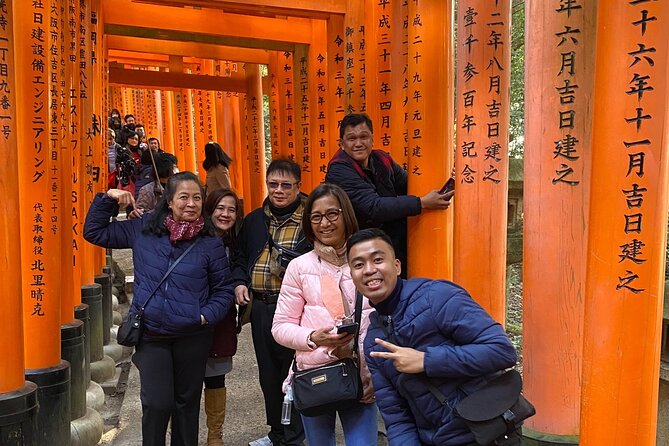
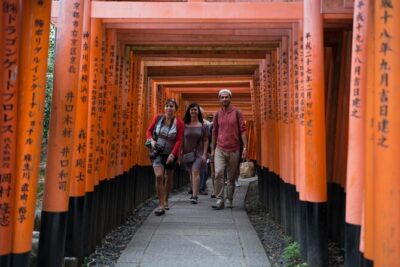
Fushimi Inari-taisha is one of Kyoto’s most recognizable shrines, known for its long corridors of orange torii gates climbing into the wooded hills. Even a short visit gives you the famous entrance section and a sense of why this Shinto shrine is so popular.
The published stop time is 15 minutes, but that should not be treated as enough time to walk far up the mountain. One guide helped a group reach more torii gates when extra time remained at the end of the day. If Fushimi Inari is one of your top choices, tell the guide that you want walking time here, not just a quick photograph at the lower gates.
The shrine is a good place for a guide to explain how to approach a Shinto site, including the customs around shrine entrances and worship. Kazuo was specifically praised for teaching the correct way to enter both Shinto shrines and Buddhist temples. That kind of context helps you see the difference between a shrine and a temple rather than treating every historic site as the same.
Tofuku-ji and Toji are other southern Kyoto options. Tofuku-ji is a major Zen temple, especially attractive during autumn color season. Toji dates from the early Heian period and is associated with Kyoto’s early years as the imperial capital. Both are worthwhile for visitors who prefer large religious complexes to heavily photographed icons.
Kiyomizu-dera, Higashiyama, and Gion
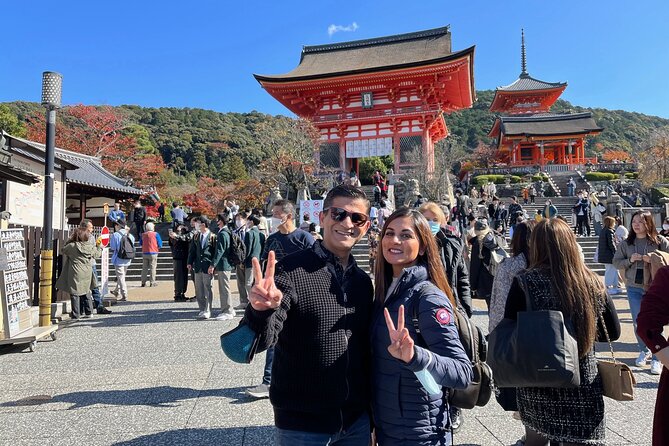
Kiyomizu-dera is one of the essential eastern Kyoto sights. Its elevated wooden stage and hillside setting give you broad views across the city, while the surrounding Higashiyama lanes provide the old Kyoto atmosphere many people hope to find.
The temple is listed with a 15-minute stop, although the tour description also refers to a one-hour guided visit. Clarify the planned time before the day begins. Fifteen minutes is enough for a quick look, but not for a relaxed walk through the temple grounds and nearby streets.
Higashiyama is the historic district along Kyoto’s eastern foothills. Its preserved streets and traditional buildings connect naturally with Kiyomizu-dera. Gion, nearby, is known for its geisha culture and narrow lanes. A guide helps you understand the area’s customs and history while steering you away from aimless wandering.
Please keep your expectations sensible. Gion is a working neighborhood, not a stage set. The value of a guide here is not simply finding a famous lane. It is learning how the district fits into Kyoto’s traditional arts, dining, and entertainment culture while behaving respectfully.
Kennin-ji, close to Hanamikoji and Shijo streets, offers another eastern option. Its grounds are pleasant to walk, and its dry gardens provide a quieter contrast to the surrounding streets. If your ideal day includes architecture and gardens rather than shopping, Kennin-ji could replace a crowded market stop.
Nijo Castle, the Imperial Palace, and central Kyoto
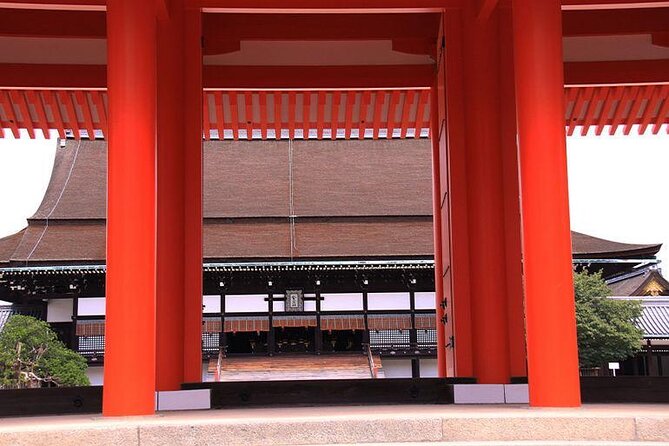
Nijo Castle gives you a different view of Japan’s past. Built in 1603 as Tokugawa Ieyasu’s Kyoto residence, it connects the city to the shogunate and the Edo period. The castle is not just another temple, so it is a smart choice if you want political history as well as religious sites.
Kyoto Imperial Palace served as the imperial residence until 1868, when the emperor and capital moved to Tokyo. Its spacious grounds offer a change of pace from tight temple lanes and crowded shopping streets. The palace works well for visitors interested in court life, imperial ceremony, and the long transition from Kyoto’s old capital role to modern Japan.
Nishiki Market is Kyoto’s Kitchen, a narrow, five-block shopping street lined with more than 100 shops and restaurants. It is useful for sampling local food and seeing everyday commerce, but the tight passage can feel crowded. Build in time to stop for food rather than expecting a quick 15-minute sweep.
Pontocho is another central Kyoto choice. This narrow alley beside the Kamogawa River is packed with restaurants and is particularly atmospheric later in the day. It is better suited to a stroll or meal than a hurried daytime stop, so ask how it fits with lunch and the return drive.
A few more Kobe tours and experiences worth a look
Kinkaku-ji, Ginkaku-ji, and the northern temples
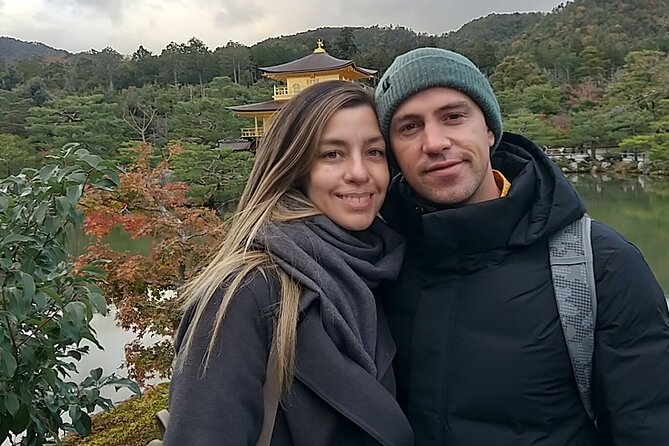
Kinkaku-ji, the Golden Pavilion, is Kyoto’s great visual knockout. The upper two floors are covered in gold leaf, and the pavilion is reflected in the pond beside it. The visit is structured around a walking route and set viewpoints, so this is a place for seeing and photographing rather than wandering freely through every room.
Ginkaku-ji, the Silver Pavilion, is more restrained. It began as Ashikaga Yoshimasa’s retirement villa in 1482 and later became a Zen temple. Its gardens and understated design make it a strong choice if you prefer quiet aesthetics to a single dramatic building.
Ryoan-ji is home to Japan’s best-known rock garden. The spare arrangement invites a slower look, although the garden’s fame means it can be busy. If you want the guide to explain Zen ideas and garden design, say that in advance. Otherwise, the stop may feel brief.
Ninna-ji is a World Heritage temple and the head temple of the Omuro school of Shingon Buddhism. It gives you another major religious site in northern Kyoto, but it may be too much if you have already chosen Kinkaku-ji and Ryoan-ji. The strength of the private tour is being able to choose one or two, not collecting all three at speed.
Arashiyama and the western hills
Arashiyama is the most ambitious western Kyoto choice. The district has long attracted visitors for its scenery, and today it combines temples, river views, shopping streets, and the famous bamboo paths.
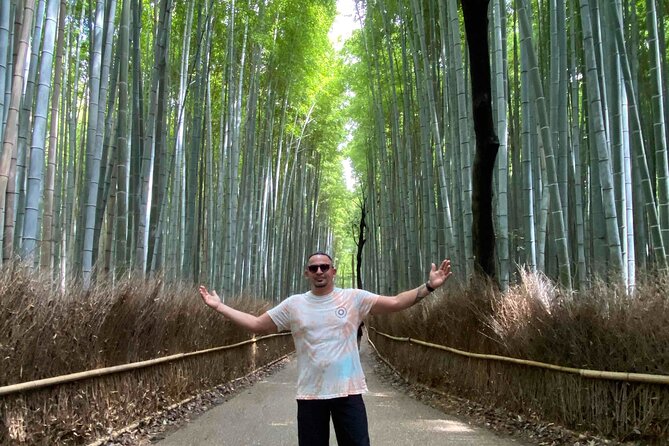
Tenryu-ji is the area’s most important temple and a World Heritage site. Its garden and temple buildings make it a better stop than the bamboo path alone if you want cultural context. The bamboo forest is free to enter and photogenic, but the walk is relatively short and can feel less peaceful than its pictures suggest.
Togetsukyo Bridge is Arashiyama’s signature landmark. The present bridge dates from the 1930s, though the crossing has older roots. It gives you a clear sense of the district’s river setting and works well alongside Tenryu-ji.
Okochi Sanso Garden, once the villa of actor Okochi Denjiro, adds carefully designed gardens and buildings beyond the bamboo grove. Admission is not included, so check the cost before choosing it. Jojakko-ji, Nisonin, and Gio-ji offer smaller temple settings, with moss, maple trees, hillside paths, and a quieter feel than the main Arashiyama route.
Adashino Nenbutsuji is known for stone figures placed for the souls of the dead, while Otagi Nenbutsu-ji has about 1,200 distinct stone statues of Buddhist devotees. These are more unusual choices, but fitting them into the day requires time. You should not expect to combine the entire bamboo and temple area with several distant Kyoto districts.
Daikaku-ji, also in the Sagano area, began as Emperor Saga’s detached palace. It is a good option if you want imperial connections and a calmer temple setting. Katsura Imperial Villa is another fine choice for architecture and garden design, but admission is not included and its access arrangements should be confirmed before you build the day around it.
The northern mountains: Shugakuin, Kibune, and Kurama
The tour’s northern options appeal to repeat visitors or people who prefer wooded mountain settings over famous central sights. Shugakuin Imperial Villa was built in the 17th century for Emperor Gomizuno and is managed by the Imperial Household Agency. Its three villa areas and gardens make it a major design destination, but a 10-minute listing does not suggest a full visit.
Kibune is a small valley town developed around Kifune Shrine. Its forest setting offers a very different mood from central Kyoto. Kurama, less than an hour from the city center, is known for Kurama-dera and a hot spring.
These northern sites are difficult to combine with Arashiyama, Fushimi, and southern Kyoto in a single day. I would choose them only if mountain scenery and traditional religious sites matter more to you than checking off Kinkaku-ji or Gion.
What the guide adds to the day
A private car is useful, but the guide is the part that turns transport into a tour. The best guide examples here do more than recite dates. They explain how to enter a shrine or temple, answer questions about Japanese culture, and adapt the schedule as the day develops.
Kazuo Sumi was praised for his explanations of history and tradition, as well as his steady communication before the tour. Hiro shaped a day around specific requests. Yuka received high marks for friendly service and route planning, including cruise-port pickup and drop-off. Andy Murao was noted for answering questions, taking photographs, and keeping a tight schedule so the group could return to the ship.
There is one important warning. One customer reported serious English communication problems and said the guide was not comfortable with children or basic site questions. The company responded by noting the guide’s experience and apologizing for the communication difficulty. Since English ability is central to the value of this tour, confirm the guide’s language level and share your needs clearly before departure.
Families should also ask about child seating. Only a limited number of car seats and booster seats are available, and rear-facing seats are not offered. Service animals are allowed, and most people can participate, but many temple grounds include steps and walking paths.
Is the $1,165.63 price worth it?
The listed price is $1,165.63 per group of up to two people. That works out to about $583 per person before admission fees, lunch, and other spending. For a solo visitor or couple, this is a premium purchase.
The value improves if you are arriving by cruise ship, have only one Kyoto day, and place a high price on getting back to Kobe on time. A private vehicle, a local licensed guide, and a route designed around your priorities can save hours of confusion. It also lets you visit places that are awkward to combine by public transportation.
The value drops if you are comfortable using Kyoto’s trains and buses, want only one or two famous sights, or have several days in the city. In those cases, independent sightseeing can cost far less and give you more time at each place.
Entrance costs need careful planning. Kiyomizu-dera, Nijo Castle, Kinkaku-ji, Ginkaku-ji, Ninna-ji, Ryoan-ji, Arashiyama temples, and other paid attractions are not generally included. The guide’s entry fees are covered only for sights listed under the tour information, so ask exactly what is included for your chosen stops.
How to plan a better nine-hour route
I would group your choices by area. For a first visit, an eastern and central plan could include Fushimi Inari, Kiyomizu-dera, Gion, and Nishiki Market. This gives you a shrine, temple, historic streets, food, and traditional Kyoto in one day.
A western plan could focus on Arashiyama, Tenryu-ji, the bamboo forest, and Togetsukyo Bridge. Add Okochi Sanso or one smaller temple only if you are willing to reduce time elsewhere.
For famous temples, choose Kinkaku-ji, Ryoan-ji, and Ninna-ji as a northern cluster, then add one central stop. Do not assume the car eliminates traffic. Kyoto can still be slow, and a full route needs room for parking, walking, meals, and temple entry lines.
Tell the guide your walking tolerance, food interests, preferred pace, and hard return time. Some people used the tour for a fast list of major sights. Others extended the day by an hour or used spare time to walk farther at Fushimi Inari. The right plan depends on what you want to remember, not how many gates you can photograph.
Who should book this Kyoto tour?
I would recommend it to a couple or small private group visiting Kobe for one day, especially from a cruise ship. It suits you if you want a guide to explain Japanese customs, need private transportation, and would rather pay for efficiency than manage Kyoto’s transit system.
It is also a good fit for families, older visitors, and people with a firm list of must-see places, provided you confirm seating and walking needs. The guides have shown they can build routes around requests and tight sailing times.
I would hesitate if your budget is limited, you want a slow temple day, or you hope to see nearly every place on the long sightseeing list. Choose three or four sites, budget for admissions and lunch, and confirm the English-speaking guide before you commit.
The tour permits free cancellation up to 24 hours before the start time. After that, the amount paid is not refunded, so keep the cutoff in mind when your Kobe plans are uncertain.
FAQ
How long does the Kyoto tour from Kobe last?
The tour lasts approximately nine hours.
How many people can join the private tour?
The listed price covers a private group of up to two people. Only your group participates.
Is pickup available?
Yes. Pickup is offered, and past arrangements have included pickup and drop-off at the Kobe cruise port.
Can I choose the Kyoto sights?
Yes. You select your must-see places from the available list and work with the guide to create a customized itinerary of three or four sites.
Are admission fees included?
No. Entrance fees, lunch, and personal expenses are not included. The guide’s entry fees are covered only for sights listed under the tour information.
Is an English-speaking guide provided?
A licensed local English-speaking guide is included. The tour information also refers to multilingual guides, so confirm your required language when the guide contacts you.
Are child car seats available?
Only a limited number of car seats and booster seats are available. Rear-facing car seats are not offered, and you must contact the provider directly if you need a seat.
More Full-Day in Kobe
More Guided Tours in Kobe
More tours in Kobe we've reviewed
Kobe, compared.
 ★ 4.5Shore excursion: Full Day Private Kyoto Tour From Osaka/Kobe PortFrom $490
 ★ 4.7Kobe: Private Tour – Excursion to Osaka / Kyoto possibleFrom $763 - 8 hours
 ★ 4.5Kobe : Private Custom Tour (Excursion to Osaka / Kyoto possible)From $72
 ★ 4.5Cruise Stop-Over: Private Custom Day trip to Kyoto from Kobe PortFrom $348
 ★ 4.7Kobe:Private Guide Shore Excursion to Kyoto,Osaka,Nara,KobeFrom $84
 ★ 4.5Kyoto Full-Day Excursion from Kobe (Osaka) PortFrom $490