
Reviewed · KYOTO
Kyoto Cultural IKEBANA Experience@SEKKA FLOWERS
A quiet flower lesson in a 100-year-old Kyoto townhouse offers a welcome pause from temple crowds and city traffic. You learn the basics of ikebana, then create your own arrangement for display in a traditional tokonoma alcove.
I like the calm, personal setting and the balance between instruction and freedom. Taro-san and Chiaki-san guide you without forcing every arrangement into the same shape. I also like that your finished flowers can be delivered to your accommodation, letting you enjoy the work after class.
The main limitation is time. At about 40 minutes, this is a compact introduction rather than a full study of ikebana. The price also feels easier to justify if you value a small-group cultural lesson and a take-home arrangement, not just a quick craft activity.
In This Review
- Key points at a glance
- A 40-minute introduction to Kyoto flower arranging
- What happens during the class
- Why the townhouse setting changes the mood
- A small group with room for personal help
- What you learn about flowers, branches, and seasonal beauty
- The finished arrangement and delivery option
- Is $65.15 a fair price?
- Who will enjoy this ikebana experience most?
- How to fit it into a Kyoto day
- Booking, cancellation, and practical details
- Should you book this Kyoto ikebana class?
- FAQ
- Where does the ikebana experience take place?
- How long does the experience last?
- Does the activity begin and end at the same place?
- Is the ikebana class suitable for beginners?
- How many people can join the class?
- Who leads the ikebana lesson?
- What style of ikebana will I learn?
- Will my flower arrangement be displayed?
- Can the finished flowers be delivered to my accommodation?
- Is cancellation free?
- Is the activity accessible by public transportation?
- Are service animals allowed?
Key points at a glance
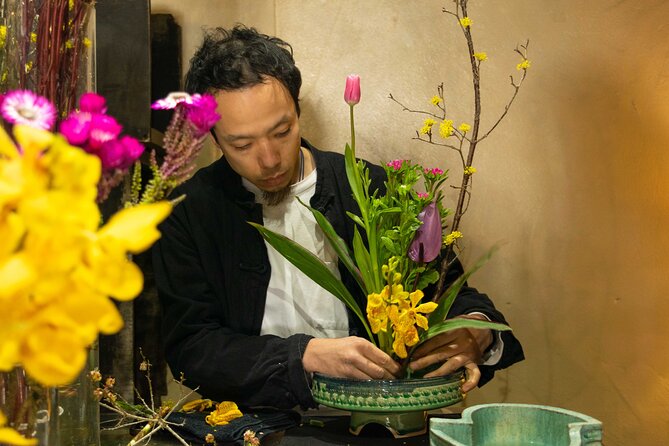
- A traditional townhouse setting: The class takes place in a renovated building about 100 years old near Kinkaku-ji and Daitoku-ji.
- A small maximum group: No more than six people can join, which allows for personal help without making the lesson feel private or formal.
- Classical ikebana principles: You work with flowers and branches while respecting their natural shape and seasonal character.
- A gentle introduction to wabi-sabi: The lesson connects flower arranging with an appreciation of simplicity, irregularity, and impermanence.
- Friendly named instructors: Taro-san and Chiaki-san lead the class and encourage creative freedom.
- A practical souvenir: Your arrangement may be delivered to your accommodation after the session.
A 40-minute introduction to Kyoto flower arranging
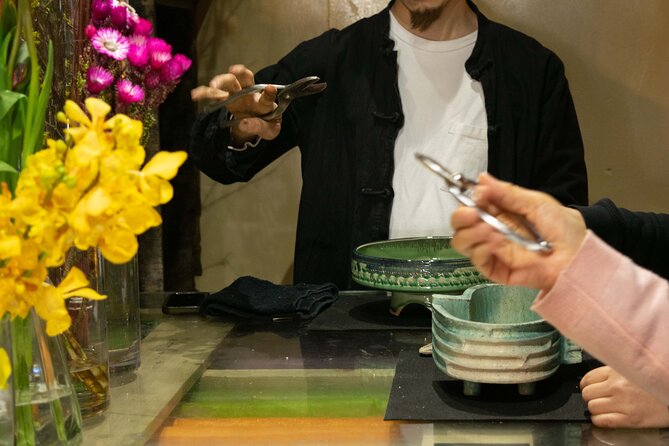
Ikebana is not simply putting flowers in a vase. The placement of each stem, the open space around it, and the angle of branches all help create a sense of balance. This class introduces those ideas in a short, approachable format.
You begin at the flower shop and workshop at 44-4 Murasakino Kamimonzenchō in Kyoto’s Kita Ward. The location is close to two major temple areas, Kinkaku-ji and Daitoku-ji, so it fits naturally into a day spent exploring northern Kyoto.
The setting matters. A traditional townhouse gives the activity a stronger sense of place than a modern classroom would. You are not only learning a Japanese art form. You are doing so in an old Kyoto building that has been adapted for present-day use.
The lesson focuses on classical forms. You work with flowers and branches chosen to show the character of the season, then arrange them with attention to their natural state. That approach makes the activity less about producing a perfect decoration and more about noticing shape, line, texture, and space.
The workshop also introduces wabi-sabi, a Japanese aesthetic that finds beauty in simplicity, natural irregularity, and change over time. You do not need prior knowledge of Japanese art to understand the basic idea. The instructor uses the arrangement itself to help you notice what is already attractive in a crooked branch or an uneven bloom.
If you're still narrowing it down, here are other tours in Kyoto we've reviewed.

What happens during the class
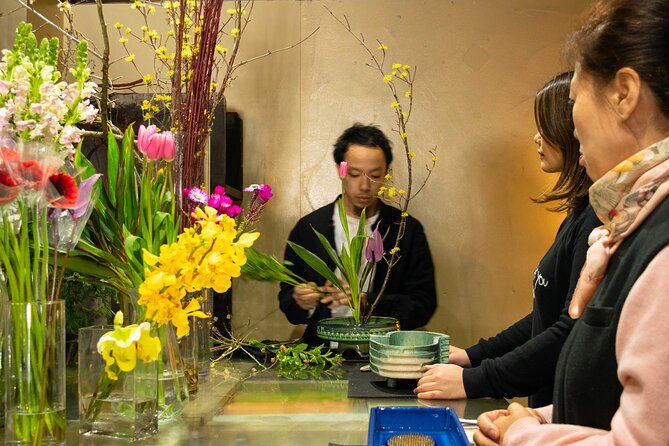
The exact sequence may vary, but the experience is built around instruction followed by hands-on arranging. You learn about the history and art of ikebana, examine the flowers and branches, and then make your own composition with guidance nearby.
This is a good format for beginners. You are not expected to arrive with an artistic background, and the activity is designed so you can follow the basic principles while still making personal choices.
Taro-san and Chiaki-san are especially important to the feel of the lesson. Their teaching style gives you direction without taking over. You can ask for help with placement or structure, but your arrangement does not need to copy a model exactly.
That balance is valuable. Too much instruction can turn a cultural activity into a formal demonstration where you simply repeat the teacher’s movements. Too little instruction can leave you wondering what to do. Here, the aim is to give you enough knowledge to begin, then let you shape the result.
You eventually display your arrangement in a tokonoma, the alcove traditionally used in a Japanese room to show art or seasonal objects. This small detail adds meaning to the finished work. The flowers are not treated as a disposable craft project. They become part of the room for a while, shown with care in a setting made for quiet appreciation.
Why the townhouse setting changes the mood
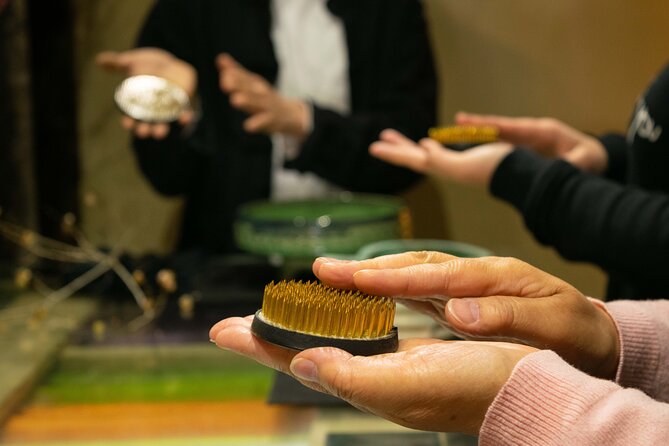
Kyoto can be tiring. A day of temple visits often means crowds, walking, queues, and constant movement between sights. This flower lesson gives you 40 minutes to slow down and pay attention to something small.
The townhouse setting supports that change of pace. The experience is held in a former traditional home rather than a large attraction or busy tour facility. You might find the room itself as memorable as the activity, especially if you have spent the morning around Kyoto’s most famous sights.
The contrast is one of the strongest reasons to book. The class does not try to compete with Kinkaku-ji’s famous exterior or Daitoku-ji’s temple compounds. Instead, it offers a quieter look at Japanese aesthetics through an everyday art form.
The location is also useful for planning. You can pair the class with a visit to Kinkaku-ji, then continue toward Daitoku-ji, or arrange the lesson around sightseeing in northern Kyoto. The activity ends back at the starting point, so you do not need to plan for a separate finish location.
A small group with room for personal help
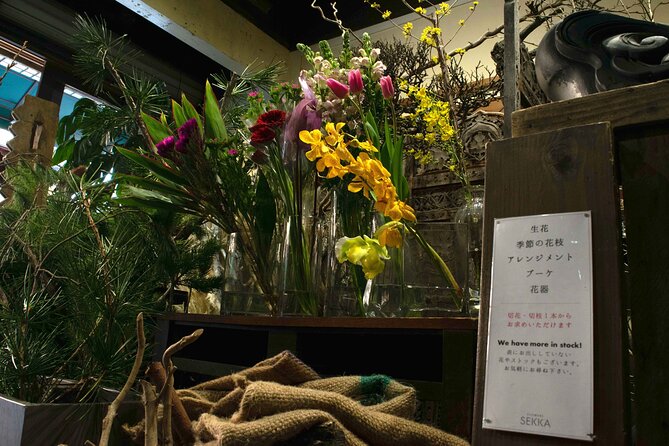
The maximum group size is six people. That is large enough to keep the activity social, but small enough for the instructors to see what each person is doing.
For a hands-on lesson, this matters. You may need help deciding where to place a branch, how to create a pleasing angle, or how to leave enough open space around the flowers. In a large group, those questions can be difficult to ask. Here, the setup should allow more direct attention.
The class can work for couples, families, and solo participants. One couple enjoyed the peaceful quality of the lesson, while a family found that both adults and children could take part. The compact size helps different types of groups share the room without making the activity feel impersonal.
If you are looking for a private lesson only for your own party, note that the information provided describes a small group experience, not a guaranteed private booking. The maximum of six is a useful limit, but it does not promise that you will be alone.
What you learn about flowers, branches, and seasonal beauty
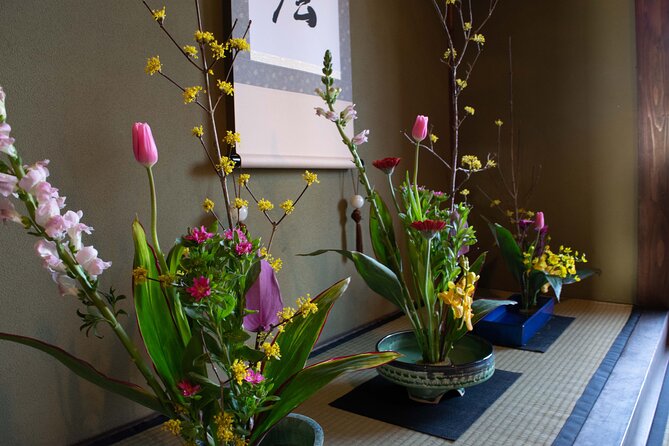
The workshop uses the changing seasons as part of the lesson. Flowers and branches help show the time of year, and the classical approach asks you to work with their existing forms instead of forcing them into a rigid design.
This is where ikebana differs from a standard flower-arranging class. The goal is not simply to fill a container with as many blooms as possible. A branch may provide height or direction. A flower may become a focal point. Empty space may be just as important as the flowers themselves.
You can expect to think about balance in a broader sense. A successful arrangement does not have to be symmetrical. It can use contrast, movement, and space to suggest a natural scene.
The short lesson will not cover every school or form of ikebana. Japanese flower arrangement has a long and varied tradition, and 40 minutes can only introduce a few core ideas. Still, the class gives you a useful starting point and a way to see floral displays differently during the rest of your time in Japan.
The emphasis on natural beauty also makes the activity less intimidating. You are not being asked to create a flawless professional arrangement. You are being asked to notice what each stem already wants to do and build around it.



The finished arrangement and delivery option
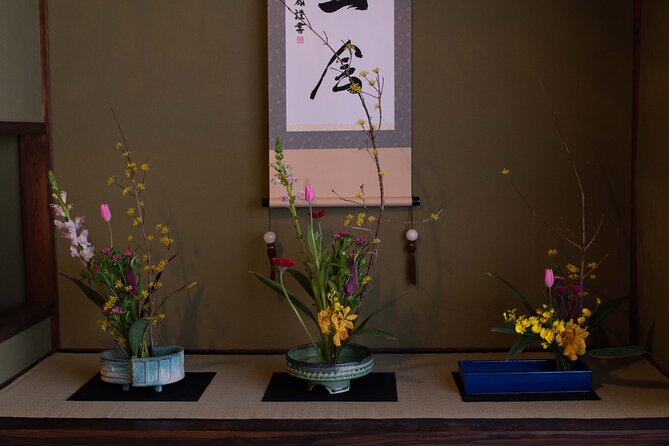
A practical advantage is that your flowers may be delivered to your accommodation after the lesson. This solves a common problem with creative activities: you make something appealing, then have to carry it around for the rest of the day.
Delivery is especially helpful if you are continuing to temples, shopping areas, or dinner. It also lets you enjoy the arrangement later in your room instead of leaving it behind at the workshop.
You should confirm the delivery details when booking or at the start of the activity. The supplied information indicates that arrangements have been delivered safely to accommodations, but it does not specify a delivery area, timing, or extra charge.
The flowers also make the experience feel more substantial than a demonstration. You do not simply watch someone else arrange plants. You leave with a temporary work of your own, one that can remind you of Kyoto after the class.
Keep in mind that flowers are living material. Their appearance will change, and the arrangement may not last throughout a long trip. That fits the wabi-sabi idea introduced in the lesson, but it also means this is a short-lived souvenir rather than a permanent object.
Is $65.15 a fair price?
At $65.15 per person, this is not the cheapest activity you can add to a Kyoto itinerary. You are paying for more than flowers, though. The price includes a guided cultural lesson, a small maximum group, access to a traditional townhouse setting, and the chance to create an arrangement with personal help.
I see the value most clearly for visitors who want a calm, focused experience between major sightseeing stops. The class gives you direct contact with a Japanese art form, rather than a quick photo opportunity or a passive explanation.
The value is less clear if you want a long workshop, advanced technical training, or a large finished arrangement. The 40-minute duration makes this an introduction. It is best viewed as a compact cultural experience, not a serious professional course.
Families should also consider the price for each participant. The activity can suit children as well as adults, but a family of four will pay considerably more than a couple or solo visitor. If everyone in your group enjoys making things and learning through practice, the cost may feel worthwhile. If only one person is interested in flowers, a shorter observation-based activity might be a better use of the budget.
The fact that the experience is often booked about 35 days ahead suggests that you should not leave it until the last minute if your Kyoto schedule is fixed. That does not guarantee every date will sell out, but planning ahead is sensible for a small activity with space for only six people.
Who will enjoy this ikebana experience most?
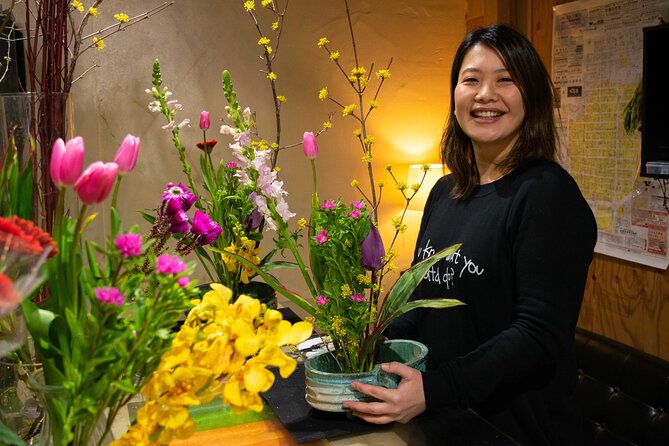
I would recommend it to you if you want a peaceful break from sightseeing and prefer a hands-on activity to a lecture. It suits beginners because the instructors explain the basic ideas and allow you to make your own choices.
It is also a good match for couples. The quiet setting gives you something to do together without the pressure of a busy group tour. Families can enjoy it too, especially when children are interested in flowers, design, or Japanese culture.
Solo visitors should feel comfortable joining. The small group and instructor support make it easier to participate without needing a companion.
The class may be less suitable for someone who wants an extensive lesson on ikebana schools, historical development, or advanced composition. It may also disappoint you if you expect a large bouquet or a long list of formal techniques. The appeal is the setting, the seasonal flowers, the creative freedom, and the chance to slow down.
Service animals are allowed, and the location is near public transportation. Most people can participate. The information does not provide detailed accessibility measurements, so you should contact the provider directly if you have specific mobility or seating needs.
How to fit it into a Kyoto day
The meeting point is in Murasakino Kamimonzenchō, in northern Kyoto. Since the activity ends where it begins, you can plan your transportation around one central point rather than arranging a pickup at another sight.
Kinkaku-ji and Daitoku-ji are the obvious nearby anchors for your day. You could schedule the class before or after temple visits, depending on the time offered. Because the lesson lasts only about 40 minutes, it can fit between other plans more easily than a half-day workshop.
Give yourself enough time to reach the townhouse. The activity is short, and arriving late could reduce the time you have to arrange your flowers. A mobile ticket makes admission simple, but it does not remove the need to allow time for local transportation and finding the exact address.
I would avoid squeezing the class between too many fixed reservations. The point is to slow down, and a rushed arrival would work against the experience. Pair it with one or two nearby sights, then leave room for a relaxed meal or walk.
Booking, cancellation, and practical details
You receive confirmation when you book, and the ticket is mobile. The activity starts and ends at 44-4 Murasakino Kamimonzenchō, Kita Ward, Kyoto, postal code 603-8217.
Free cancellation is available if you cancel at least 24 hours before the scheduled start time. Cancellations made less than 24 hours before the start are not refunded, and changes within that period are not accepted. The cut-off uses local Kyoto time.
The experience is recommended for beginners, and most people can participate. With a maximum of six participants, available dates may be limited, so booking around a month ahead is sensible if this is important to your itinerary.
Should you book this Kyoto ikebana class?
Book it if you want a small, quiet cultural activity with a strong sense of place. The old townhouse, seasonal flowers, tokonoma display, and gentle instruction from Taro-san and Chiaki-san give the class more character than a basic flower craft lesson.
I would especially choose it after a busy morning at Kyoto’s major temples. The 40-minute format is short, but that is also its strength. You get a clear introduction without surrendering half a day.
Skip it if you want advanced ikebana study or if the $65.15 price feels high for a brief activity. For everyone else, particularly couples, families, and first-time visitors who want to make something personal, this is a thoughtful way to experience Kyoto at a slower pace.
FAQ
Where does the ikebana experience take place?
The class takes place at 44-4 Murasakino Kamimonzenchō in Kyoto’s Kita Ward, postal code 603-8217. It is held in a flower shop located in a renovated traditional townhouse about 100 years old.
How long does the experience last?
The activity lasts approximately 40 minutes.
Does the activity begin and end at the same place?
Yes. The experience starts at the listed meeting point and ends back there.
Is the ikebana class suitable for beginners?
Yes. Beginners are welcome, and the class introduces the history and art of Japanese flower arranging with instructor guidance.
How many people can join the class?
The activity has a maximum of six participants.
Who leads the ikebana lesson?
The instructors are identified as Taro-san and Chiaki-san.
What style of ikebana will I learn?
The class is based on classical forms. It focuses on showing the beauty of flowers and branches while respecting their natural shape.
Will my flower arrangement be displayed?
Yes. Your arrangement will be displayed in a tokonoma, a traditional alcove in a Japanese room.
Can the finished flowers be delivered to my accommodation?
The activity offers delivery of the finished flowers to your accommodation. Confirm the delivery details with the provider, since the supplied information does not specify the delivery area or timing.
Is cancellation free?
Yes, you can cancel for a full refund up to 24 hours before the experience starts. Cancellations or changes made less than 24 hours before the start are not accepted for a refund.
Is the activity accessible by public transportation?
The location is near public transportation.
Are service animals allowed?
Yes. Service animals are allowed.
More tours in Kyoto we've reviewed



Kyoto, compared.
 ★ 5.0PERFECT KYOTO 1-Day Bus TourFrom $129
 ★ 4.8Kyoto: Fushimi Inari, Kinkakuji, Bamboo Grove 1 Day Bus TourFrom $122510 minutes - 9 hours
 ★ 4.9Kyoto: Tea Ceremony in a Traditional Tea House in KiyomizuFrom $4945 min
 ★ 4.7Kyoto Geisha Walking Tour: Gion District & Hidden GemsFrom $252 hours
 ★ 4.9Kyoto: Tea Ceremony Ju-An at Jotokuji TempleFrom $291h 10m
 ★ 4.3Kyoto: 45-Minute Tea Ceremony Lesson ExperienceFrom $2245 min