
Reviewed · TEA CEREMONY EXPERIENCES
World Heritage Kyoto & Nara Uji Authentic Matcha Experience
Nara’s deer and Uji’s matcha-making are the stars here, but this 8.5-hour coach trip also packs in Todai-ji, Kasuga Taisha, Byodoin Temple, and several useful glimpses of the Kansai region. You get a lot in one day without piecing together trains, buses, temple admissions, and lunch.
I like the mix of major sights and hands-on culture. The air-conditioned bus saves energy between stops, while guides such as Nanami, Yuta, Mai, At-chan, Den, and Ciel add history and practical help along the way. I also like that you get guided time plus chances to wander on your own.
The trade-off is simple: this is a full day with plenty of walking, stairs, hills, and sometimes 15 minutes or more between the coach parking area and a sight. On a hot, humid day, or for anyone with limited mobility, the pace can feel demanding.
In This Review
- Key points at a glance
- Why this day trip works for a first visit
- Meeting at Kyoto Avanti at 7:50 a.m.
- Kasuga Taisha, Nara’s great shrine
- Nara Park and the 1,400 deer
- Nandaimon and Todai-ji’s Great Buddha
- Lunch beside the Uji River
- Byodoin Temple and the Phoenix Hall
- Making matcha at a 500-year-old tea shop
- Matcha sweets along Byodoin Omotesando
- What the $129.25 price really covers
- Walking, weather, and group pace
- Who should book this Nara and Uji tour?
- Should you book it?
- FAQ
- Where does the tour start and end?
- What time should I arrive?
- Is hotel pickup included?
- Is lunch included?
- Can I request a vegetarian lunch?
- What admissions are included?
- How much walking is involved?
- What languages are supported?
Key points at a glance
- Feed Nara’s famous deer: Around 1,400 deer roam Nara Park, and you can buy crackers locally if you want to feed them.
- See Todai-ji’s Great Buddha: Admission is included for one of Japan’s most important temples and one of the world’s largest wooden buildings.
- Learn matcha in historic Uji: Prepare your own bowl of matcha at a tea shop with more than 500 years of tradition.
- Enjoy a practical Kyoto departure: Meet at Tully’s Coffee inside Kyoto Avanti at 7:50 a.m., then return there after the tour.
- Choose a Japanese lunch: A traditional set meal beside the Uji River is available, with a vegetarian option if arranged at least two days ahead.
- Expect a medium-size group: The coach holds up to 38 people, with WiFi, air conditioning, and multilingual audio guidance.
Why this day trip works for a first visit
If you have only one open day for Nara, this tour gives you the essential sights in a tidy package. Nara and Uji are close enough to combine, but the temples, park, shrine, lunch stop, and tea experience are spread out. Public transportation can handle the route, yet it takes planning and attention. Here, the coach does the connecting.
The day begins in Kyoto and passes sights such as Fushimi Castle and the Heijo Palace site before reaching Nara. Those views are mainly from the road, so do not treat them as full visits. The real stops are Kasuga Taisha, Nara Park, Nandaimon, and Todai-ji, followed by Uji.
The tour is especially useful if you want context. A guide explains what you are seeing, helps keep the group moving, and gives you enough direction to use your free time well. Strong guide performances are a recurring feature of the experience. Nanami is praised for clear, lively explanations, while Yuta is noted for historical details, practical tips, and keeping the group together. At-Chan, Mai, Den, Ciel, Sakura, Keigo, Harry, and Tommy are also named as warm and capable guides.
Do keep your expectations realistic. This is not a quiet private visit with unlimited time at each temple. It is a carefully packed day for seeing a lot.
If you're still narrowing it down, here are other tours in Nara we've reviewed.
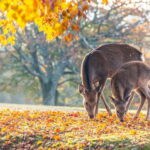
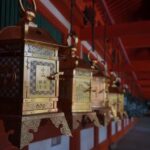
Meeting at Kyoto Avanti at 7:50 a.m.
The starting point is Tully’s Coffee on the first floor of Kyoto Avanti, near Kyoto Station, at 7:50 a.m. The tour ends back at the same meeting point. There is no hotel pickup or drop-off, so you need to arrange your own way to Kyoto Avanti.
Arrive early. Late arrivals are not accepted, and joining the group midway is not considered practical. One unusual situation worked out when a group coordinated with guide Nanami and met the bus in Nara, but you should not count on that option. Treat the meeting time as firm.
The coach is air-conditioned and includes onboard WiFi. Outlets are also mentioned in the experience feedback, which is useful on a long day when phones are working hard for photos and maps. Multilingual audio guidance is available in English, Spanish, French, Italian, German, Portuguese, and Ukrainian, in addition to the professional English-speaking guide.
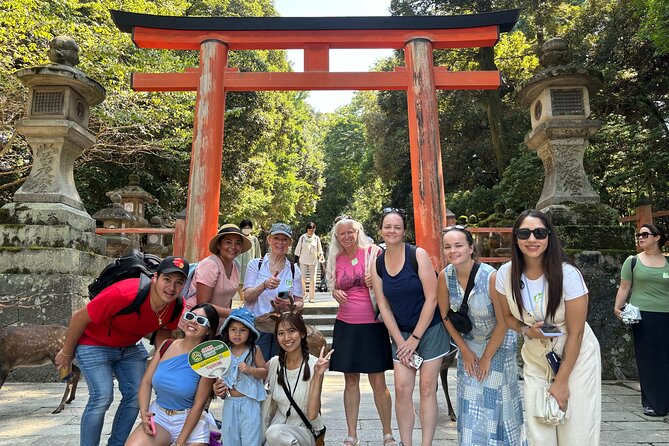
The group can reach 38 people. That is not a small-group outing, but the coach format is a sensible choice for covering this much ground. The main value is not personal attention at every moment. It is having transport, admissions, explanations, and a set plan in one booking.
Kasuga Taisha, Nara’s great shrine
Kasuga Taisha is described as Nara’s most celebrated shrine, and it makes a good first stop. You have about 30 minutes here, with admission listed as free.
The shrine is associated with classic Shinto architecture and the wooded approach that gives this part of Nara a calmer feel than the open park. Your guide can explain the role of the shrine and help you notice details that are easy to miss when you are moving on your own.
Thirty minutes is enough for an introduction and photographs, but not a full, slow exploration of every corner. Keep your shoes comfortable and your camera ready. The tour includes several stops where you will want to pause, but the clock remains part of the day.
Nara Park and the 1,400 deer
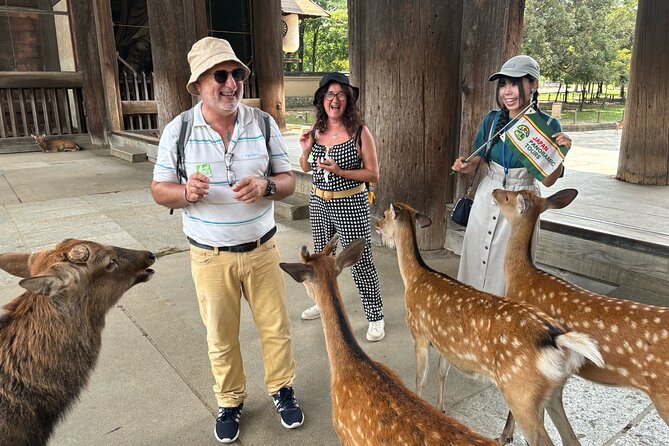
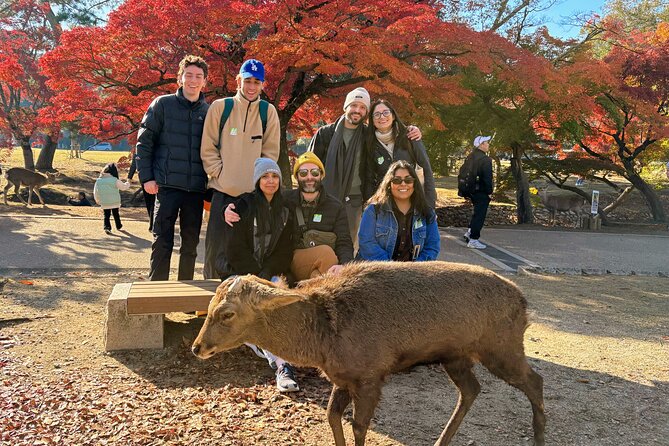
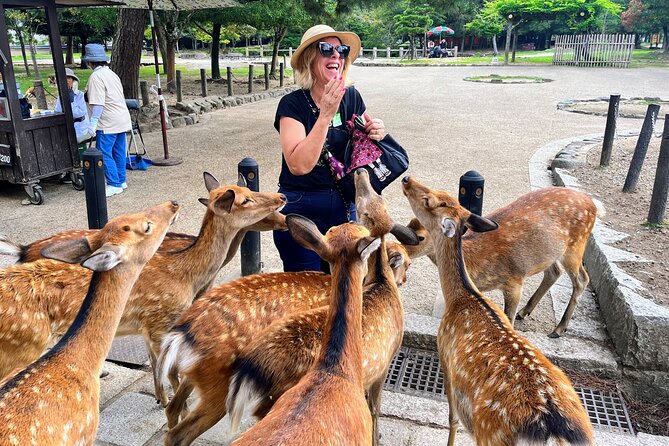
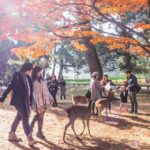
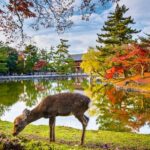
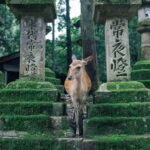
Nara Park is the most playful stop. About 1,400 deer live around the park, and they wander close to the paths and temple grounds. You receive roughly 30 minutes here, which gives you time to see the animals and take photographs.
If you want to feed them, buy deer crackers with yen. The deer are generally calm, but they can nip or give a forceful pinch when they see food and you stop offering it. Keep the crackers moving, follow local instructions, and do not tease an animal by holding food out of reach.
The deer are not a staged show. That is what makes the stop memorable. They walk among people, bow for food, and sometimes follow you for another biscuit. You may find them more insistent than expected, so protect maps, loose papers, and anything easy to chew.
Families often enjoy this part most, and one account specifically found the tour suitable for a four-year-old. Still, children need close supervision around the deer. The park is also one of the places where walking adds up, especially in warm weather.
Nandaimon and Todai-ji’s Great Buddha
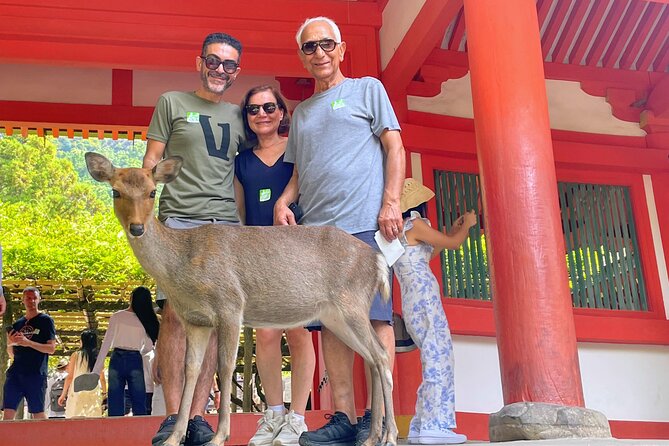
Nandaimon, the Great South Gate, receives only about five minutes, but it is an impressive architectural preview of Todai-ji. The gate’s scale and guardian statues help prepare you for the main temple complex.
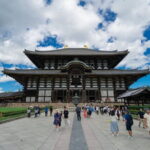
Todai-ji admission is included, and you have about 40 minutes inside the temple area. Todai-ji houses the Great Buddha of Nara and occupies one of the world’s largest wooden buildings. Even with limited time, this is the tour’s major temple visit.
The building is not simply large for the sake of size. Its scale changes your sense of proportion as you approach it. Inside, the Great Buddha gives the visit a powerful focal point, while the surrounding structure shows the engineering and religious ambition behind the temple.
Forty minutes is enough to enter, see the main hall, listen to an explanation, and take photographs. It is not enough for a leisurely study of every feature. If Todai-ji is your main reason for visiting Nara, you may later want to return independently for more time.
The palace site is also included as one of Nara’s World Heritage sites, though the supplied schedule does not give it a separate stop length or clear walking plan. Consider it an added part of the route rather than a guaranteed extended visit.
A few more Nara tours and experiences worth a look
Lunch beside the Uji River
After Nara, the tour heads to Uji, where the lunch option adds a welcome pause. You can choose a traditional Japanese set meal at a restaurant along the Uji River. A vegetarian meal is available if you note the request at least two days before the tour date.
The restaurant may change for operational reasons. Last-minute bookings receive the regular meal, so do not assume a vegetarian arrangement can be made at short notice. Food and drinks are otherwise not included unless you choose the lunch option.
I would lean toward adding lunch if you want the day to run smoothly. Finding a meal for a group in Uji can use precious time, and the set meal gives you a chance to try Japanese presentation and several components in one sitting. Accounts of the lunch describe it as artistic and tasty, and another family found it a worthwhile part of the day.
If you prefer to choose your own food, the lunch stop may feel less flexible than eating independently. The tour’s strength is convenience, not a long restaurant break with a wide menu.
Byodoin Temple and the Phoenix Hall
Byodoin is one of Uji’s defining sights. Admission is included, and the visit lasts about 30 minutes, though the supplied schedule lists 50 minutes for the broader Uji lunch stop before the temple visit.
The temple is famous because its Phoenix Hall appears on the Japanese 10-yen coin. That detail gives you an easy visual connection: after seeing the building, you will recognize the image the next time you handle Japanese change.
Byodoin offers a different mood from Todai-ji. Todai-ji impresses with mass and scale, while Byodoin is known for its elegant form and strong connection to Uji’s tea culture and religious past. You should have time for the main view, photographs, and an explanation from the guide, but not an unhurried museum-style visit.
The Uji portion is more than a second temple stop. It changes the rhythm of the day from Nara’s deer and immense wooden hall to a town closely associated with tea.
Making matcha at a 500-year-old tea shop
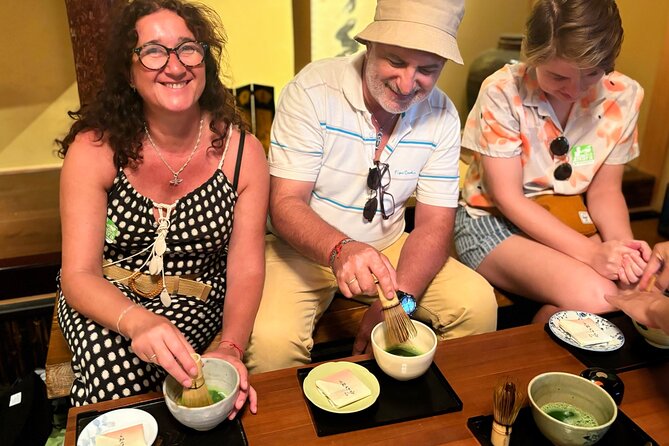
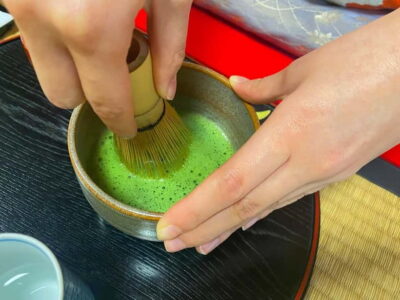
The hands-on matcha activity is the tour’s most distinctive feature. At a historic tea shop with more than 500 years of tradition, you prepare your own bowl of matcha and learn the proper traditional way to drink it.
You are not just handed a cup and sent on your way. The point is to whisk the tea yourself and understand the basic movements behind it. That makes the experience accessible even if you know little about tea ceremony customs.
The session lasts about 30 minutes. It is short enough to fit into a packed day, but long enough to give you an actual task and a sensory memory. The shop owner is described as funny, and the atmosphere appears to be friendly rather than stiff or overly formal.
This is also where the tour feels most personal. You have already seen grand religious buildings. Now you handle the whisk, taste the tea, and learn a small piece of everyday Japanese culture. Matcha can taste grassy or bitter if you are not used to it, but the preparation helps explain why the drink is valued.
Matcha sweets along Byodoin Omotesando
The last listed stop is Byodoin Omotesando, a 30-minute walk where you can browse and taste matcha sweets. The street gives you a chance to see how Uji’s tea identity appears in shops and snacks, not only in a formal tea lesson.
This is a good place to buy edible souvenirs or try flavors you may not find elsewhere. The schedule does not specify which sweets are included, so plan to pay separately for anything you purchase or taste beyond the included activities.
The stop also gives you a little breathing room after the temples. You can browse at your own pace, but remember that the group still has a return departure to make.
What the $129.25 price really covers
At $129.25 per person, this is not the cheapest way to visit Nara and Uji. The price makes more sense when you count what is bundled: air-conditioned transportation, a professional English-speaking guide, multilingual bus audio, Todai-ji admission, Byodoin admission, and the matcha-making experience.
Lunch is included only if you select that option. Food and drinks are not otherwise covered. You should also allow extra money for deer crackers, matcha sweets, and personal purchases.
The strongest value comes from time saved. In one day, you reach two destinations, visit several major cultural sites, and take part in a tea activity without managing connections or finding each admission desk. If you are staying in Kyoto for only a short time, that convenience can justify the cost.
The value is weaker if you dislike fixed schedules or already plan to spend several days in Nara and Uji. Independent visits would give you longer at each place and more control over meals. This tour is best understood as a broad first look, not the final word on either destination.
Walking, weather, and group pace
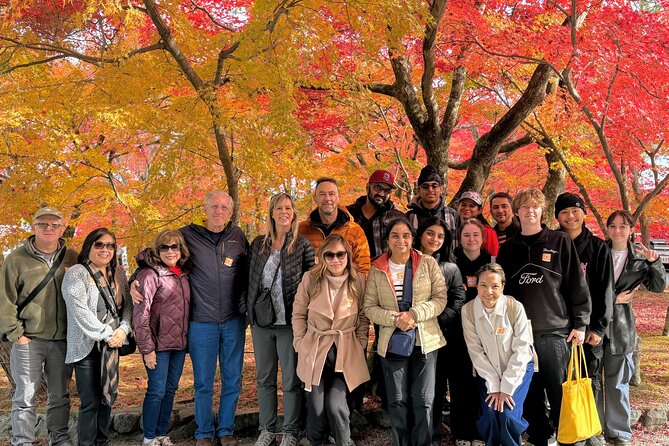
Take the walking warning seriously. You will walk between coach parking areas and sights, and the route includes stairs and hills. One account specifically pointed out that some walks between parking and historic sites lasted more than 15 minutes.
The tour is not recommended for anyone unable to walk long distances. A moderate level of physical fitness is expected. Hot, humid weather can make the day feel harder, particularly around Nara Park and the temple grounds where shade and seating may vary.
Wear reliable shoes, carry water, and keep your belongings organized around the deer. The air-conditioned coach provides useful recovery time, but it does not remove the walking between stops.
The order can change because of traffic, weather, closures, or operating conditions. If a place closes, the operator may substitute another stop. Activities may also be adjusted during difficult conditions, sometimes with a gift as compensation, and no refund is provided for these changes.
Who should book this Nara and Uji tour?
I would choose this tour if you want to see the headline sights in one day, prefer having an English-speaking guide, and like a blend of temples, animals, food, and a practical cultural activity. It is a strong fit for a first visit to the Kansai region, families who want variety, and people who do not want to plan several transport connections.
It also suits you if you enjoy learning a little as you go. Guides such as Nanami and Yuta have been especially effective at explaining historical and cultural details while leaving room for independent wandering. A good guide matters here because the schedule is tight and the stops need clear instructions.
I would think twice if you need a slow pace, have difficulty with hills or stairs, or want extended time inside each temple. The 38-person maximum can also feel less intimate than a private tour, even though the bus keeps the route practical.
The cancellation terms are reasonable: you can cancel for a full refund up to 24 hours before the start time. Changes made inside that window are not accepted.
Should you book it?
Book this tour if your priority is efficient sightseeing with a worthwhile hands-on finish. The combination of Nara’s deer, Todai-ji’s Great Buddha, Kasuga Taisha, Byodoin, a Japanese lunch option, and self-made matcha gives the day real variety.
Skip it if you want to linger, avoid group travel, or cannot comfortably manage a long walking day. For most first-time visitors with limited time in Kyoto, the $129.25 cost is fair for the transport and admissions included. Add lunch, arrive well before 7:50 a.m., bring yen for deer crackers, and treat the matcha session as the day’s special extra.
FAQ
Where does the tour start and end?
The tour starts at Tully’s Coffee on the first floor of Kyoto Avanti, at 31 Higashikujō Nishisannōchō in Kyoto’s Minami Ward. It ends back at the same meeting point.
What time should I arrive?
The scheduled start time is 7:50 a.m. Late arrivals are not accepted, and joining the tour midway is not feasible.
Is hotel pickup included?
No. Hotel pickup and drop-off are not included, and no extra pickup or drop-off service is provided.
Is lunch included?
Lunch is included only if you select that option when booking. The meal is a traditional Japanese set meal served at a restaurant along the Uji River.
Can I request a vegetarian lunch?
Yes. Vegetarian arrangements can be made if you request them in the booking notes at least two days before the tour date. Last-minute bookings receive the regular meal.
What admissions are included?
Admission to Todai-ji Temple and Byodoin Temple is included. The matcha-making experience is also included.
How much walking is involved?
The tour includes substantial walking, stairs, and hills. Some walks between the coach parking area and historic sites may take more than 15 minutes, so it is not recommended for people unable to walk long distances.
What languages are supported?
A professional English-speaking guide accompanies the tour. Multilingual audio guidance is available on the bus in English, Spanish, French, Italian, German, Portuguese, and Ukrainian.
More Nara Day Trips in Nara
More tours in Nara we've reviewed
Tea Ceremony Experiences, compared.
 ★ 4.9Kyoto: Tea Ceremony in a Traditional Tea House in KiyomizuFrom $4945 min
 ★ 4.9Kyoto: Tea Ceremony Ju-An at Jotokuji TempleFrom $291h 10m
 ★ 4.3Kyoto: 45-Minute Tea Ceremony Lesson ExperienceFrom $2245 min
 ★ 4.9Kyoto: Table-Style Tea Ceremony at a Kyo-MachiyaFrom $451h 30m
 ★ 5.0Kimono Tea Ceremony at Kyoto Maikoya, NISHIKIFrom $65
 ★ 4.9Kyoto: Tea Museum Tickets and Matcha Grinding ExperienceFrom $231 hour