
Reviewed · KYOTO
Authentic knife making experience at a blacksmith in Kyoto
A glowing bar of steel, a heavy hammer, and your own hands: that is the heart of this Kyoto knife-making workshop. Under the close guidance of Mao, Taka, and the Studio NIN team, you shape hot metal into a practical Japanese-style knife and take it home at the end.
I like two things right away. You make a usable object, not a token craft that sits in a drawer, and the three-hour session gives you a real taste of forging without committing to the five-plus hours and much higher price of a larger knife. I also like the clear safety coaching, English support, and traditional blacksmith uniform.
The main consideration is physical effort. You will hammer repeatedly, work near a furnace, and spend time sharpening and polishing. The studio can help correct mistakes, but your knife will have handmade character rather than factory-perfect symmetry. Also, confirm the studio address before setting out.
In This Review
- Key points to know before booking
- Why this Kyoto knife workshop feels different
- Arriving at Studio NIN in Sakyo-ku
- Putting on the blacksmith uniform
- Learning the tools and safety rules
- The furnace and the first hammer blows
- Cooling, shaping, and accepting handmade character
- Sharpening and polishing the blade
- What the $154 price buys you
- Who will enjoy it most
- Timing, photos, and the final knife
- Should you book this Kyoto knife-making experience?
- FAQ
- How long does the knife-making experience last?
- How much does the experience cost?
- What size knife will I make?
- Can I take the knife home?
- Is the workshop offered in English?
- Where does the workshop take place?
- What should I bring?
- Can children join the workshop?
Key points to know before booking
- You forge a 13 to 15 cm knife: The finished blade is compact, practical, and easy to give as a gift.
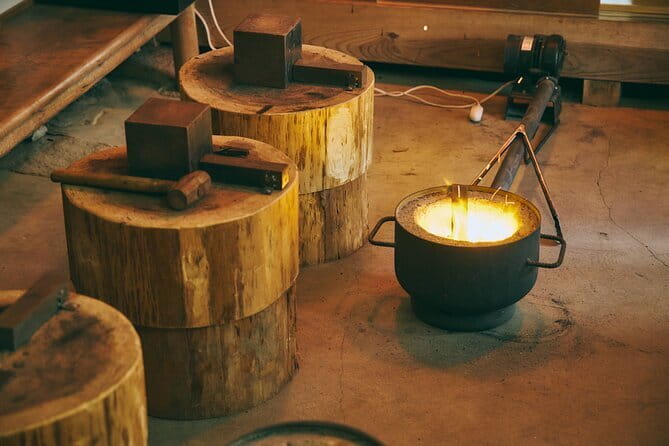
- The furnace reaches about 800 to 900°C: Expect real heat, careful instructions, and plenty of hammering.
- Mao and Taka guide beginners closely: English and Japanese instruction is available, with patient help during each stage.
- The finish is often rustic kurouchi: The dark, forged surface is part of the knife’s character, not a flaw to remove.
- The workshop is outside central Kyoto: The listed meeting point is near the Eizan Electric Railway, but allow extra time for the correct studio.
- You wear the part: A traditional craftsman’s uniform, towel, water, tools, materials, box, and bag are included.
Why this Kyoto knife workshop feels different
Kyoto offers plenty of polished cultural activities. This one is louder, hotter, and more hands-on. You do not simply watch a smith work. You handle the tools, strike the steel, grind the rough edges, and help bring the blade to a usable finish.
That matters because blacksmithing is now uncommon even in Japan. A short workshop cannot teach the full craft of a professional swordsmith or kitchen-knife maker, but it can show you why forging demands strength, timing, patience, and judgment.
I especially like the balance between authentic work and beginner-friendly help. The instructors let you do the important parts, then step in when the metal needs correction or a dangerous movement needs to be stopped. This gives you a genuine role without expecting you to arrive with workshop skills.
You should also set your expectations correctly. This is not a quiet demonstration with a souvenir handed to you at the end. You will work. Several people found the hammering more tiring than expected, and one useful tip is to stretch before you arrive.
If you're still narrowing it down, here are other tours in Kyoto we've reviewed.

Arriving at Studio NIN in Sakyo-ku
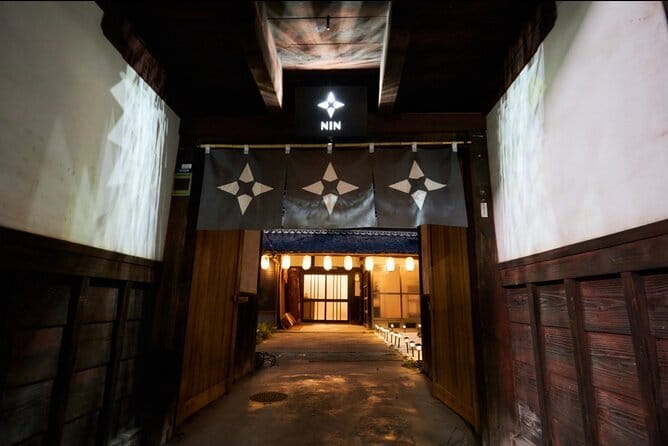
The stated meeting point is Studio Shinobi YASE, at 168-1 Yase-no-secho in Sakyo-ku. It is listed as a one-minute walk from the Yase-Hieizan Exit of the Eizan Electric Railway, and the train is the recommended way to arrive.
There are two studio locations in Sakyo-ku: Studio NIN Yase and Studio NIN Kendo. The staff will message you before the session to tell you which one to use. Take that message seriously. One participant found the directions confusing because the knife-making activity and the initial directions pointed to different studios.
I would leave extra time, even though the official directions describe a very short walk from the station. Another account allowed about 15 minutes from the train, so the sensible plan is to arrive early, check the exact address, and avoid rushing into a safety briefing. Taxis are also available.
The setting is described as attractive and somewhat removed from central Kyoto. That is part of the appeal, but it means you should not treat this as an activity you can squeeze in between two downtown temple visits. The trip out adds planning time, while the location gives the workshop a more separate, craft-focused feel.
Putting on the blacksmith uniform
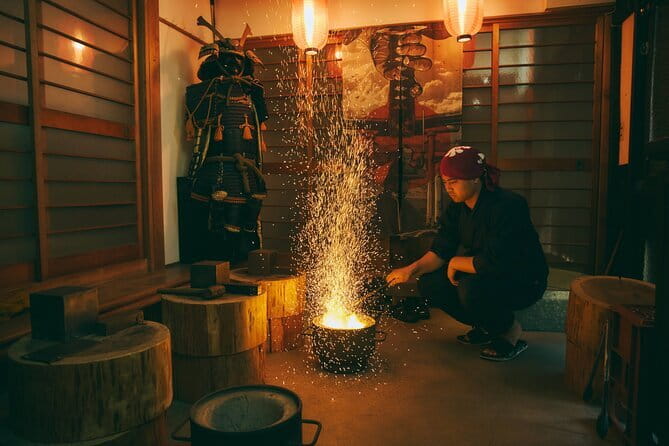
At check-in, Mao or another member of the team welcomes you and gets the session moving. Mao is described as a knife professional with more than 10 years of experience. Depending on the day, you may also work with instructors such as Taka, Mits, Atsushi, or Daiki.
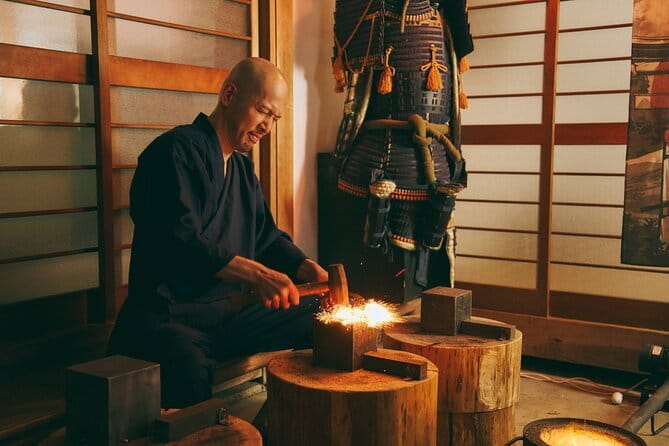
You change into traditional blacksmith attire before handling the tools. It is a small step, but it changes the mood. You are not standing in sightseeing clothes beside an industrial machine. You look and feel ready to work at the forge.
Bring socks. Other useful items are supplied, including a towel and water. In summer, the heat can be intense, especially near the furnace. The studio has provided frozen neck coolers and cooling wraps during hot sessions, but you should still expect to sweat.
Photos and videos are welcome throughout the process. Staff may also help capture key moments, which is useful because your hands will be occupied when the steel is glowing and the hammer is moving.
Learning the tools and safety rules
The first teaching stage covers hammers, tongs, grinders, sharpening stones, and the basic layout of the work area. The instructors explain how to hold each tool and how to work safely around hot metal.
This briefing is not filler. The steel is heated to roughly 800 to 900°C, and the activity includes sparks, forceful hammering, grinding, and sharp edges. You are told where to stand, how to hold the work, and when to wait for an instructor.
The teaching style appears to be one of the strongest parts of the experience. The staff use English and Japanese, and the instructions are described as clear, patient, upbeat, and easy to follow. Beginners are not expected to know how to swing a hammer or judge a blade’s shape.
Children under 15 must have a guardian, and the experience is not suitable for children under 15 or people over 95. The safety notice also makes clear that this is an activity with genuine risks. You should take the instructions seriously and accept that you are responsible in the unlikely event of an accident or injury.
The furnace and the first hammer blows
The raw iron or steel goes into the furnace until it turns red-hot. This is the moment when the workshop shifts from explanation to action. The metal no longer looks like a simple bar. It becomes something that can be stretched, shaped, and formed under the hammer.
With Mao or another instructor guiding you, you strike the heated steel repeatedly. You learn the correct angle, rhythm, and amount of force. You will not simply pound at random. The instructor watches the work and helps you place your blows where they will change the blade’s form.
This is the most physical part of the session. You should expect repeated hammering and the need to hold the work in position. The heat adds to the effort, although the format is short enough to keep the project manageable for most people who can take part safely.
A small group is a real advantage here. The exact group size is not fixed, but small groups are available, and quiet sessions may provide more individual attention. One participant described working in a group of three and appreciated the extra guidance. If the studio is busy, you may have to wait briefly while the instructor works with someone else.
The instructors also protect the final result. If your hammer blows leave a bend or rough shape, they can help fix it. That does not erase your role. You still take part in the main work, but the staff keep a beginner’s mistake from ruining the blade.


Cooling, shaping, and accepting handmade character
Once the metal has been forged, it is cooled and checked. You work on the rough edges and prepare the blade for the next stages. This is where you start to see whether your early hammering produced the shape you wanted.
Do not expect a perfectly uniform blade. The point is to create something you helped form, and the finished knife will show small variations. That is part of the story you take home.
Many finished knives have a kurouchi finish, a dark and rustic surface left by the forging process. If you are hoping for a bright, mirror-like blade, this may surprise you. The raw forged look is intentional and gives the knife a more traditional workshop character.
The knife is about 13 to 15 cm long. That size makes it a sensible souvenir for everyday kitchen use or a gift, although the workshop does not promise that every blade will look identical. I would choose this experience for the process first and the object second.
Sharpening and polishing the blade
After forging, you move to sharpening. With guidance, you use stones and grinders to form the cutting edge. This is a different kind of work from hammering. The furnace and force are gone, replaced by attention to angle, pressure, and steady movement.
This stage gives the knife its practical purpose. A rough forged shape is interesting, but a properly sharpened edge turns it into a tool. Mao and the other instructors help beginners understand the basic movement and correct errors as the blade develops.
You then polish the knife. The blade changes again, from rough metal to a finished object that looks ready to use. The polishing stage is less dramatic than the glowing steel, but it rewards care. It is also a good reminder that knife making is not only about strength. The final quality depends on several quieter steps.
A handle may be an optional extra. One account reported a 5,000-yen additional charge for a handled version, payable by cash or card, including Apple Pay. Confirm the current option and price before you begin, since the main activity price does not clearly include that upgrade.
What the $154 price buys you
At $154 per person, this is not a cheap craft class. The value comes from the amount of instruction, the real use of the forge, the supplied materials, and the knife you take home. You also receive the costume, towel, water, tools, box, and bag.
The comparison with larger knives helps explain the price. A larger knife takes more than five hours and costs over $400, while this workshop uses a shorter format designed to give you the core forging experience in about three hours. If you mainly want to try blacksmithing and leave with a useful souvenir, the shorter session is the better fit.
The knife can also function as a gift. A factory-made Japanese knife may offer more precise finishing, but it will not carry the memory of you heating, hammering, sharpening, and polishing the steel. For a birthday, family outing, or special Japan souvenir, that personal link adds real value.
I would not book it if your main goal is to buy the finest kitchen knife for professional cooking. I would book it if you value the story behind an object and want a craft experience that feels more substantial than painting a postcard or assembling a pre-cut souvenir.
Who will enjoy it most
This workshop suits people who like practical, hands-on activities. Families with older teenagers, couples, solo visitors, and groups of friends can all find a good reason to book it. One teenager described it as a favorite part of a Japan trip, which says something about its appeal to young people who may not be excited by another museum.
It is also a good choice if you prefer making something together rather than standing quietly in front of exhibits. You may meet people from several countries while working in the same small group, and the instructors keep the tone friendly and light.
You should have enough strength and stamina for repeated hammering. Stretch first, wear socks, and dress for heat under the provided uniform. Summer sessions can be particularly warm, even with cooling aids.
The activity is less suitable for anyone who wants a slow, purely historical lesson. You receive some background on Japanese blacksmithing and the knife-making process, but the main focus is doing the work. If you want a long lecture on craft history, this may feel brief.
Timing, photos, and the final knife
The full experience lasts about three hours, though the knife-making format itself is described as roughly two and a half hours. That leaves room for arrival, changing, instruction, finishing, questions, and photographs.
At the end, your handmade knife is boxed and bagged for transport. You can ask final questions about technique, history, or knife care. The staff are happy to explain the work, and you can capture the finished blade along with the earlier stages.
Some extra activities, such as shuriken throwing, may be available while you wait or through the same provider, but they are not the main promise of this booking. Treat them as a possible bonus rather than a reason to choose the workshop.
Free cancellation is available up to 24 hours before the start time for a full refund, and you can reserve now and pay later. Check the available starting times for your date. The activity is offered in English and Japanese.
Should you book this Kyoto knife-making experience?
I would book this if you want a souvenir with a story, enjoy physical work, and can spare most of a morning or afternoon for the trip to Sakyo-ku. The strongest reasons are the close instruction, the rare chance to work with a real forge, and the fact that you leave with a practical 13 to 15 cm knife.
I would think twice if you dislike heat, repetitive hammering, sharp tools, or imperfect handmade results. Also confirm the studio location before leaving, and allow more arrival time than the one-minute station description suggests.
For most visitors who want something beyond temples and shopping, this is a memorable use of three hours. You will not become a master blacksmith, but you will understand the craft better, feel the effort behind a forged blade, and carry home an object you helped make.
FAQ
How long does the knife-making experience last?
The activity lasts three hours. The knife-making format itself is described as about two and a half hours, with additional time for arrival, changing, instruction, finishing, photos, and questions.
How much does the experience cost?
The listed price is $154 per person. A handled knife may cost an additional 5,000 yen, based on the available activity details, so confirm the current upgrade price before starting.
What size knife will I make?
You will make a handmade knife approximately 13 to 15 cm long.
Can I take the knife home?
Yes. Your finished knife is prepared in a box and bag for you to take home.
Is the workshop offered in English?
Yes. Instruction is available in English and Japanese.
Where does the workshop take place?
The meeting point is listed as Studio Shinobi YASE, at 168-1 Yase-no-secho, Sakyo-ku, Kyoto. The operation uses two studios, Studio NIN Yase and Studio NIN Kendo, so staff will confirm your exact location before the visit.
What should I bring?
Bring socks. The activity supplies the costume, towel, water, tools, materials, box, and bag.
Can children join the workshop?
Children under 15 cannot join. Participants under 15 are not suitable for the activity, and the stated age guidance says children under 15 must be accompanied by a guardian.
More tours in Kyoto we've reviewed







Kyoto, compared.
 ★ 5.0PERFECT KYOTO 1-Day Bus TourFrom $129
 ★ 4.8Kyoto: Fushimi Inari, Kinkakuji, Bamboo Grove 1 Day Bus TourFrom $122510 minutes - 9 hours
 ★ 4.9Kyoto: Tea Ceremony in a Traditional Tea House in KiyomizuFrom $4945 min
 ★ 4.7Kyoto Geisha Walking Tour: Gion District & Hidden GemsFrom $252 hours
 ★ 4.9Kyoto: Tea Ceremony Ju-An at Jotokuji TempleFrom $291h 10m
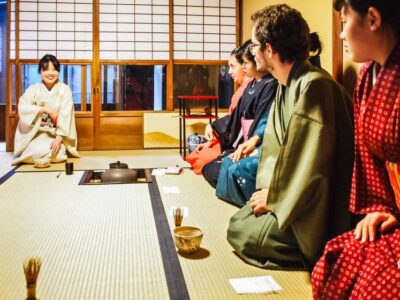 ★ 4.3Kyoto: 45-Minute Tea Ceremony Lesson ExperienceFrom $2245 min