
Reviewed · KYOTO
Authentic Knife Making Experience at a Blacksmith in Kyoto
The best part of this Kyoto experience is that you do not simply watch a blacksmith work. You hammer hot steel into shape, then grind, sharpen, and polish your own knife. The finished blade is a real, usable object, not a token souvenir.
I like the small group, limited to six, because instructors can step in before a beginner makes a serious mistake. I also like the honest scale of the project: in about three hours, you make a compact 13 to 15 centimeter knife rather than pretending you can produce a full-size chef’s knife in an afternoon.
The main consideration is that this is physical work. Hammering takes effort, and grinding requires care and patience. Some of the finishing work may feel less clearly explained than the forging, and the workshop is not a polished, sit-back-and-watch attraction.
In This Review
- Key points
- Turning a Steel Billet into a Kyoto Souvenir
- What Happens During the Three-Hour Class
- Forging the blade
- Cutting and shaping
- Grinding and sharpening
- A Small Workshop with Personal Attention
- What Kind of Knife You Take Home
- Why the Price Can Make Sense
- Getting to Studio NIN in Yase
- Who Will Enjoy This Experience Most
- Practical Tips for a Better Class
- Cancellation and Basic Booking Facts
- Should You Book the Atelier NIN Knife Class?
- FAQ
- Where does the knife-making experience take place?
- How long does the experience last?
- What size knife will I make?
- Is the knife functional?
- Is a wooden handle included?
- Are tools and materials provided?
- Is protective clothing provided?
- Is the experience taught in English?
- How many people can join the class?
- Can I cancel for a refund?
Key points
- Hammer the steel yourself: The forging section is hands-on and takes roughly an hour.
- A real handmade knife: The finished blade is approximately 13 to 15 centimeters and can be functional and very sharp.
- Traditional dress included: You change into a goldsmith-style uniform before working.
- Small group instruction: Atelier NIN accepts a maximum of six people.
- Complete the blade by hand: You learn grinding, sharpening, and polishing, not just forging.
- Plan your return journey: The workshop is at Yasenosecho in Kyoto, and phone signal may be weak near the station.
Turning a Steel Billet into a Kyoto Souvenir
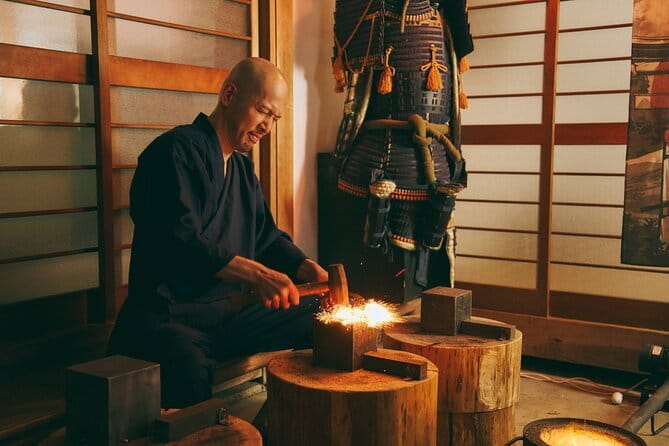
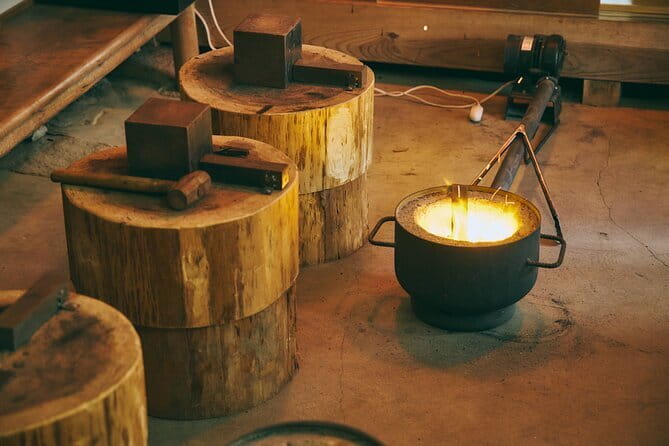
This is a good choice if you want a souvenir with a story attached to it. You begin with a simple piece of steel and spend real time changing its shape with a hammer. It is noisy, warm, repetitive work, and that is exactly why the result feels personal.
The process follows the basic traditional method used for Japanese kitchen knives. You learn how the steel is forged and flattened, then move on to shaping and finishing. The instructors help correct your technique, but you still do much of the work yourself.
That distinction matters. Some craft classes give you a finished item after a quick symbolic task. Here, the forging portion can take around an hour, followed by grinding and sharpening. You will feel the difference between a demonstration and a workshop.
The knife is small, usually about 13 to 15 centimeters. Since it is handmade, the final size and shape vary from person to person. You can request a knife design, but the exact result depends partly on your hammering and finishing.
If you're still narrowing it down, here are other tours in Kyoto we've reviewed.


What Happens During the Three-Hour Class
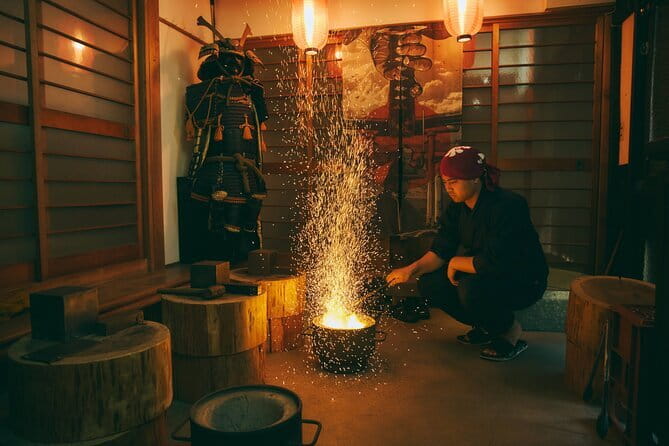
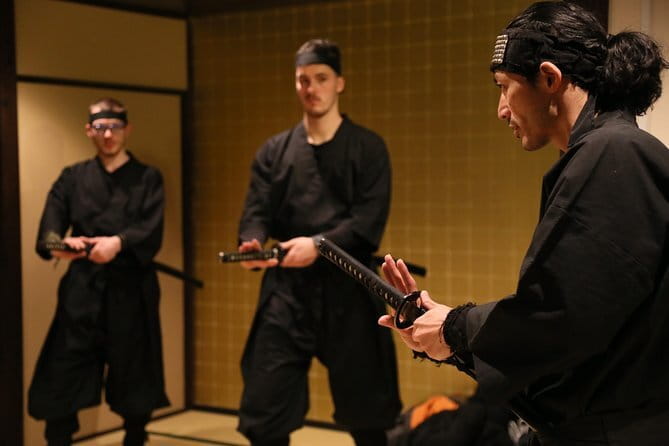
The experience lasts about three hours, though the workshop describes the hands-on portion as roughly two and a half hours. You start by changing into a traditional goldsmith outfit. It gives the session a more authentic feel and saves you from bringing protective clothing.
The staff then explain the tools and show you how to work safely. This introduction is important because the equipment is not decorative. You will handle tools used for hot steel, hammering, grinding, and sharpening.
Forging the blade
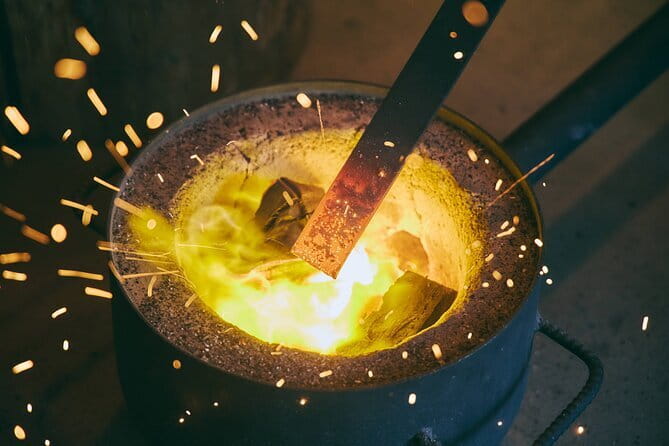
Forging is the central part of the class. You hammer the heated steel to flatten and shape it, working toward the outline of a knife. The task takes strength and repeated effort, so do not expect to finish this section with delicate taps.
This is also where the instructors are most likely to guide you closely. Daiki is described as an engaging teacher who quietly steps in when help is needed. The staff generally aim to let you make the knife while correcting errors before they become difficult to fix.
You may find this part both satisfying and tiring. It is a better fit for someone who likes practical work than for someone hoping to spend a calm afternoon taking photographs.
Cutting and shaping
Once the initial steel has been forged, the staff help turn it into a recognizable knife shape. The blade is then prepared for the next stage. At this point, your rough piece of metal starts to look like a finished tool.
The shape is not the only thing that matters. The angle and thickness of the edge will affect the final knife, so paying attention during the instructions pays off later.
Grinding and sharpening
Grinding removes rough areas and cleans up the blade. You work with a sanding belt or similar equipment, then form the preliminary edge. This part gives you more control over the final appearance, but it also demands more care than the hammering.
Take your time here. Keep listening to the instructor’s directions about the angle of the blade and how to use the belt. One practical weakness of the class is that the grinding and finishing instructions may not feel as detailed as the forging guidance, especially for a first-time knife maker.
The blade is then sharpened and polished. The staff may complete some of the final finishing work so the knife is safe and usable. You should leave with a genuinely sharp blade, so handle it carefully from the moment it is handed back to you.



A Small Workshop with Personal Attention
The maximum group size is six. That is a strong feature for a class involving hot steel and powered grinding equipment. You have a better chance of getting direct help than you would in a large group.
The instructors speak English well enough to explain the process and safety points. Daiki is specifically noted as a patient, engaging teacher, while the wider team is described as friendly and willing to correct mistakes.
The teaching style is practical rather than formal. You are shown how to use the tools, then encouraged to try. If you make a rough blade, the staff can help you improve it, but the final shape may still show your level of experience.
That is part of the appeal. Your knife will not look exactly like one made by a career blacksmith. Small variations make it clear that you made it yourself.
There is one important balance to keep in mind. Most of the instruction appears helpful, but the quality of guidance may vary by stage. Forging receives strong attention, while grinding and edge angles require you to ask questions if you are unsure.
What Kind of Knife You Take Home
The standard knife is approximately 13 to 15 centimeters long. The size can vary because the knife is handmade. Larger knives take more time and cost more, so this class focuses on a manageable size that can be completed within the session.
The standard design uses a simple iron handle rather than a wooden one. That keeps the traditional process straightforward and helps hold the price to $158.52 per person.
An optional wooden handle has also been offered for an additional ¥5,000, with the handle attached by the buyer after returning home. Confirm the current arrangement before booking if the handle is important to you, since the included format is the simple iron-handled knife.
The finished blade is not just a decorative object. It is described as functional and sharp. That makes it a useful keepsake, but it also creates a practical issue for your trip home. Check your airline and local transport rules, and plan to place the knife in checked luggage if required. A blade may not be accepted in carry-on baggage.
The completed knife is wrapped and placed in a gift bag. A small photograph may also be provided as a memento at no extra cost.
Why the Price Can Make Sense

At $158.52, this is not a cheap activity. You are paying for instruction, materials, use of specialist tools, protective clothing, and a finished handmade knife.
The comparison with a larger cooking knife is useful. A regular full-size cooking knife can take more than five hours to make and cost more than $400 in this setting. Atelier NIN keeps this experience shorter and more accessible by using a smaller blade.
I see the price as fair if you value time at the forge and want to take home a usable object. It is less attractive if you only want a finished Japanese knife. Kyoto has many places to buy excellent kitchenware without spending three hours hammering steel.
The value also depends on your attitude toward the work. You are not paying for a perfect professional blade made entirely by someone else. You are paying for the chance to shape part of it, learn the basic process, and leave with a knife that carries evidence of your effort.
Getting to Studio NIN in Yase
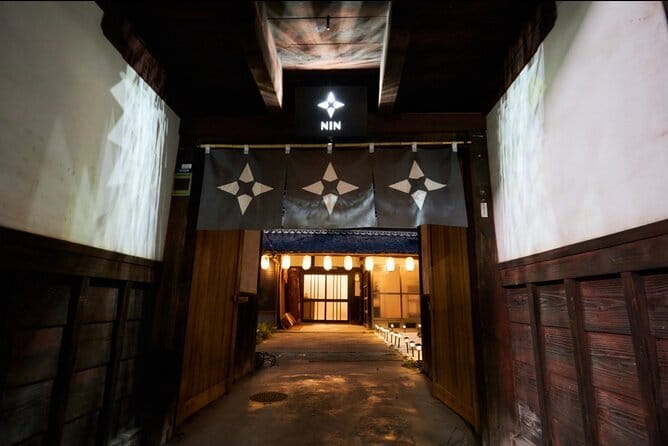
The meeting point is studio NIN at 168-1 Yasenosecho, Sakyo Ward, Kyoto, 601-1254. The activity ends at the same place.
The workshop is near public transportation, but it is not necessarily a quick walk from the station. The route can feel long, and the studio is in a residential area. Phone service may be unreliable near the station, so save directions before leaving central Kyoto.
The train used to reach the area has been described as a small, one-carriage service. That can be part of the charm, but allow extra time and do not assume the location will be obvious when you arrive.
Rurikoin appears as the itinerary stop, while the stated start and end point is studio NIN. For planning, treat the workshop address as the place you need to reach, and check the exact meeting directions with your confirmation.
Private transportation is not included. Snacks are not included either, so eat beforehand or bring something for after the class. Water and toilets are available on site.
Who Will Enjoy This Experience Most
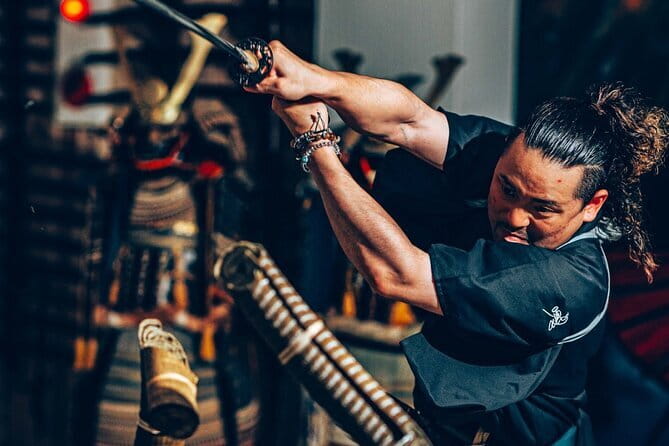
I would recommend this to adults, couples, families with older children, and anyone interested in Japanese craft. A 13-year-old has completed the activity successfully, and the staff can provide guidance, but the work still requires attention and physical effort.
It is particularly well suited to:
- People who enjoy blacksmithing, carpentry, cooking, or practical crafts
- Couples who want matching or personalized souvenirs
- Families looking for an activity beyond temples and shopping
- Cooks who want to understand how a knife begins as raw steel
- Anyone happy with a handmade result rather than factory-perfect symmetry
You should think twice if you dislike heat, noise, repetitive hammering, or machinery. The session is not passive. You will need moderate physical fitness, steady concentration, and a willingness to follow safety directions.
The workshop can also be a good break from Kyoto’s formal sights. After several hours of temples, gardens, and crowded streets, working with your hands gives you a different view of Japanese craftsmanship.
Practical Tips for a Better Class
Wear clothes that allow easy movement, even though a uniform is supplied. Closed footwear would be sensible, but the available information indicates that footwear and safety guidance may not always feel ideal, so ask about workshop footwear when you arrive.
Keep your hands relaxed while hammering and let the instructor correct your grip. The goal is not to hit as hard as possible every time. Good control will help you shape the metal and reduce fatigue.
Pay extra attention during the sanding and sharpening stages. Ask the instructor to demonstrate the correct angle more than once if needed. This is the point where a beginner can most easily spoil an otherwise promising blade.
Do not rush the polished finish. Small marks and uneven areas are part of the handmade character, but careful work will make the final knife more satisfying.
Finally, plan for transport home before you start. The finished blade is sharp, and you do not want to discover at the airport that your luggage arrangements are unsuitable.
Cancellation and Basic Booking Facts
Confirmation is provided at booking. You can cancel for a full refund if you do so at least 24 hours before the local start time. Cancellations or changes made within 24 hours are not accepted for a refund.
The experience has a maximum of six people, includes an English guide, a uniform, and the tools needed for knife making. It does not include private transportation or snacks.
Should You Book the Atelier NIN Knife Class?
Book it if you want a hands-on Kyoto memory and are willing to work for your souvenir. The strongest part is the full sequence: forge the steel, grind the blade, sharpen it, and polish it. You do not simply pose beside a blacksmith’s fire.
The $158.52 price is reasonable for a small group, equipment, instruction, and a functional handmade knife, though it is more than you would pay for a standard sightseeing activity. The main drawbacks are the physical effort, the somewhat remote location, and the need to be alert during grinding and sharpening.
For a craft-minded visitor, a cook, or a family with an older child, this is one of the more memorable ways to spend half a day near Kyoto. For anyone seeking a relaxed demonstration or a guaranteed perfect knife, buy one from a specialist shop instead.
FAQ
Where does the knife-making experience take place?
It takes place at studio NIN, 168-1 Yasenosecho, Sakyo Ward, Kyoto, 601-1254, Japan.
How long does the experience last?
The activity lasts approximately three hours. The hands-on experience is also described as about two and a half hours.
What size knife will I make?
The knife is approximately 13 to 15 centimeters long. The final size may vary because each knife is handmade.
Is the knife functional?
Yes. The finished knife is a usable, sharp blade rather than a purely decorative souvenir.
Is a wooden handle included?
No. The standard knife uses a simple iron handle. A wooden handle has been offered as an optional ¥5,000 add-on, so confirm the current details before booking.
Are tools and materials provided?
Yes. The experience includes the tools used to make the knife and the materials needed for the activity.
Is protective clothing provided?
Yes. You change into a traditional goldsmith-style uniform for the workshop.
Is the experience taught in English?
Yes. An English guide is included, and the instructors provide guidance throughout the process.
How many people can join the class?
The maximum group size is six people.
Can I cancel for a refund?
Yes. You can receive a full refund if you cancel at least 24 hours before the local start time. Changes or cancellations made less than 24 hours before the activity are not accepted for a refund.
More tours in Kyoto we've reviewed









Kyoto, compared.
 ★ 5.0PERFECT KYOTO 1-Day Bus TourFrom $129
 ★ 4.8Kyoto: Fushimi Inari, Kinkakuji, Bamboo Grove 1 Day Bus TourFrom $122510 minutes - 9 hours
 ★ 4.9Kyoto: Tea Ceremony in a Traditional Tea House in KiyomizuFrom $4945 min
 ★ 4.7Kyoto Geisha Walking Tour: Gion District & Hidden GemsFrom $252 hours
 ★ 4.9Kyoto: Tea Ceremony Ju-An at Jotokuji TempleFrom $291h 10m
 ★ 4.3Kyoto: 45-Minute Tea Ceremony Lesson ExperienceFrom $2245 min