
Reviewed · FUSHIMI INARI TOURS
Fushimi Inari Shrine: Explore the 1,000 Torii Gates on an audio walking tour
Fushimi Inari’s famous red torii gates are easy to photograph and easy to misunderstand. This self-guided audio walk gives you the stories behind the gates, fox statues, Shinto rituals, and forest path in about 45 minutes to an hour.
I like the freedom to pause, wander, and listen at your own pace, and I like that the tour ends farther inside the shrine complex rather than sending you straight back through the entrance. The main trade-off is simple: you must bring your own charged smartphone and headphones, and the tour cannot be refunded or changed after booking.
In This Review
- Key points
- Why an audio walk improves Fushimi Inari
- Starting at the fox statue by Inari Station
- Understanding the shrine before the gates
- Hand Water and the practical side of Shinto ritual
- The main hall and the idea of wabi-sabi
- Walking through the Senbon Torii
- Okusha Shrine and the Heavy-Light Stone
- The Root up Pine Tree and the final pond
- What $5.99 gets you
- Who will enjoy this format most
- Tips for a smoother visit
- Should you book this Fushimi Inari audio tour?
- FAQ
- Where does the Fushimi Inari audio tour start?
- Where does the tour end?
- How long does the tour take?
- What language is the audio tour in?
- Is this a guided group tour?
- What does the price include?
- Do I need a smartphone and headphones?
- Do I need an internet connection during the walk?
- Can I cancel or change the booking?
Key points
- Start beside a fox statue near Inari Station: The meeting point is easy to identify at the shrine entrance.
- Learn the meaning behind the scenery: The audio explains fox imagery, hand washing, wabi-sabi, and Shinto customs.
- Walk through the Senbon Torii: The route includes the celebrated passage of 1,000 bright red gates.
- Use the tour offline: Download the audio, map, and location data before arriving.
- Make a wish at the Heavy-Light Stone: The route introduces this unusual shrine feature near the end.
- Finish by a quiet pond: The final stop is at Kumataka Shrine, where you can pause or continue exploring.
Why an audio walk improves Fushimi Inari

Fushimi Inari Taisha is one of Kyoto’s most photographed sights, but a photograph tells you very little about what you are seeing. The torii gates are not simply decorative arches. They are tied to worship, gratitude, and offerings at a shrine devoted to Inari, a Shinto deity associated with rice, prosperity, and success.
This tour gives you a way to connect the symbols with the place. As you walk, the audio points out fox statues, explains the hand-washing ritual, and introduces ideas such as wabi-sabi. That matters here because Fushimi Inari is full of details that can blur together if you only follow the crowd and take pictures.
The format is private by default because you use the VoiceMap app on your own phone. There is no live guide setting the pace, and no group waiting for the slowest person. You can stop the audio for photographs, replay a section, or take a short break when the path gets busy.
The experience lasts roughly 45 minutes to one hour. That makes it useful as a focused introduction, not a full hike over the entire mountain. At the end, you can keep walking through the shrine grounds or rest before making your way back.
A few more Kyoto tours and experiences worth a look



Starting at the fox statue by Inari Station
The walk begins opposite Inari Station, in front of a fox statue at the entrance to Fushimi Inari Taisha. This is a practical starting point because the location is near public transportation and the statue gives you a clear visual marker.
Foxes appear throughout the shrine grounds. Inari’s fox messengers are among the first details the tour helps you notice, and the statues are not all identical. Look closely as you move along the route, since their expressions, poses, and objects can vary.
Beginning outside the main worship area also helps you get your bearings. You are not dropped into a long explanation while trying to work out where to stand. The audio leads you from the entrance toward the shrine’s important religious spaces.
Download everything before you arrive. The tour includes offline audio, maps, and geodata, but the app still needs to have the material stored on your phone first. This is the most important practical tip for a smooth start.
Understanding the shrine before the gates
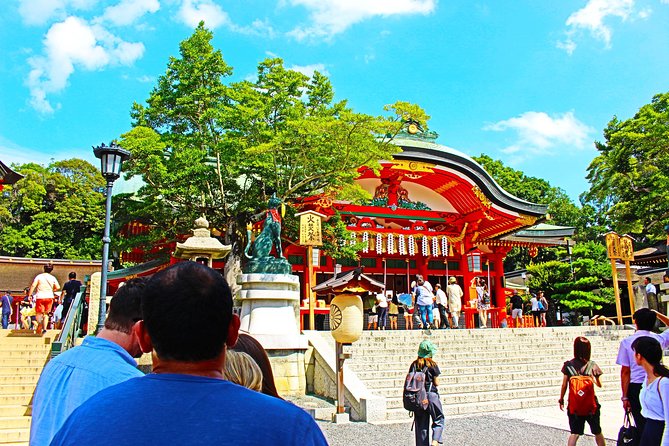
The second stop begins the main explanation of the shrine’s significance. Fushimi Inari has influenced people’s lives for more than 1,300 years, and the audio places the buildings and rituals within that long religious tradition.
This is where the tour earns its small price. At $5.99 per person, you are not paying for a live guide or a long excursion. You are paying for a structured explanation that helps you make sense of a major Kyoto sight while you walk.
I particularly like this approach for a first visit. You can enjoy the bright gates and forest path, but you also receive enough context to understand why people pray, wash, bow, and leave offerings. The result is a more respectful visit and a better sense of place.
Keep your expectations in check. The experience is in English, and the supplied information does not identify a live guide for this audio tour. If you want a person answering questions as you go, this is not the right format.
Hand Water and the practical side of Shinto ritual
One stop explains a ritual called Hand Water. This introduces the custom of cleansing before prayer and helps you recognize the purpose of the water basin rather than treating it as an ornamental feature.
The audio format is helpful here because you can listen before deciding how closely you want to watch the ritual. You are given an explanation of what the act means, rather than simply being told to copy the people around you.
As with any active place of worship, you should keep your voice low and follow posted instructions. The tour can explain the custom, but it does not replace the need to observe what is happening around you.
This short stop is also a good reminder that Fushimi Inari is a functioning shrine, not just a scenic walking route. The torii gates create a dramatic corridor, but religious practice remains the central purpose of the site.
The main hall and the idea of wabi-sabi

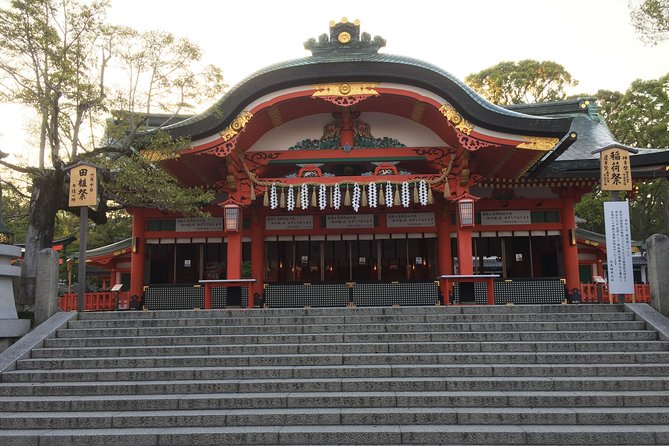
The route pauses at the beautiful main hall, giving you a chance to look at the architecture before moving into the long torii passage. The stop breaks up the walk and gives the opening section a clear center.
Another point introduces wabi-sabi, a Japanese aesthetic linked with simplicity, imperfection, and the passage of time. The tour uses the shrine setting to discuss an idea that can be easy to reduce to a slogan. Here, it becomes part of the way you look at old religious buildings, worn surfaces, natural surroundings, and quiet pauses between major sights.
You will not need specialist background to follow this section. The short audio stops are designed for people who want a simple explanation while standing in the place being discussed.
The main hall is also a useful place to slow down. Fushimi Inari can feel hectic near the entrance, especially during peak visiting times. A short pause gives you time to listen, take in the building, and let the walk become more than a race toward the famous gates.
Other walking tours we've reviewed in Kyoto






Walking through the Senbon Torii
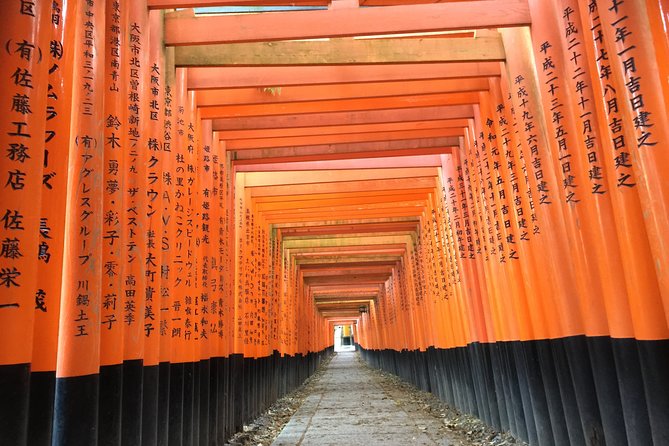
The central moment arrives at the Senbon Torii, the passage of 1,000 torii gates. This is the stretch most people picture when they think of Fushimi Inari, and the audio helps turn the familiar image into a meaningful part of the visit.
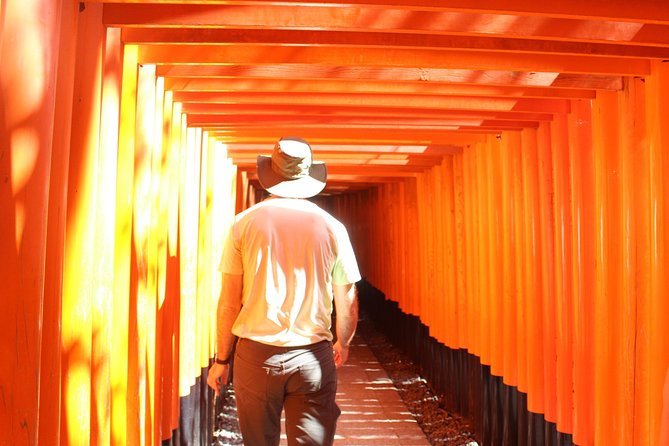
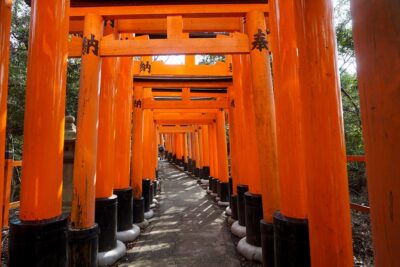
The gates are a striking shade of red-orange, packed closely enough to create a tunnel effect. As you walk through, the view changes from open shrine grounds to a more enclosed forest path. The contrast gives the route much of its visual power.
This is also the section where patience helps. You may want to stop for photographs, and other people may have the same idea. Since the tour is self-guided, you do not have to hold up a group. Pause the audio, step aside when possible, and continue when the path clears.
The tour lists the Senbon Torii twice among its stops, which suggests that the gate passage forms a substantial part of the route. That is useful rather than repetitive. You get time to experience the gates as a place to walk through, not just a single photo stop.
Do not expect the 45-minute to one-hour route to cover every part of Fushimi Inari. The shrine complex extends beyond this introductory walk. The tour gives you a focused section and then leaves you free to continue on your own.
Okusha Shrine and the Heavy-Light Stone
After the torii gates, the audio takes you to Okusha Shrine. This stop gives the walk a quieter religious focus after the highly photographed gate passage.
The route also introduces the Heavy-Light Stone, where you can make a wish. The idea is simple and memorable: you engage with one small feature of the shrine rather than moving from one large sight to another.
This is the kind of stop that makes an audio tour useful. Without an explanation, you might walk past the stone without knowing its purpose. With the context, it becomes a personal moment within the larger visit.
The wishing stone is not presented as a paid attraction, and there is no ticket or separate entrance fee included or required for the audio experience. You simply reach the stop as part of the walking route and decide how you want to take part.
The Root up Pine Tree and the final pond
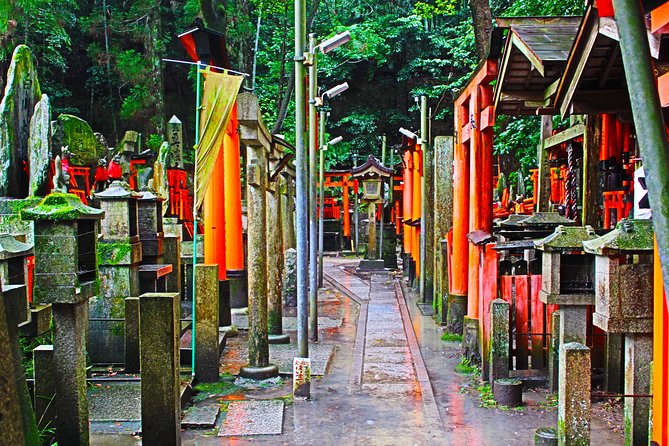
Near the end, the route makes a brief stop by the Root up Pine Tree. The audio explains more about this unusual feature, giving you another example of how Fushimi Inari mixes natural forms with religious meaning.
The walk ends at Kumataka Shrine, beside a lovely pond deeper inside the complex. This is a thoughtful finish. You are not left at the loudest entrance or pushed straight toward the next attraction. Instead, you reach a place where you can take a break, continue walking, or return toward the start.
The ending is flexible, but you should remember that transportation back is not included. The tour provides the route and audio only. You are responsible for getting to the shrine, carrying your phone and headphones, and deciding how long to remain after the final stop.
What $5.99 gets you
At $5.99 per person, this is a low-cost way to add structure to a shrine visit. You receive lifetime access to the English tour, the VoiceMap app for Android and iOS, and offline access to the audio, map, and location data.
The value is strongest if you want independence. A live private guide would offer conversation and flexibility, but it would also cost far more. This tour gives you an organized route and explanations without tying you to a fixed group schedule.
The value is weaker if you already know Shinto customs and the shrine well. In that case, you may prefer to walk without commentary. The experience also does not include food, drinks, transportation, a smartphone, or headphones, so the $5.99 price is not the full cost of your visit.
There are no museum or attraction tickets included because the route focuses on the shrine walk itself. Plan your budget around your transportation and any other Kyoto sights you visit that day.
Who will enjoy this format most
I would recommend this audio walk to independent visitors who want more than photographs but do not want a formal group tour. It suits solo visitors, couples, and small private groups who like stopping when they choose.
It is also a good fit for anyone visiting Fushimi Inari after a rushed first look. One supplied experience describes returning after an earlier larger Kyoto and Nara tour had allowed too little time. That is a useful lesson: Fushimi Inari rewards a slower second visit, and the audio gives that visit a clear shape.
Most people can participate, according to the supplied practical information. Still, this is a walking route with forest scenery and shrine paths, so you should be comfortable walking for up to an hour. The supplied details do not give a precise surface description or step-free route, so anyone needing specific mobility information should check before booking.
The 24-hour opening information gives you broad timing flexibility, though the audio tour itself still takes about 45 minutes to one hour. Early or late visits may offer a calmer setting, but the supplied details do not promise a certain crowd level at any time.
Tips for a smoother visit
Download the VoiceMap app and all tour data before you reach Kyoto’s shrine grounds. Offline access is included, but relying on a live connection at the entrance is an avoidable risk.
Bring headphones and make sure your phone is charged. Neither is provided. Keep the volume low enough to hear what is happening around you, especially near worship areas.
Allow extra time beyond the stated tour length if you plan to take photographs or continue past Kumataka Shrine. The audio route is short, but Fushimi Inari itself offers more walking than this introduction covers.
Start at the listed fox statue near Inari Station rather than trying to join the route halfway through. The opening explanations set up the rituals and symbols that make later stops easier to understand.
Finally, remember the cancellation rule. This experience is non-refundable and cannot be changed after booking, so confirm your date, phone compatibility, and plans before paying.
Should you book this Fushimi Inari audio tour?
Book it if you want a low-cost, self-paced introduction to Fushimi Inari and you value context as much as scenery. The strongest parts are the fox statues, hand-washing ritual, wabi-sabi explanation, Senbon Torii, Heavy-Light Stone, and quieter ending near Kumataka Shrine.
Skip it if you want a live guide, personal conversation, or a tour that covers the entire shrine and mountain. For everyone else, $5.99 is a reasonable price for a flexible English audio walk, provided you download the material first and bring your own phone and headphones.
FAQ
Where does the Fushimi Inari audio tour start?
It starts at the fox statue at the entrance to Fushimi Inari Taisha, opposite Inari Station in Fushimi Ward, Kyoto.
Where does the tour end?
The audio walk ends at Kumataka Shrine, by a pond deeper inside the shrine complex. You can take a break there, continue exploring, or return toward the starting area.
How long does the tour take?
The tour takes approximately 45 minutes to one hour.
What language is the audio tour in?
The tour is available in English.
Is this a guided group tour?
No. It is a self-guided audio tour using the VoiceMap app, and only your group participates.
What does the price include?
The $5.99 price includes lifetime access to the English tour, the VoiceMap app for Android and iOS, and offline access to the audio, maps, and geodata.
Do I need a smartphone and headphones?
Yes. A smartphone and headphones are not provided, so you need to bring your own.
Do I need an internet connection during the walk?
Offline access to the audio, maps, and geodata is included. Download the material before arriving so you can use it at the shrine.
Can I cancel or change the booking?
No. The experience is non-refundable and cannot be changed for any reason after booking.
More Self-Guided Tours in Kyoto

More Walking Tours in Kyoto
More Fushimi Inari Tours in Kyoto


More tours in Kyoto we've reviewed












Fushimi Inari Tours, compared.
 ★ 4.8Kyoto: Fushimi Inari, Kinkakuji, Bamboo Grove 1 Day Bus TourFrom $122510 minutes - 9 hours
 ★ 5.0Fushimi Inari Hidden Hiking Tour (Private Option Available)From $63
 ★ 4.7Kyoto/Osaka: Nara, Fushimi Inari Taisha, Arashiyama Bus TourFrom $529 - 10 hours
 ★ 4.4Osaka/Kyoto: Arashiyama, Nara & Fushimi Inari Shrine w/LunchFrom $61
 ★ 5.0Kyoto: Nijo, Kinkaku-ji, Arashiyama, Kiyomizu & Fushimi InariFrom $51
 ★ 5.0Kyoto Fushimi-Inari Night Walking TourFrom $43