
Reviewed · FUSHIMI INARI TOURS
Kyoto: Fushimi Inari Shrine Walking Tour
Fushimi Inari Taisha is famous for its endless orange torii gates, but the gates are only the beginning. This two-hour walking tour explains the shrine’s connection to Inari worship, the meaning of its fox statues, and the rituals that can be easy to miss when you are focused on taking photos.
I like the small group of up to 10 people, which gives you a better chance to ask questions and hear the guide clearly. I also like the route’s quieter trails and the chance to see Kyoto from higher up, especially if your tour catches a sunset like Nayeen’s group did on September 2, 2025.
The main drawback is the climb. This is not a flat shrine stroll, and the mountain paths may be tiring. The tour is not suitable for wheelchair users, visually impaired people, or baby strollers, and comfortable shoes are essential.
In This Review
- Key points at a glance
- Why Fushimi Inari deserves more than a photo stop
- Meeting at 93 Fukakusa Inarionmaechō
- Entering Fushimi Inari Taisha with a local guide
- Walking beneath the torii gates
- Fox statues and the meaning behind them
- Quiet trails and Kyoto views
- What the two-hour format means
- Is $38 a fair price?
- Who should book this Fushimi Inari walk?
- Practical preparation for the climb
- Should you book this tour?
- FAQ
- Where does the Fushimi Inari walking tour meet?
- How long does the tour last?
- Is the tour conducted in English?
- How large is the group?
- Does the tour involve uphill walking?
- Is the tour suitable for wheelchair users or baby strollers?
Key points at a glance
- Fox statues with a story: Learn why foxes serve as messengers of Inari and how they shape the shrine’s visual character.
- Beyond the first torii gates: Follow quieter paths instead of stopping only at the most photographed entrance.
- A two-hour mountain walk: Expect ascending trails, stairs, and a pace built around walking rather than sitting.
- Small-group attention: With no more than 10 participants, questions and conversation are easier than on a large group outing.
- English-language guidance: The tour is led in English by a local guide, with Nayeen among the guides named in the feedback.
- Good timing can change the mood: A sunset departure may bring beautiful light and fewer people, though starting times depend on availability.
Why Fushimi Inari deserves more than a photo stop
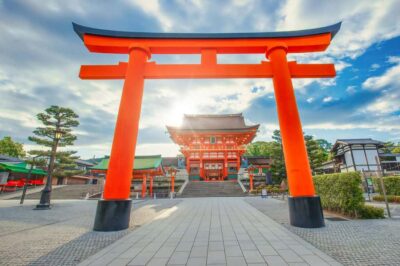
Fushimi Inari Taisha is one of Kyoto’s most recognizable sights. Its rows of orange torii gates climb Mount Inari, creating the famous tunnel effect that fills guidebooks and social media feeds.
It is easy to visit, snap a few pictures, and leave with only a fraction of what the shrine represents. This tour is designed to slow you down and explain the place as a living Shinto site, not just a striking backdrop.
You will hear about Inari worship and the role of foxes as messengers of the deity. That context matters because the fox statues are not simply decorative. Once you understand their religious role, details around the shrine begin to make more sense.
I find guided visits especially useful at places where symbols carry several layers of meaning. At Fushimi Inari, the gates, statues, rituals, and mountain setting all connect. A local guide can point out those links while you walk, rather than leaving you to piece them together later.
A few more Kyoto tours and experiences worth a look

Meeting at 93 Fukakusa Inarionmaechō
The tour begins at 93 Fukakusa Inarionmaechō, in front of the Daily Yamazaki convenience store. If the store area feels crowded, you can wait beside the fox statue across the road.
That meeting point is practical because it gives you two clear visual markers: the convenience store and the fox statue. Still, allow enough time to find the spot without rushing. You do not want to begin a walking tour by sprinting through the approach to one of Kyoto’s busiest shrines.
Look for the guide and confirm that you are in the correct small group before setting off. The tour returns to the same address at the end, which keeps the route simple. You are not left trying to work out a new meeting point after a climb.
Entering Fushimi Inari Taisha with a local guide
The first part of the walk introduces Fushimi Inari Taisha and its place in Kyoto’s religious life. The guide’s role is not only to lead you from gate to gate, but to explain what you are seeing and why it matters.
The tour covers Inari worship, shrine rituals, and Shinto beliefs. These subjects can feel abstract if presented as a list of facts. They become easier to understand when connected to the statues, gates, and worship spaces directly in front of you.
You can expect the guide to tell stories about Inari and the fox messengers associated with the deity. Fox imagery is one of the shrine’s most memorable features, and the explanation adds meaning to what might otherwise seem like a repeated motif.
This is also a good setting for questions. In a group capped at 10, you are less likely to disappear into a crowd. If you want to ask about a ritual, a statue, or a detail you have noticed, the format should make that conversation manageable.
The exact balance between storytelling and walking can depend on the guide and the group. The available information identifies the tour as an English-language experience, but it does not promise a fixed script or a particular number of stops. Think of it as a guided interpretation of the shrine rather than a formal lecture.
Walking beneath the torii gates
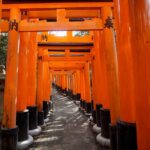
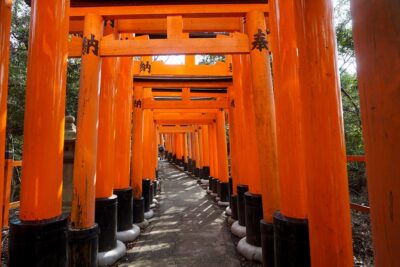
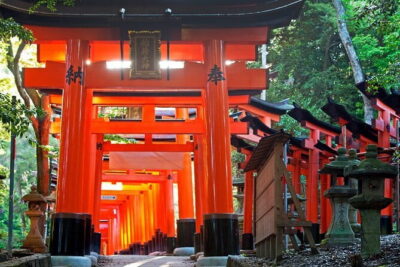
The torii gates are the visual heart of Fushimi Inari. One after another, they create shaded passages that lead uphill through the shrine grounds and toward the mountain.
Many people visit only the lower section, where the gates are easiest to reach and the photo opportunities are strongest. This tour includes exploration of quieter trails, giving you a reason to walk farther and see more of the site.
The quieter paths are valuable for two reasons. First, they can offer a calmer setting for listening and reflection. Second, they show that Fushimi Inari is larger than its famous entrance corridors. You get a better sense of the shrine as a mountain pilgrimage route.
Do not expect a leisurely flat walk. The tour involves ascending mountain trails, so the physical effort is part of the experience. Comfortable shoes are listed as essential, and that advice is worth taking seriously. Choose shoes with good support rather than relying on fashion footwear.
The tour lasts two hours, so the guide must keep a steady pace. You will have time to notice the gates and hear explanations, but this is not a full-day exploration of every path on Mount Inari. If you want to wander for hours or climb to every possible viewpoint, plan extra time before or after the tour.
Fox statues and the meaning behind them
The fox statues are among the easiest details to photograph and one of the easiest details to misunderstand. The tour explains their connection to Inari worship and their role as messengers of Inari.
That explanation gives the shrine a stronger sense of place. Instead of seeing similar statues repeated around the grounds, you begin to recognize them as part of a religious system with its own symbols and stories.
I like this kind of interpretation because it changes how you look at familiar sights. The orange gates may draw your eye first, but the foxes help explain the shrine’s spiritual character. You are not simply walking through a colorful tunnel. You are moving through a place shaped by centuries of worship and offerings.
The supplied information does not specify every fox symbol or ritual the guide will discuss, so it is best not to expect a detailed academic tour. What you do get is a practical introduction to the beliefs and customs connected with Fushimi Inari.
Other walking tours we've reviewed in Kyoto






Quiet trails and Kyoto views
The tour promises lesser-used trails and views over Kyoto. These are important additions to the standard Fushimi Inari visit because they reward you for walking uphill.
From higher points, you can look back toward Kyoto and see the city from a different angle. The view is a welcome pause after the climb, although the tour details do not guarantee a particular viewpoint or weather conditions.
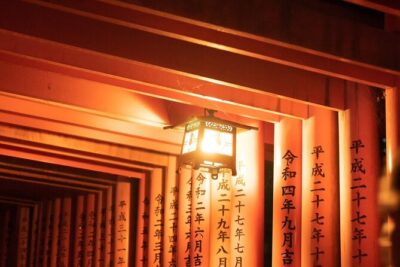
A sunset departure can add a special quality to the walk. Nayeen’s group had beautiful sunset light and relatively few visitors, which made the timing work especially well. That does not mean every departure will have the same conditions, but it shows why checking available start times is worthwhile.
You should also keep expectations sensible. Sunset is not promised, and the schedule depends on availability. A daytime tour may offer clearer visibility, while an evening tour may bring softer light. The best choice depends on your priorities and the starting times offered when you book.
The quieter trails may also be uneven or more demanding than the lower shrine paths. Pay attention to your footing, particularly if you are watching the scenery or taking pictures. The climb is part of the route, not an optional side trip.
What the two-hour format means
Two hours is a useful length for this experience. It is long enough to go beyond the entrance area, hear cultural explanations, and reach mountain paths without consuming half your day in Kyoto.
I would see it as a focused introduction. You get structure, local interpretation, and a clear beginning and end at the same meeting point. Afterward, you can continue exploring on your own if you want more time at the shrine.
The short format also has limits. A guide cannot cover every aspect of Fushimi Inari in two hours, and the pace may feel brisk if you prefer frequent stops. The tour is best for people who want a guided overview with cultural context, not for those seeking a slow private meditation or a complete mountain hike.
Since the group is limited to 10, the experience should feel more personal than a large coach-style outing. That does not make it a private tour, but it does give the guide a better chance to keep the group together and respond to questions.
Is $38 a fair price?
At $38 per person, the tour sits in a reasonable range for a short guided experience at one of Kyoto’s major sights. Fushimi Inari itself is the main attraction, but you are paying for more than access. The value comes from the guide’s explanations, the planned route, and the chance to find quieter trails without having to work out the shrine’s layout alone.
I would consider the price worthwhile if you care about cultural background and prefer a clear route. It is also a sensible choice for a first visit, when the torii gates and mountain paths can feel confusing.
The value is weaker if you only want quick photos at the lower gates. You can visit the shrine without a guide, and anyone who is happy to read independently may prefer to save the money.
The small group helps support the price. With a maximum of 10 people, you are buying a more attentive format than a large group walk. The English-speaking guide is another practical benefit for anyone who wants to ask about Shinto traditions without relying on signs or phone research.
Free cancellation up to 24 hours before the tour and the option to reserve now and pay later also reduce the risk of booking ahead. Those policies are useful when your Kyoto schedule is still changing.
Who should book this Fushimi Inari walk?
I would recommend this tour to you if you want more than a famous backdrop. It suits first-time visitors who want the shrine explained, culture-minded visitors who are curious about Shinto beliefs, and anyone who likes walking with a local guide rather than following a printed route.
It is also a good fit if you want to see parts of Fushimi Inari beyond the busiest lower section. The promise of quieter trails and Kyoto views gives the walk more substance than a short entrance-area visit.
You should think twice if you have limited mobility or strongly dislike uphill walking. The route ascends mountain trails and is not suitable for wheelchair users, visually impaired people, or baby strollers.
Families with young children should consider the terrain and the two-hour duration carefully. The tour data does not provide a minimum age or child-specific program, so you will need to judge whether your child can manage the climb and stay with a small walking group.
Practical preparation for the climb
Wear comfortable shoes with solid support. This is the single most useful preparation because the route includes ascending trails rather than only paved, level paths.
Keep your schedule flexible around the two-hour walk. The tour starts and ends at 93 Fukakusa Inarionmaechō, but the uphill route may leave you ready for a pause afterward.
Arrive at the Daily Yamazaki convenience store meeting point with enough time to identify the group. If the area is crowded, use the fox statue across the road as the alternate waiting spot.
Starting times vary, so check availability before booking. If you hope for sunset light and fewer people, choose an available evening start, but remember that the conditions described for one tour are not guaranteed for every date.
Should you book this tour?
Book it if you want Fushimi Inari to make sense, not simply to look good in your photos. The combination of fox symbolism, Inari worship, Shinto customs, quiet mountain trails, and Kyoto views gives the two-hour walk a clear purpose.
The strongest reasons to choose it are the small group, the English-language guidance, and the route beyond the most obvious gates. The main reason to skip it is physical: the mountain ascent may not suit everyone.
For $38, I see this as a good-value introduction to one of Kyoto’s most famous shrines, especially for a first visit. Choose comfortable shoes, consider a sunset start if available, and book only if you are ready for a real uphill walk.
FAQ
Where does the Fushimi Inari walking tour meet?
The meeting point is in front of the Daily Yamazaki convenience store at 93 Fukakusa Inarionmaechō. If the convenience store area is too crowded, you can wait beside the fox statue across the road.
How long does the tour last?
The guided walk lasts two hours and returns to 93 Fukakusa Inarionmaechō.
Is the tour conducted in English?
Yes. The tour includes a live English-speaking guide.
How large is the group?
The tour is limited to 10 participants, making it a small-group experience.
Does the tour involve uphill walking?
Yes. The route includes ascending mountain trails, so comfortable walking shoes are recommended.
Is the tour suitable for wheelchair users or baby strollers?
No. The tour is not suitable for wheelchair users, visually impaired people, or baby strollers.
More Walking Tours in Kyoto
More Fushimi Inari Tours in Kyoto

More tours in Kyoto we've reviewed











Fushimi Inari Tours, compared.
 ★ 4.8Kyoto: Fushimi Inari, Kinkakuji, Bamboo Grove 1 Day Bus TourFrom $122510 minutes - 9 hours
 ★ 5.0Fushimi Inari Hidden Hiking Tour (Private Option Available)From $63
 ★ 4.7Kyoto/Osaka: Nara, Fushimi Inari Taisha, Arashiyama Bus TourFrom $529 - 10 hours
 ★ 4.4Osaka/Kyoto: Arashiyama, Nara & Fushimi Inari Shrine w/LunchFrom $61
 ★ 5.0Kyoto: Nijo, Kinkaku-ji, Arashiyama, Kiyomizu & Fushimi InariFrom $51
 ★ 5.0Kyoto Fushimi-Inari Night Walking TourFrom $43