
Reviewed · GION & GEISHA WALKS
Kyoto: Gion Geisha District & Sake-in-Hand Walking Tour
Kyoto’s Gion is most atmospheric after dark, when lanterns glow on wooden machiya houses and the narrow lanes grow quieter. This small-group walk takes you from the Kamo River through Gion and Higashiyama, with stories about geisha culture, samurai life, Zen, shrines, and local customs along the way. A sake tasting gives the evening a friendly local touch.
I like the maximum group size of 10, which makes it easier to ask questions and keep up in tight lanes. I also like the route itself: you get Gion’s famous streets, Yasaka Pagoda, Ninenzaka, Sannenzaka, and Yasaka Shrine in one compact evening.
The main drawback is that this is a walking tour with only about an hour to an hour and a half available. The route covers a lot, so some stops receive only a few minutes. Guide quality also matters. Most comments praise guides such as Shumpei, Shunpei, and Mune, but one disappointed participant found the commentary too limited.
In This Review
- Key points to know before booking
- Why Gion works best after sunset
- Gion and Hanamikoji Street
- Yasui-Konpiragu and the meaning behind the shrine
- Hokan-ji Temple and Yasaka Pagoda
- Ninenzaka and Sannenzaka, Kyoto’s stone-paved lanes
- Nene-no-Michi and the slower side of Higashiyama
- Yasaka Shrine, the natural finish
- What the sake tasting adds
- Guide style can shape the whole evening
- Price, pace, and overall value at $27.84
- Who should book this Gion night walk
- Should you book it?
- FAQ
- How much does the Kyoto Gion sake walking tour cost?
- How long does the tour last?
- What age must participants be?
- Is sake included in the tour price?
- How many people can join the group?
- Where does the tour begin?
- Where does the tour end?
- Which places are visited?
- Is the tour suitable for people who do not walk much?
- Can I cancel for a full refund?
Key points to know before booking

- Lantern-lit Gion after dark: See Hanamikoji Street and the old lanes when the wooden facades take on a softer, quieter mood.
- Sake tasting included: Try local sake during the walk, with some guides offering selections from different regions of Japan.
- A route beyond Gion: The walk continues toward Yasaka Pagoda, Ninenzaka, Sannenzaka, Nene-no-Michi, and Yasaka Shrine.
- Small group format: The tour accepts no more than 10 people, although the group can be much smaller.
- Cultural context: Expect explanations about geisha culture, samurai, Zen meditation, shrines, and where you might spot a geisha.
- A good value at $27.84: The price is modest for a guided evening walk with a sake tasting, though it is not a full-length cultural lecture or food tour.
Why Gion works best after sunset
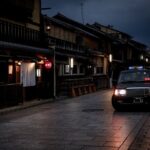
Gion can feel crowded during the day, especially around the best-known streets. At night, the district changes character. Lanterns cast warm light across wooden buildings, and the stone lanes of Higashiyama can feel far more atmospheric.
This tour begins near the Kamo River, a useful place to meet because it is central and close to public transportation. The river itself is one of Kyoto’s familiar city views, with paths and scenic banks running through the heart of town. The walk then moves into Gion, where your guide helps you find the smaller lanes without wasting time on wrong turns.
That guidance matters. Gion’s streets are easy to explore casually, but it is also easy to miss the quieter passages or misunderstand what you are seeing. A guide can explain the difference between a traditional teahouse, a private residence, and a place connected with geisha entertainment.
You may also hear the terms geiko and maiko. The tour is designed to improve your understanding of this culture and may point out places where you might spot one. A sighting is never guaranteed, and you should not treat people working in the district as photo props. Keep your voice low, stay out of doorways, and follow any local requests about photography.
A few more Kyoto tours and experiences worth a look

Gion and Hanamikoji Street
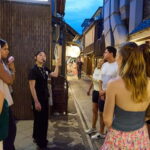
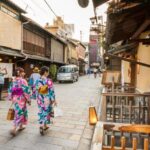
The first major part of the route enters Gion, Kyoto’s best-known geisha district. Traditional machiya houses line the streets, many with dark wood, narrow fronts, and restrained signs. Behind these facades are restaurants, teahouses, shops, and homes, so the area is not a theme park. It is a real neighborhood with a long connection to Kyoto’s performing arts.
The listed timing gives about 10 minutes in Gion and another 10 minutes on Hanamikoji Street. That is enough for an introduction and a few good views, but not enough to explore every side street. I would treat this section as orientation rather than a complete tour of the district.
Hanamikoji is the polished, famous stretch. It is photogenic, but the best part of the walk may be the smaller roads branching away from it. Guides such as Shumpei and Mune have been praised for explaining the area in a friendly way, while Shumpei in particular is noted for answering questions about daily life in Japan.
That personal exchange can make the difference. If you are curious, ask about the role of a geiko, the training of a maiko, or how visitors should behave around teahouses. The experience is strongest when you treat it as a conversation rather than a silent procession from one photo stop to the next.
Yasui-Konpiragu and the meaning behind the shrine
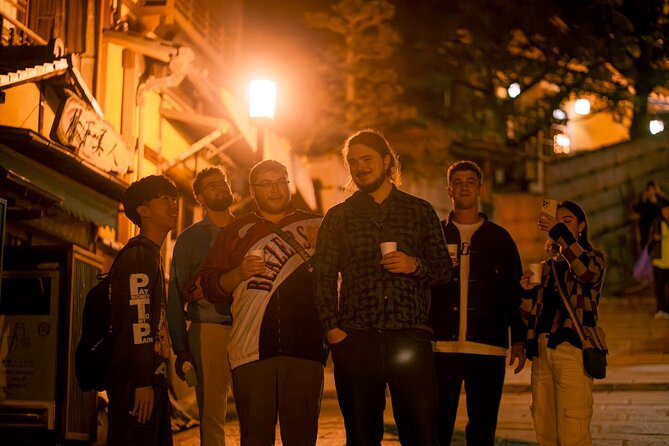
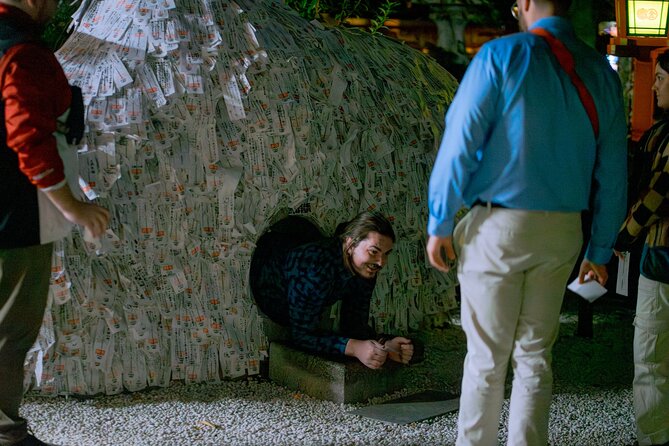
The route next reaches Yasui-Konpiragu, with about 15 minutes set aside. This small Shinto shrine is known for its association with ending harmful relationships and encouraging better ones. Its large enmusubi and enki-related stone is one of the site’s distinctive features.
This stop adds more than another pretty building. It gives your guide a chance to explain how Japanese religious sites often connect ritual with ordinary concerns such as love, luck, family, and personal change. The ideas may be unfamiliar if you have only visited Kyoto’s major temples.
The short visit means you should not expect a long religious lecture. Instead, you get a quick explanation, time to look around, and a sense of how local belief works in practice. As with every shrine, be respectful of people who are there to pray. The sake portion is an addition to the walk, not a substitute for proper shrine behavior.
Hokan-ji Temple and Yasaka Pagoda
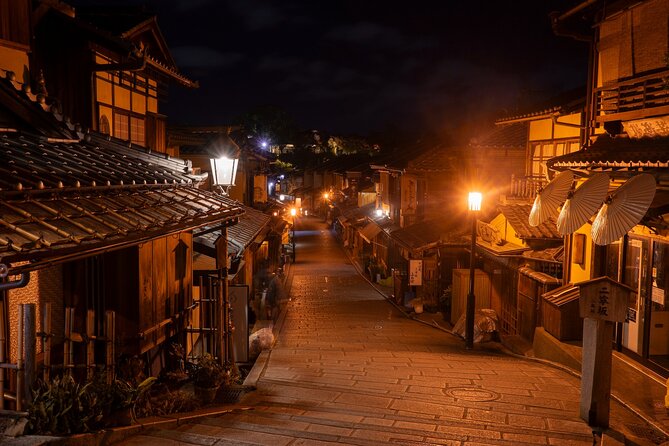
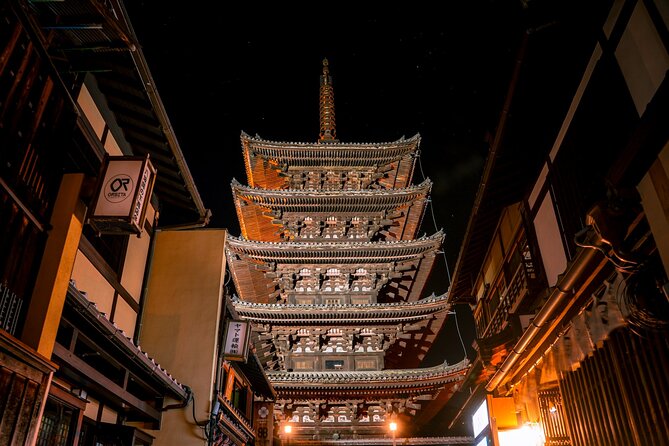
Hokan-ji Temple is better known as Yasaka Pagoda, one of Higashiyama’s most recognizable sights. The five-story pagoda dates back to the sixth century and gives this part of Kyoto a strong vertical landmark.
The planned stop lasts about 15 minutes. At night, the pagoda and surrounding streets make excellent photo subjects, especially when the area is softly lit. Several positive comments focus on the beauty of Kyoto’s shrines and temples after dark, and this is one of the places where that appeal is clearest.
Keep your expectations in check. The tour does not promise an extended temple visit or interior access. You are mainly seeing the exterior and hearing about its place in the district. That is still worthwhile, particularly if you want a well-paced introduction before returning on your own during daylight.
The route also involves uneven stone surfaces and slopes. Comfortable shoes are essential. The physical demand is moderate, but this is not a ride between sights. You will be walking almost continuously, sometimes through narrow or gently rising streets.
Ninenzaka and Sannenzaka, Kyoto’s stone-paved lanes
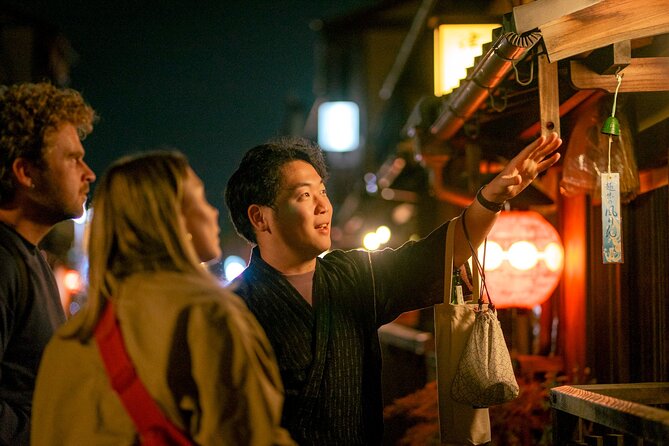
Ninenzaka and Sannenzaka are two of Higashiyama’s best-known pedestrian streets. Their traditional wooden buildings, stone paving, and gentle slopes create the classic Kyoto scene many people hope to find.
The schedule allows only about five minutes at each. That may sound brief, but it reflects the nature of these stops. You are passing through the streets rather than touring individual shops or spending time inside a temple.
These lanes can be busy, so your guide’s route planning helps keep the group together. The streets are also uneven and can be slippery in rain. One particularly favorable account describes a rainy evening when the wet stones and lantern light made the district feel even more atmospheric. Rain can add beauty, but bring suitable clothing and accept that weather may affect the outing.
This is also a good place to take photos, but be considerate. Stop at the side rather than in the middle of the lane, and avoid photographing residents or workers without permission.
Other sake brewery and tasting tours in Kyoto




Nene-no-Michi and the slower side of Higashiyama

Nene-no-Michi receives about 10 minutes and offers a calmer change of pace. The stone path is associated with Nene, the wife of Toyotomi Hideyoshi, and links the area around Kodaiji Temple with Maruyama Park.
Compared with Hanamikoji and the two famous slopes, this path can feel less rushed. It is a pleasant stretch for listening to your guide while looking at traditional walls, lanes, and temple-area scenery.
The walk is not designed as a detailed tour of Kodaiji Temple, and the supplied route does not include temple admission. Think of Nene-no-Michi as a scenic connector with historical context. It helps tie Gion to the larger Higashiyama district instead of ending the experience after only the geisha quarter.
Yasaka Shrine, the natural finish

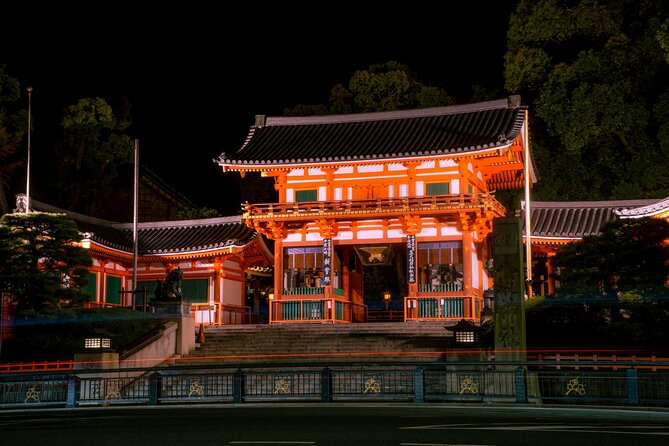
The tour ends at Yasaka Shrine, also called Gion Shrine. The shrine dates to 656 AD and has a major connection with the Gion area. Its location makes practical sense: you finish near one of Kyoto’s best-known religious sites, rather than being left in an obscure side street.
The scheduled visit lasts about 20 minutes, the longest stop on the route. That gives you time to see the main approach, take in the shrine grounds, and ask final questions.
Ending here is useful if you want to continue exploring Higashiyama independently. It also gives the evening a clear finish after the sake tasting and long walk. If you need to return to your hotel, the operator can help arrange a taxi. Most buses may have stopped running by the time the tour ends, so do not assume public transport will still be convenient.
What the sake tasting adds
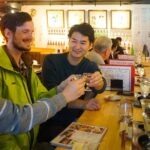
The sake is a small but important part of the experience. At this price, a tasting included in the walking tour makes the outing feel more social and gives you a simple way to try a Japanese drink you might not order confidently on your own.
Some accounts describe sampling sake from different regions of Japan, while others mention snacks as well. The exact selection may vary, so you should not book this expecting a full meal or a formal sake seminar. It is best understood as a casual tasting during an evening walk.
The phrase sake in hand should not be read as permission to drink carelessly in the streets. Participants must be at least 20 years old, and the operator asks you to drink responsibly. Alcohol is not the main attraction. Gion, its stories, and the night scenery are.
Guide style can shape the whole evening
The guide is the most variable part of a tour like this. The route itself is attractive, but your experience depends on how much context and conversation you receive.
Guides named in the feedback include Shumpei, Shunpei, and Mune. Their strengths are described in similar terms: friendly conversation, useful explanations, local knowledge, and a willingness to answer questions about Japan as well as the sights.
I would arrive ready to participate. Ask questions, mention what interests you, and tell the guide if you want more cultural detail. One negative account describes a lot of walking with little interaction and less time than expected. That criticism is worth taking seriously, especially if you want a lively, talk-heavy tour.
The advertised duration is approximately 60 to 90 minutes. A walk that ends after about 70 minutes is still within that range, but the shorter timing may disappoint you if you expect a full hour and a half. The experience is a better fit if you value atmosphere and an easy introduction over a tightly scripted lecture.
Price, pace, and overall value at $27.84
At $27.84 per person, this is an affordable Kyoto activity. The cost covers a guide, a small-group format, a route through several important districts, and a sake tasting. You are paying for orientation, local explanation, and an evening with a clear plan.
The value is strongest on a first visit to Kyoto, when Gion’s lanes can seem confusing and you want someone to explain what you are seeing. It is also useful if you have only one evening in the area and want to combine scenery with cultural background.
The value is weaker if you want deep historical detail at every stop, a substantial amount of sake, or plenty of free time for shopping and photography. You could walk much of this area without paying, but you would lose the guide’s explanation and the tasting.
The group limit of 10 helps justify the cost. A smaller party can move through narrow lanes more easily and gives you a better chance to speak with the guide. Some departures may be very small, even just a guide and two participants, though that is not guaranteed.
Who should book this Gion night walk
I would recommend it to first-time visitors who want a gentle introduction to Kyoto after dark. It also suits solo visitors and couples who prefer a planned route, and anyone interested in geisha culture but unsure how to explore Gion respectfully.
You should be comfortable walking for the full outing. Wear shoes with good grip and clothing suited to the weather. The route includes stone paving, slopes, and residential areas where low voices are expected.
I would not choose it as your main Kyoto activity if you dislike group tours, do not drink alcohol, or want extensive access inside temples and traditional houses. You can still enjoy the scenery without drinking, but the sake tasting is one of the tour’s stated features.
Book at least 24 hours ahead if your plans may change. You can cancel for a full refund up to that point, while cancellations or changes made within 24 hours are not refunded. The outing also depends on good weather and a minimum number of participants. If poor weather or low enrollment cancels it, you are offered another date, another experience, or a full refund.
Should you book it?
Book this tour if you want a low-cost evening introduction to Gion, especially with a small group and a tasting included. The lantern-lit lanes, Yasaka Pagoda, stone streets, and Yasaka Shrine give you a lot of visual appeal in a short time.
Skip it if you need a long, scholarly explanation or dislike walking with alcohol in hand. The route moves quickly, and guide interaction can vary. For most visitors who want an easy, atmospheric first look at Gion, the $27.84 price is fair, provided you arrive with realistic expectations.
FAQ
How much does the Kyoto Gion sake walking tour cost?
The tour costs $27.84 per person. Group discounts may be available.
How long does the tour last?
The approximate duration is 1 hour to 1 hour 30 minutes.
What age must participants be?
All participants must be at least 20 years old because the experience includes alcohol.
Is sake included in the tour price?
Yes. A local sake tasting is included. Some tour descriptions from the experience also refer to snacks.
How many people can join the group?
The tour has a maximum of 10 participants.
Where does the tour begin?
The meeting point is Kikunoi Roan at 118 Saitocho, Shijo-sagaru, Shimogyo Ward, Kyoto.
Where does the tour end?
The walk ends at Yasaka Shrine, at 625 Gionmachi Kitagawa, Higashiyama Ward, Kyoto.
Which places are visited?
The route includes the Kamo River area, Gion, Hanamikoji Street, Yasui-Konpiragu, Hokan-ji Temple and Yasaka Pagoda, Ninenzaka, Sannenzaka, Nene-no-Michi, and Yasaka Shrine.
Is the tour suitable for people who do not walk much?
The tour requires a moderate level of physical fitness and includes a lot of walking. Comfortable clothing and shoes are recommended.
Can I cancel for a full refund?
Yes, if you cancel at least 24 hours before the start time. Cancellations and changes made less than 24 hours before the start are not refunded. If poor weather or insufficient enrollment cancels the tour, you are offered another date, another experience, or a full refund.
More Sake Brewery Tours in Kyoto
More Sake Brewery Tours in Kyoto
More Gion & Geisha Walks in Kyoto
More tours in Kyoto we've reviewed




Gion & Geisha Walks, compared.
 ★ 4.7Kyoto Geisha Walking Tour: Gion District & Hidden GemsFrom $252 hours
 ★ 4.7Kyoto: Gion Geisha District Walking Tour – Stories of GeishaFrom $202 hours
 ★ 4.9Best of Kyoto: Gion, Geisha, Pagodas & CobblestonesFrom $242 hours
 ★ 4.5Night Walk in Gion: Kyoto’s Geisha DistrictFrom $211h 40m
 ★ 5.0Kyoto Night Foodie Tour in Gion (9+ dishes + 6 Sake tastings)From $163
 ★ 5.0Kyoto Gion Geisha District Walking Tour – The Stories of GeishaFrom $25