
Reviewed · TOURS
Explore Hidden Alleyway with a Local Expert (Afternoon Tour)
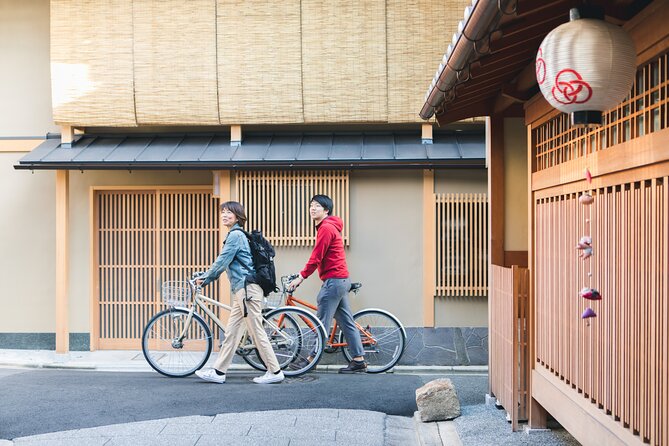
Kyoto’s best moments often happen away from its famous temple gates. This three-hour afternoon bike tour takes you through narrow lanes, old wooden homes, quiet waterways, and ordinary residential corners that are easy to miss from a bus or taxi. You also reach familiar sights, including Gion and the Kyoto Imperial Palace, but the bicycle connects them in a more personal way.
I like the small private-group format, limited to two to six people per guide, and I like the attention given to traffic safety and group riding. The tour also has a practical rainy-day plan: you can continue by bicycle with a free poncho or switch to walking and public transportation. The main drawback is that you need to be a confident road cyclist, and the 2 p.m. start may feel warm in Kyoto’s summer months.
In This Review
- Key points to know before you book
- Why a bicycle reveals a different Kyoto
- Miyagawacho Kaburenjo and Kyoto’s geisha districts
- Gion, where famous Kyoto meets lived-in streets
- Tatsumi Bridge and the quieter side of Gion
- Kyoto Imperial Palace and a longer stretch of riding
- Kashiwayacho and time beside the Kamo River
- What the guide adds to the ride
- Is $102.47 a fair price?
- Weather, fitness, and family considerations
- Timing, booking, and cancellation details
- Who will get the most from this Kyoto ride?
- Should you book it?
- FAQ
- Where does the Kyoto bike tour begin?
- What time does the tour start?
- How long does the experience last?
- Where does the tour finish?
- How many people can join each guide?
- Can one person book the tour?
- What places does the route visit?
- Can children join the tour?
- Does the tour operate in rain?
- Is the tour private?
Key points to know before you book
- Quiet Kyoto comes first: The route uses narrow backstreets and traditional wooden-house lanes, not only the headline sights.
- Five distinct stops: You visit Miyagawacho Kaburenjo, Gion, Tatsumi Bridge, Kyoto Imperial Palace, and Kashiwayacho along the Kamo River.
- Small groups matter: Two to six people ride with each guide, keeping the pace easier to manage than a large cycling convoy.
- Guides are trained beyond sightseeing: Their preparation includes traffic safety, group cycling, and local etiquette.
- Rain does not automatically cancel the ride: You can use a free rain poncho or change to a walking tour using public transportation.
- Children face clear limits: Riders must be at least 10 years old, at least 145 centimeters tall, and able to cycle safely on roads without help.
Why a bicycle reveals a different Kyoto
Kyoto is easy to admire from a distance. You see temple roofs, stone lanes, gardens, and lanterns. Yet the city’s everyday character is often found between those postcard views, where a quiet alley suddenly opens onto a main street and the mood changes in seconds.
A bicycle lets you make those shifts at street level. You notice the changing light between buildings, the scent of food or wood, and the different pace of a residential lane compared with a main road. I like that this route does not treat Kyoto as a string of isolated sights. It shows how the old districts and daily city life fit together.
The tour lasts about three hours and begins at 2 p.m. It starts and ends at 552-13 Higashiaburanokōjichō in Shimogyo Ward. Since the experience returns to its starting point, you do not need to arrange a separate ride from the final stop.
The group size is one of the tour’s strongest features. Each guide takes two to six people, and a group of seven to 12 can be handled with an additional guide. A solo booking is not accepted, so this is best for couples, families, or friends traveling together.
If you're still narrowing it down, here are other tours in Kyoto we've reviewed.
Miyagawacho Kaburenjo and Kyoto’s geisha districts
The first stop is Miyagawacho Kaburenjo, in Miyagawacho, one of Kyoto’s five traditional geisha districts. It is the second largest of those districts, and its character comes from the rows of traditional wooden houses lining the alley.
The stop lasts about 15 minutes, with no admission fee. That is enough time to pause, look closely at the architecture, and get a sense of the calm atmosphere. The point is not to rush inside a major attraction. It is to understand how a historic entertainment district can still function as part of the city.
You should treat this area with care. A geisha district is not a stage set, and the respectful way to see it is quietly, without blocking lanes or treating residents and workers as photo subjects. The guide’s training in local etiquette is useful here, since a good explanation can help you notice details without crossing local boundaries.
For some people, 15 minutes may feel brief. That is a fair limitation. This tour gives you a taste of the district rather than a long cultural program, and admission to a performance is not part of the stated experience.
Gion, where famous Kyoto meets lived-in streets
The route continues into Gion, perhaps Kyoto’s best-known geisha district. Its refined old-town mood is one reason so many people want to see it, but the area can feel very different depending on the street and the time of day.
On a bike, you can approach Gion through quieter lanes instead of arriving only on a main road. The 15-minute stop gives you a short look at the district’s traditional setting and its links to maiko and geiko culture.
I see this as a useful orientation stop rather than the tour’s main event. If you want a long walk through every lane of Gion, three hours on a bicycle will not provide that. If you want to place Gion within a wider route and then keep moving, the timing works well.
The guide can also help separate what is genuinely old from what is simply designed to look old. That context is valuable in Kyoto, where historic streets and modern city life often sit close together.
Tatsumi Bridge and the quieter side of Gion
Tatsumi Bridge brings a change of pace. The route follows a narrow, winding stream, with willows moving in the breeze and a more restful feeling than you may expect so close to Gion.
This is another 15-minute stop, but it offers a different kind of reward from the geisha districts. Instead of focusing on buildings and social history, you get a small pocket of water, greenery, and changing light. It is the sort of place where pausing for a few minutes makes more sense than checking it off quickly.
The bridge and stream also show why cycling works so well here. You can move between the lanes and the water without spending much time finding parking or waiting for a vehicle. At the same time, narrow paths require attention. You should be ready to slow down and follow the guide’s directions, especially where pedestrians and bicycles share limited space.
Kyoto Imperial Palace and a longer stretch of riding
The tour then heads to Kyoto Imperial Palace, once the residence of Japan’s Imperial Family. The palace grounds are now open to the public as a national garden, with seasonal flowers and broad gravel paths.
The stop lasts about 20 minutes, slightly longer than the earlier visits. The group cycles along the gravel paths rather than treating the palace as a full palace tour. That distinction matters. You are seeing the grounds as part of a bike route, not entering a program focused on palace rooms, formal interiors, or extensive garden interpretation.
The palace area gives the afternoon a wider, more open setting after the tight lanes of Miyagawacho and Gion. It is also a good place to understand Kyoto’s scale. The city can feel enclosed in its old districts, then suddenly open into broad garden space.
Gravel changes the ride. You should not expect the same easy roll as on smooth pavement, and the guide’s group-riding training becomes relevant here. The route is designed for sightseeing, not speed, so the emphasis is on staying together and moving safely.

Kashiwayacho and time beside the Kamo River
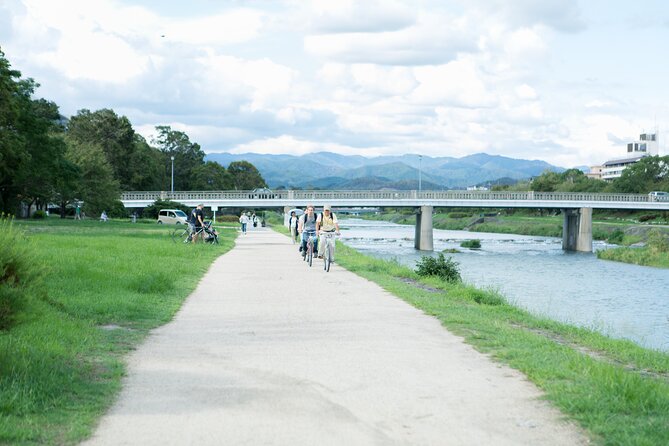
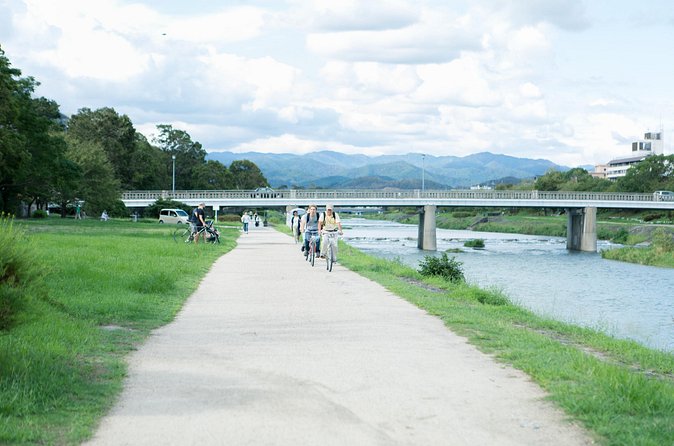
The final listed stop is Kashiwayacho, where you can relax beside a section of the Kamo River favored by local residents. This stop lasts about 20 minutes and is included in the tour price.
The river gives you a chance to slow down before riding back to the starting point. After the close lanes of the geisha districts and the formal space of the Imperial Palace, the river offers an everyday view of Kyoto. It is less about a single monument and more about how people use the city’s open spaces.
I like this ending because it leaves room for a pause. A short break beside the water can be more useful than adding one more hurried sight. The route then returns to the original meeting point, keeping the logistics simple.
The itinerary lists five stops, but the ride between them is part of the experience. Those connecting streets are not empty time. They are where you see the contrast between quiet residential lanes and the more familiar city streets.
What the guide adds to the ride
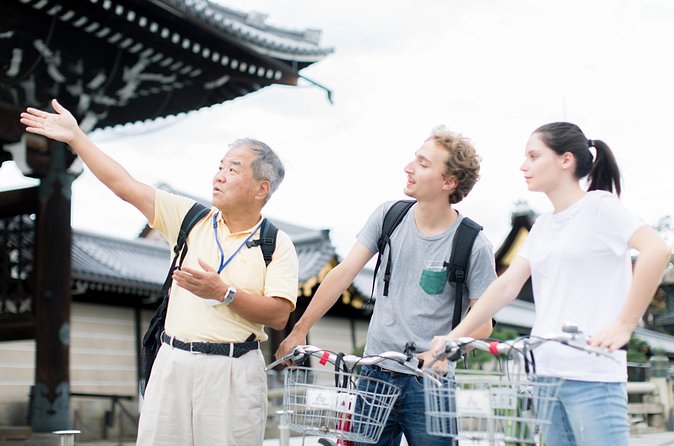
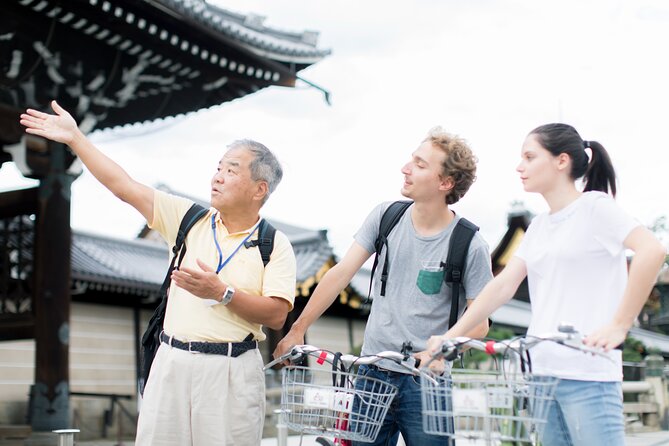
The guides are trained through an original professional program. Their preparation covers Kyoto culture, traffic safety, group cycling methods, and local manners. That combination is important because a cycling guide has two jobs: explaining the city and keeping a moving group safe.
A good guide can also adjust the feel of the afternoon. The available information identifies Yuichi as one guide who received especially warm praise for being personable, informative, and funny. You cannot assume he will lead every departure, but his presence gives you a sense of the standard this operator aims for.
The group limit of six per guide makes it easier to ask questions and keep a natural pace. It also helps on narrow roads, where a large line of bicycles would be awkward. Families benefit from that format, as do first-time visitors who want a guide nearby without joining a crowded bus tour.
The tour is private, meaning only your group participates. That gives you more control than a large shared excursion, though the route and timing still need to work for the whole party.
Is $102.47 a fair price?
At $102.47 per person, this is not a bargain bicycle rental. You are paying for a guided route, a trained cycling leader, local cultural explanation, traffic management, and a private small-group setting.
The value is strongest if you have only a short time in Kyoto or want help making sense of several districts in one afternoon. One tour links Miyagawacho, Gion, Tatsumi Bridge, the Imperial Palace, and the Kamo River without requiring you to plan the route yourself.
It also saves you from spending part of your day learning how to navigate Kyoto’s backstreets. That matters if you are visiting for the first time, especially when you want a balance of famous sights and ordinary city scenes.
The price is less attractive if you already know Kyoto well, prefer to stop for long periods, or mainly want independent cycling. You also need at least two participants, so the per-person cost is easier to justify for a couple, family, or small group than for a solo visitor who cannot book.
The listed stops do not require costly admission, so the fee is primarily for the guide and the route rather than entry tickets. That is perfectly reasonable for a private experience, but you should choose it for the quality of the riding and interpretation, not for included attractions.
Weather, fitness, and family considerations
The tour operates in rain. If wet weather arrives, you can continue by bicycle with a free rain poncho or switch to a walking tour using buses or the metro, with public transportation included in the tour fee.
That flexibility is a real advantage in Kyoto, where a rainy afternoon can arrive without much warning. The walking option also means you are not forced to cycle in conditions that make you uncomfortable. Still, confirm how the weather choice will be handled with your guide on the day.
You need to be able to ride a bicycle safely on the road without assistance. Children must be at least 10 years old and at least 145 centimeters tall. Those rules are clear, but they do not replace an honest look at your group’s cycling ability.
This is not the right choice for someone who cannot ride confidently in city traffic or who wants a slow walking tour with frequent indoor stops. It can work well for families with older children who meet the height and riding requirements, particularly because the private format avoids being tied to strangers’ pace.
Timing, booking, and cancellation details
The tour begins at 2 p.m. and lasts about three hours, making it a useful afternoon plan. You still have the morning for another activity, and the finish time leaves room for dinner or an evening walk.
Confirmation is sent within 48 hours of booking, subject to availability. The experience is commonly booked about 13 days ahead, so reserving roughly two weeks early is sensible if your Kyoto dates are fixed.
The cancellation information supplied is inconsistent. One section says you can request a refund at least three days before the tour date by 6 p.m. Japan time, while the stated cancellation policy says the experience is non-refundable and cannot be changed for any reason. Because those terms conflict, ask KCTP to confirm the exact rule before paying.
Rescheduling also requires notice by 6 p.m. Japan time at least three days before the date. After that deadline, a change requires cancellation and a new reservation. If the minimum number of participants is not met and the operator cancels, you are offered another date or experience, or a full refund.
Who will get the most from this Kyoto ride?
I would choose this tour if you want to see Kyoto at street level but do not want to build your own cycling route. It suits first-time visitors who want Gion and the Imperial Palace, yet also want quieter lanes and a look at ordinary neighborhoods.
It is especially useful for families with suitable older children, couples, and small groups who value a private guide. The route gives you several different moods in one afternoon: traditional wooden houses, geisha districts, a stream with willows, a formal garden, and the Kamo River.
You may want something else if your main goal is a long visit inside the Imperial Palace, an extended geisha performance, or a temple-focused itinerary. Those are not the focus here. This is a moving city tour, with short stops and a strong emphasis on connecting places by bicycle.
Should you book it?
Book this experience if you want a compact, private introduction to Kyoto’s quieter side, and you are comfortable riding on city roads. The best reasons to choose it are the small group, the trained guides, the mix of famous districts and less obvious lanes, and the sensible rain backup.
Think twice if you dislike bicycles, need a fully flexible cancellation policy, or prefer spending an hour or more at each sight. Before booking, confirm the cancellation terms because the supplied policies do not agree. For the right group, this is a practical way to see several faces of Kyoto without spending the whole afternoon in traffic.
FAQ
Where does the Kyoto bike tour begin?
The tour begins at 552-13 Higashiaburanokōjichō, Shimogyo Ward, Kyoto, 600-8235, Japan.
What time does the tour start?
The tour starts at 2 p.m.
How long does the experience last?
It lasts approximately three hours.
Where does the tour finish?
The activity ends back at the original meeting point.
How many people can join each guide?
Each guide accepts a minimum of two and a maximum of six people. Groups of seven to 12 can be arranged with an additional guide.
Can one person book the tour?
No. A single-person booking is not accepted.
What places does the route visit?
The route includes Miyagawacho Kaburenjo, Gion, Tatsumi Bridge, Kyoto Imperial Palace, and Kashiwayacho beside the Kamo River.
Can children join the tour?
Children must be at least 10 years old, at least 145 centimeters tall, and able to ride a bicycle safely on the road without assistance.
Does the tour operate in rain?
Yes. You can continue by bicycle with a free rain poncho or switch to a walking tour using public transportation. Bus or metro costs are included in the tour fee.
Is the tour private?
Yes. Only your group participates in the activity.
More tours in Kyoto we've reviewed

Tours, compared.
 ★ 5.0PERFECT KYOTO 1-Day Bus TourFrom $129
 ★ 4.8Kyoto: Fushimi Inari, Kinkakuji, Bamboo Grove 1 Day Bus TourFrom $122510 minutes - 9 hours
 ★ 4.7Kyoto Geisha Walking Tour: Gion District & Hidden GemsFrom $252 hours
 ★ 4.7Kyoto: Gion Geisha District Walking Tour – Stories of GeishaFrom $202 hours
 ★ 5.0Hidden Kyoto E-Biking tourFrom $116
 ★ 5.0Kyoto Night Foodie Tour in Gion (9+ dishes + 6 Sake tastings)From $163