
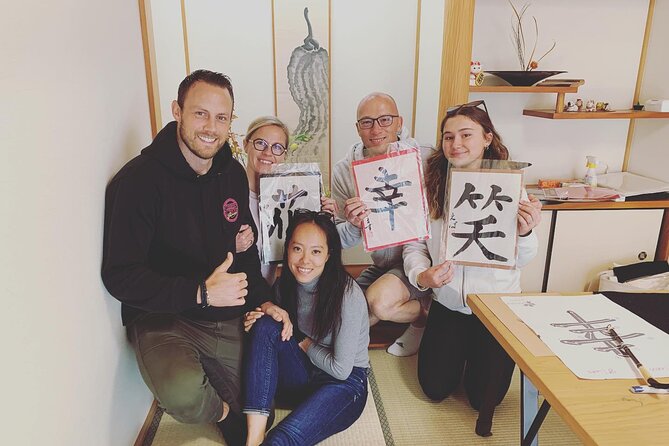
Reviewed · PRIVATE
Private Japanese Calligraphy in Kyoto – Learn Shodō with a Master
Japanese calligraphy is not treated here as a quick craft project. In Aya’s private Kyoto home, you learn how a brush is held, how ink moves across paper, and why the artist’s state of mind matters. The setting is quiet, personal, and very different from a busy group workshop.
I like two things especially: Aya’s patient, hands-on teaching and the chance to take home several pieces of your own work, not just a souvenir bought in a shop. The class also gives you a small but meaningful look at Shodō, a Japanese art practiced for centuries.
The main drawback is time. One hour passes quickly, especially if you want to write both a kanji character and your name in Japanese. The class is also not suitable for children under 12, and finding the house can take care, so arrive early.
In This Review
- Key points to know before booking
- Why this small Kyoto class feels different
- What happens during the one-hour lesson
- Learning from a teacher with decades of practice
- The value of the private format
- A genuine home setting, with a few practical limits
- Finding the house near Nijo Castle
- How to get the most from your artwork
- Who should book this class
- Booking advice and cancellation terms
- Should you book SAKURA’s private calligraphy class?
- FAQ
- Where does the calligraphy class take place?
- How long does the activity last?
- Is the class private?
- Can children take part?
- Do I need to bring calligraphy supplies?
- What should I wear or bring?
Key points to know before booking
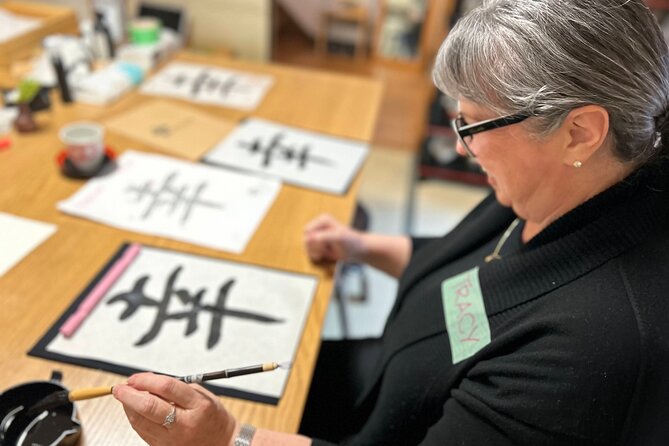
- Learn in a private Kyoto home: Only your group takes part, with the lesson held in a tatami room near Nijo Castle.
- Study with Aya: Your teacher has more than 55 years of calligraphy practice and teaches in English and Japanese.
- Practice before making your final pieces: You learn basic brush movements, copy examples, and receive direct guidance.
- Choose your own kanji: You can select a character that has personal meaning and work on writing it yourself.
- Take home your artwork: Your finished calligraphy becomes a personal Kyoto keepsake.
- Plan for a strict start time: Arriving more than 15 minutes late can mean losing the class and the payment.
Why this small Kyoto class feels different
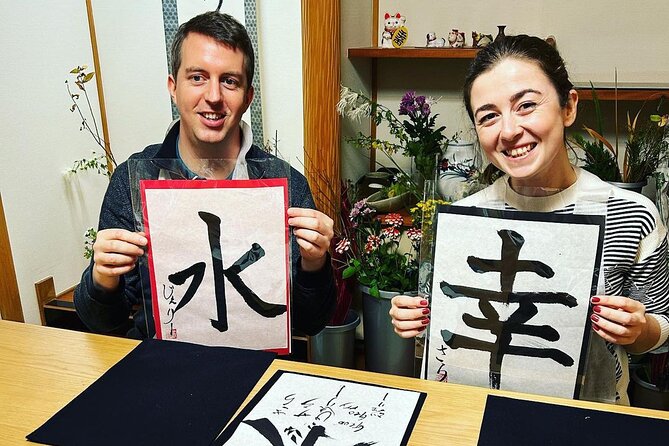
Many cultural activities in Kyoto take place in formal studios or large teaching rooms. This one takes place at SAKURA Experience Japanese Culture Nijo Home, a private residence close to Nijo Castle.
That home setting matters. You are not simply sitting at a table with a dozen other people copying a character. You have Aya’s attention, and the pace can respond to your ability. If your hand is tense, she can correct it. If a stroke goes wrong, you can try again without feeling watched by a roomful of strangers.
Aya’s husband, Manabu, may also help welcome you, take photographs, and assist with local directions. Previous sessions have included tea, traditional Japanese sweets, and friendly conversation about Kyoto, Japan, and calligraphy. These touches are not the central point of the lesson, but they make the visit feel more like being welcomed into a home than attending a standard tourist class.
The class is led in English and Japanese. Aya’s English has been described as helpful for instruction, though you should still expect an introduction to a Japanese art with its own vocabulary and traditions. If you have a specific request, such as writing a long name, explain it at the start. An hour can be too short to cover every idea in depth.
Other private tours in Kyoto


What happens during the one-hour lesson
The published itinerary has one stop: the SAKURA home near Nijo Castle. That sounds simple, but the hour usually has several parts.
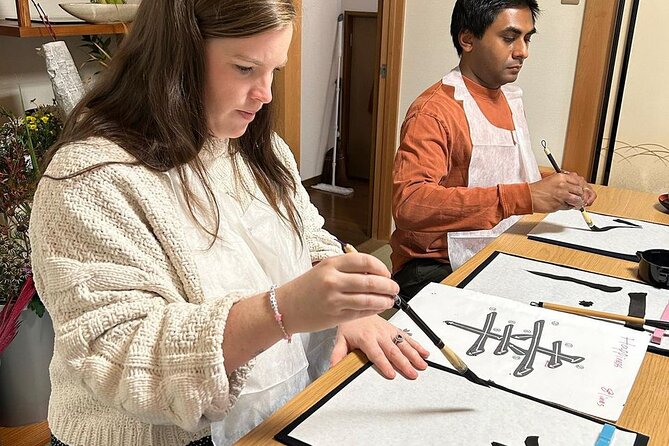
You first settle into the room and receive an introduction to Shodō. Aya explains the role of the brush, ink, paper, and basic stroke order. Calligraphy is not simply drawing attractive symbols. The order, direction, pressure, and finish of each stroke affect the character.
Next comes practice. You copy examples and work on the movements needed to create balanced kanji. Beginners should not worry about producing a perfect character right away. The point is to learn how the brush responds. You may begin with cautious, thin lines and gradually learn to press, lift, and turn the brush with more confidence.
Aya’s strength is encouragement. She guides beginners without making the class feel like an exam. You can expect correction and demonstration, but not a high-pressure performance. That makes this a good choice if you are curious about calligraphy but have never used a Japanese brush.
After practice, you choose a kanji character to write. The character might reflect a personal idea, a family connection, or something you want to remember from Japan. The selection is part of the fun, but take the meaning seriously. If you want a character connected to an English concept, ask Aya about the meaning and natural Japanese use rather than relying only on a direct translation.
You can also write your name in Japanese. This is a popular part of the lesson, but names with many letters can take a large share of the available time. One participant wanted to write a long name and found that the hour was not enough to complete everything. If your name is your priority, say so immediately and be ready to simplify the plan.
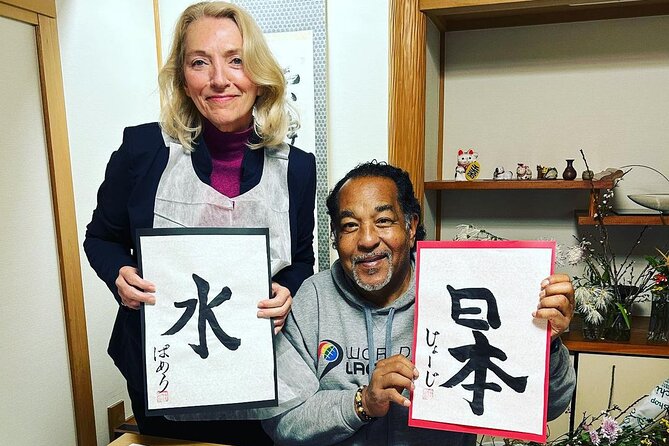
At the end, you select the pieces you want to keep. The activity includes the paper, ink, brush rental, instruction, and your finished artwork. Some people have produced several pieces, while others have focused on one character and their name. Your result will depend on your pace and how much practice you want before making a final attempt.
Learning from a teacher with decades of practice
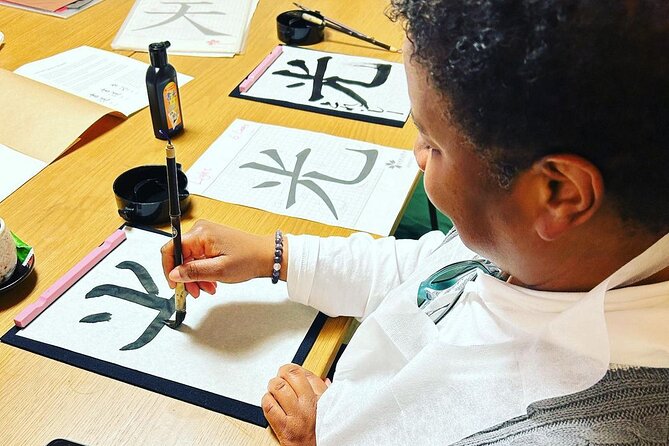
Aya brings more than 55 years of calligraphy experience to the lesson. That does not mean you will receive a lengthy academic course in Japanese art. It does mean that small corrections come from years of watching how beginners hold and move a brush.
The most useful part of learning from an experienced teacher is seeing the difference between a stiff mark and a controlled stroke. Aya can demonstrate the movement, then help you adjust your hand. She also explains the cultural background of calligraphy and the importance of concentration.
One four-star assessment found the lesson somewhat rushed and felt that the historical explanation was limited. That is a fair caution. The class is designed as a practical introduction, not a full study of Japanese calligraphy. A printed handout may contain extra historical information, so read it if you want more context.
I would book this for the hands-on practice first and the history second. You will learn enough to understand why the movements matter, but you should not expect a museum lecture or a formal examination of calligraphy styles.
The value of the private format
At $77.51 per person, this is not the cheapest one-hour activity in Kyoto. The value depends on what you want from the class.
If you only want to make a quick brush painting, a larger workshop may cost less. If you want personal instruction, time to ask questions, and a quiet setting, the private format makes the price easier to justify. The fee includes the teacher’s attention for your group, use of the tools, paper, guidance in choosing kanji, and artwork to take home.
A private class also works well for mixed ability levels. One person can be nervous and another can already have some artistic confidence, while Aya moves between you without forcing everyone into the same pace. Couples, families with older children, and small groups can share the hour without losing individual attention.
The keepsake adds practical value. You do not leave with an anonymous souvenir made for tourists. You leave with something you attempted yourself. It may not look like a master’s work, but that is the point. The uneven parts record your first encounter with the brush.
Group discounts are available, which may improve the price for a small party. The booking is still private, so you are not combined with unrelated participants.
A genuine home setting, with a few practical limits
The home setting is one of the activity’s best features, but it also requires good manners. The lesson takes place in a tatami room, and you must wear or bring clean socks. Bare feet are not permitted in the room.
This is a calm cultural visit, not a place for loud play or constant movement. Children under 12 cannot be accommodated. Older children can take part, but motivation matters. A family with children aged 13 and 15 enjoyed the class, while younger children were outside the stated age range.
The private home can also feel more personal than some visitors expect. Aya and Manabu have welcomed questions about Kyoto and shared local suggestions. They may take photographs during the lesson and share them afterward, which gives you a useful record of the activity. If you do not want photographs, ask about that when you arrive.
The class has air conditioning, according to one assessment, which is useful during Kyoto’s hot and humid months. Still, wear comfortable clothing that allows you to sit and work at a low table. Black ink can stain, so I would avoid bringing your most delicate clothes.

Finding the house near Nijo Castle
The meeting point is at 660 Izumicho, Nakagyo Ward, Kyoto, postal code 604-0015. The house is about 200 meters west of the front of Nijo Castle, putting it in a useful central location for a day of sightseeing.
The area is near public transportation, and the activity ends where it begins. Private transport is not included, so you need to make your own way there and back. That is easy enough in principle, but the location deserves attention.
Some visitors have found the house difficult to locate because Google Maps street-view imagery may not match the exact entrance. The map pin is reported to be accurate, but relying on photographs or street-view images alone can send you to the wrong spot. Use the map pin, read the directions sent after booking, and allow extra time.
This is especially important because the late-arrival policy is strict. If you arrive more than 15 minutes late, the class may not be able to start, and no refund is offered. Public transport delays and weather problems should be reported as soon as possible, but you should still build in a buffer.
I would plan to be in the Nijo Castle area at least 15 to 20 minutes before the scheduled start. That gives you time to confirm the entrance rather than rushing into the tatami room with wet shoes and no socks.
How to get the most from your artwork
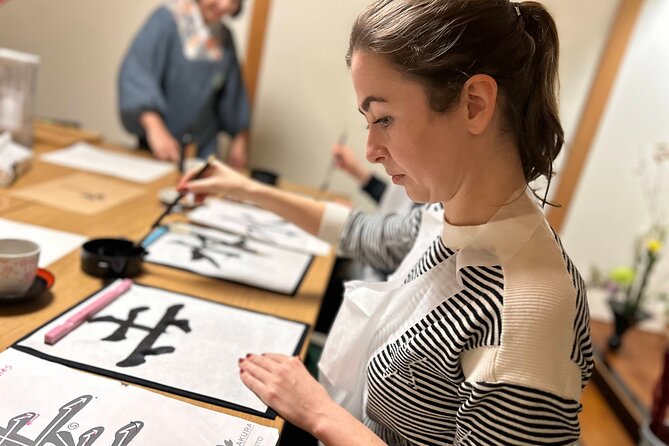
Think about your goal before the lesson. Do you want your name in Japanese, a single meaningful kanji, or several practice pieces? You can try to do all three, but the hour may feel short.
If you want a character connected to a concept such as strength, peace, family, or happiness, ask Aya about the meaning and how the character is normally used. Some English-language interpretations of Japanese words are broader than their everyday Japanese meaning.
Be prepared to practice. Your first attempts may be uneven, and that is normal. The brush has a different feel from a pen or pencil, and pressure changes the width of the line. Listen to Aya’s corrections rather than trying to force the character into a shape that looks familiar to you.
The best souvenir may not be the most polished sheet. Keep a practice piece alongside your final work. You will see how much your control changed in only an hour.
If you want to continue at home, the class can also point you toward calligraphy supplies. One family bought equipment from a recommended shop after the lesson. That is optional, but it makes sense if you find that you want to keep practicing after Kyoto.
Who should book this class
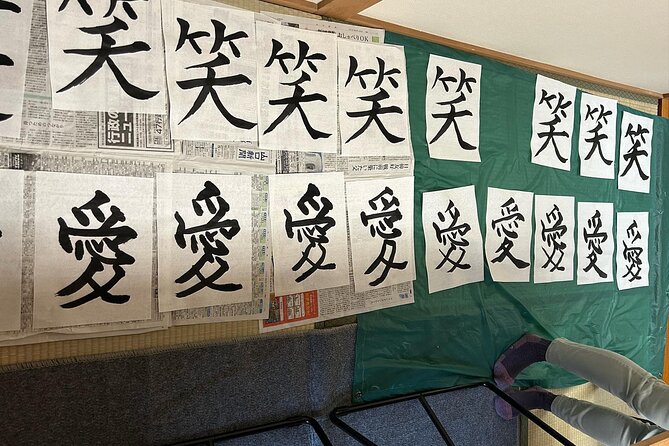
I would recommend it to adults and children aged 12 or older who want a quiet cultural activity with a personal result. It suits couples, small groups, solo participants who are comfortable joining a private session, and families with motivated teenagers.
It is particularly useful on a rainy day. You spend the hour indoors, and the activity offers more substance than simply browsing a souvenir shop. It also fits neatly around Nijo Castle because the home is close to the castle grounds.
You should book it if you like meeting local people, learning through your hands, and taking home something you made. You should think twice if you want a long historical lecture, a full artistic course, or a completely relaxed drop-in activity with flexible arrival.
The one-hour length is both a strength and a weakness. It fits a busy Kyoto schedule, but it limits how much you can cover. A beginner can learn the basics and make keepsakes, but there is not enough time for advanced technique or lengthy personal projects.
Booking advice and cancellation terms
Confirmation is provided when you book, and the activity is available in English and Japanese. The group discount may help if you are booking for several people, but the class remains private to your party.
Free cancellation is available up to 24 hours before the start time. Cancellations or changes made less than 24 hours before the activity are not refunded or accepted, and the cut-off uses Kyoto local time.
The most important booking step is checking the date, start time, age rule, and directions. Bring clean socks, arrive early, and contact the provider promptly if weather or public transportation causes a delay.
Should you book SAKURA’s private calligraphy class?
Yes, if you want a personal introduction to Japanese culture rather than a polished show. Aya’s long practice, patient instruction, and private home setting give the class a warm human touch. The artwork you take home makes the hour feel connected to your own trip.
Book with realistic expectations. This is an introductory session, not a professional calligraphy course, and the historical portion may be brief. The location can also be confusing, and arriving late can cost you the entire booking.
For most adults, couples, and motivated older children, I think the price is fair because you receive individual teaching and a handmade souvenir. Just make your priorities clear at the start. If you want your name, say so first. If you want one special kanji, leave enough time to practice it well.
FAQ
Where does the calligraphy class take place?
The class takes place at SAKURA Experience Japanese Culture Nijo Home, at 660 Izumicho in Nakagyo Ward, Kyoto. It is about 200 meters west of the front of Nijo Castle.
How long does the activity last?
The class lasts approximately one hour. The time includes the introduction, brush practice, instruction, and creation of your finished calligraphy.
Is the class private?
Yes. Only your group participates, so you receive the teacher’s attention without unrelated participants joining the session.
Can children take part?
Children under 12 cannot be accommodated. Children aged 12 and older may participate, but the class is best for children who are motivated to sit, listen, and practice.
Do I need to bring calligraphy supplies?
No. Calligraphy tools and paper are included. You receive guidance during the class and can take your finished artwork home.
What should I wear or bring?
You must wear or bring clean socks because the lesson takes place in a tatami room and bare feet are not permitted. Arrive early, since arriving more than 15 minutes late can mean the class cannot be offered without a refund.
More Private Tours in Kyoto


More tours in Kyoto we've reviewed





Private, compared.
 ★ 5.0Fushimi Inari Hidden Hiking Tour (Private Option Available)From $63
 ★ 5.0Private Kyoto Tour with a Local, Highlights & Hidden Gems, PersonalisedFrom $102
 ★ 5.0Kyoto 6hr Private Tour with Government-Licensed GuideFrom $155
 ★ 5.010 Must-see Spots in Kyoto One Day Private Tour (up to 7 people)From $179
 ★ 5.0Kyoto 4hr Private Tour with Government-Licensed GuideFrom $109
 ★ 4.8Kyoto: Private Tour with Local Licensed GuideFrom $1064 - 8 hours