
Reviewed · 1-DAY TOURS
10 Must-see Spots in Kyoto One Day Private Tour (up to 7 people)
Kyoto’s biggest sights are spread across the city, and this eight-hour private tour attacks the problem head-on. You visit Kinkaku-ji, Arashiyama, Fushimi Inari, Kiyomizu-dera, Gion, and five other stops without spending your day puzzling over train lines, bus routes, and taxi queues.
I like two things right away: the tour is private for your party of up to seven, and the guide travels with you between sights, offering local context along the way. Guides such as Tammy, Yoshi, Hiromi, Akemi, Taka, and Chihiro have been singled out for warm service, clear English, efficient routing, and helpful food suggestions.
The catch is pace. Ten sights in one day means limited time at several stops, plenty of walking, and extra costs for admissions and transport. This is a greatest-hits tour, not a slow, contemplative day at two or three temples.
In This Review
- Key points to know before booking
- Why this tour works for a first day in Kyoto
- Kinkaku-ji, Kyoto’s Golden Pavilion
- Arashiyama Bamboo Grove and Tenryu-ji
- Togetsu-kyo Bridge and Kimono Forest
- Fushimi Inari’s red torii gates
- Kiyomizu-dera and the Higashiyama slopes
- Yasakanoto, a five-story Kyoto landmark
- Ending in Gion
- Transport, walking, and the real cost
- Guides can make or break the day
- Who should book this Kyoto day tour
- My verdict on value
- FAQ
- How long does the tour last?
- Where does the tour start and end?
- Is hotel pickup included?
- Are temple admission fees included?
- How much should I budget for transportation?
- Is the tour suitable for children?
- Can I cancel for a refund?
Key points to know before booking
- Ten major sights in one day: You cover famous temples, shrines, old streets, a bamboo grove, and Kyoto’s geisha district.
- Private group of up to seven: You do not share the day with strangers, though larger groups may need two taxis.
- A very full schedule: Expect roughly eight hours and, based on the route and past experience, possibly 15,000 to 20,000 steps.
- Temple fees and transport cost extra: Budget for about ¥1,500 in temple admissions, ¥1,000 for public transportation, or taxi costs of roughly ¥7,000 to ¥9,000 per cab.
- Start in northern Kyoto and finish in Gion: The meeting point is Kitaoji Station at 9 a.m., and the tour ends around Gion.
- Good for cruise ship passengers with limits: You must reach Kyoto Station independently, and the tour does not include pickup.
Why this tour works for a first day in Kyoto
I see this as a practical orientation day. Kyoto can feel scattered at first, with Arashiyama in the west, Fushimi Inari in the south, Kinkaku-ji in the north, and the Higashiyama sights farther east. Having a guide manage the sequence can save a lot of time.
The private format matters. You can ask questions about Buddhist temples, Shinto shrines, geisha districts, Japanese food, or local customs as you go. Guides have also helped with restaurant choices, dietary needs, shopping requests such as matcha, and family interests. That flexibility gives the tour more value than simply following a flag through a crowd.
Still, you need to accept the trade-off. Forty minutes at Kinkaku-ji, 20 minutes in the bamboo grove, and 30 minutes at Tenryu-ji are enough for an introduction and photographs, but not enough for a slow visit. The schedule is fixed, and you cannot change the starting point, lunch location, or general route.
Other private tours in Kyoto

Kinkaku-ji, Kyoto’s Golden Pavilion
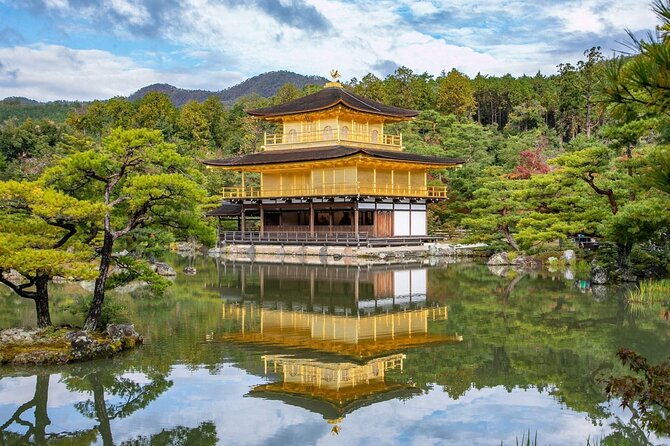
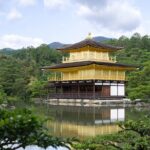
Your first stop is Kinkaku-ji, commonly called the Golden Pavilion. Its upper floors are covered in gold leaf, and the building reflects across a pond surrounded by carefully arranged greenery. It is one of Kyoto’s UNESCO World Cultural Heritage sites.
The guide explains the pavilion’s connection to the shogun, the military ruler of medieval Japan. This short history lesson helps you see the building as more than a pretty photo stop.
You have about 40 minutes here. Admission is not included, and the tour information lists temple entrance fees at about ¥1,500 per person in total. Confirm the current amount when booking or with your guide, since fees can change.
Kinkaku-ji is a strong first stop because it gives you an immediate Kyoto classic. The drawback is crowds. The route through the grounds can feel busy, and you generally view the pavilion from designated paths rather than wandering freely.
Arashiyama Bamboo Grove and Tenryu-ji
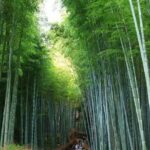
The bamboo grove is one of Kyoto’s most familiar images. You walk through tall bamboo along a short route, with about 20 minutes allotted. Admission is free, but the path is popular and the visit is brief.
This is best treated as a photo opportunity and a quick breath of nature, not a long woodland walk. Comfortable shoes matter here, as they do throughout the day.
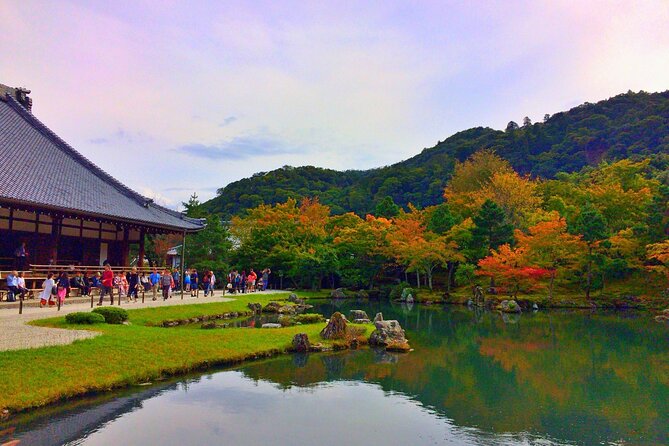
Next comes Tenryu-ji, a major Zen temple with an elegant pond garden. The garden was designed by Muso Soseki, one of Japan’s celebrated garden creators, and the temple is also a UNESCO World Cultural Heritage site.
You have 30 minutes at Tenryu-ji, with admission extra. The short visit lets you see the garden’s main composition and hear how Japanese gardens use water, rocks, plants, and borrowed views. If gardens are your main interest, you may wish for more time here. On this tour, the schedule favors variety.
Togetsu-kyo Bridge and Kimono Forest
Togetsu-kyo Bridge is one of the signature views of Arashiyama. The tour allows about 10 minutes for photographs, so have your camera ready before you arrive.
The bridge area helps you understand why Arashiyama has long been a favorite scenic corner of Kyoto. You get a broad view rather than another temple interior, which breaks up the day nicely.
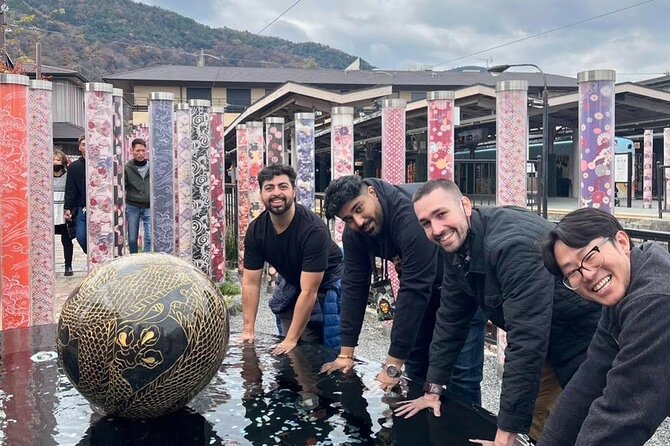
The next stop is the Arashiyama Kimono Forest, an art installation made from about 600 cylinders decorated with 36 kimono patterns. It is a quick, colorful stop with free admission and about 10 minutes to walk through and photograph.
I like this pairing because it shows two sides of modern Arashiyama: an old bridge tied to the district’s scenery and a newer public artwork designed for visual appeal. If you prefer quiet historic sites, Kimono Forest may feel lightweight. If you enjoy design and photography, it adds variety.
Fushimi Inari’s red torii gates
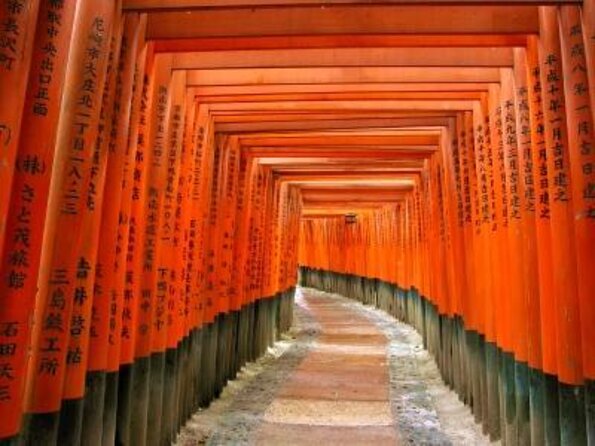
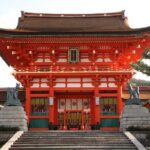
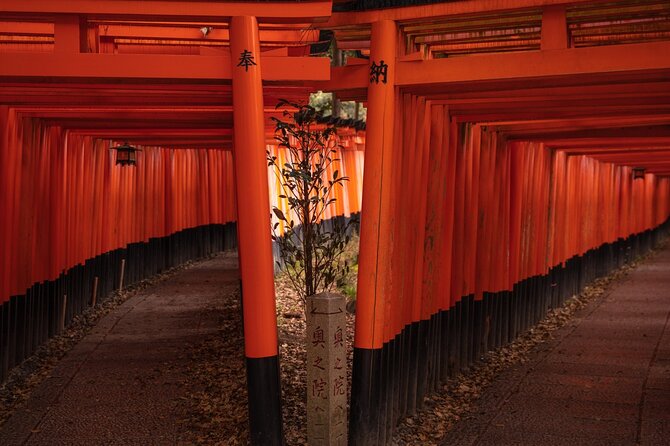
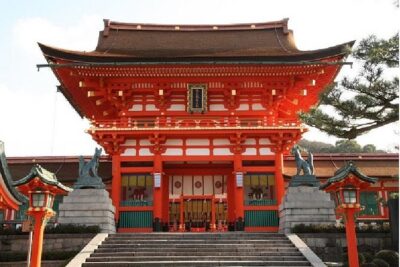
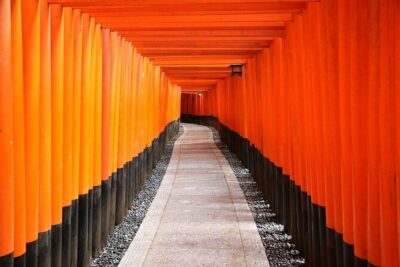
Fushimi Inari-taisha is the day’s major shrine visit. Its famous path is lined with thousands of orange-red torii gates, donated over time by individuals and businesses. You have about one hour here, and admission is free.
The key practical point is not to assume you must walk the entire mountain route. The tour gives you a timed visit, so your guide will help you experience the main gate path while keeping the rest of the day on schedule.
Fushimi Inari is one of Kyoto’s most photographed places, but it is also an active shrine, not just a backdrop. Notice the fox statues around the grounds. Foxes are linked with Inari, the Shinto deity associated with rice, prosperity, and business.
The path can be crowded near the entrance. Walking farther under the torii gates often gives you a little more breathing room, but you will need to balance that with the fixed schedule and the day’s many steps.
A few more Kyoto tours and experiences worth a look

Kiyomizu-dera and the Higashiyama slopes
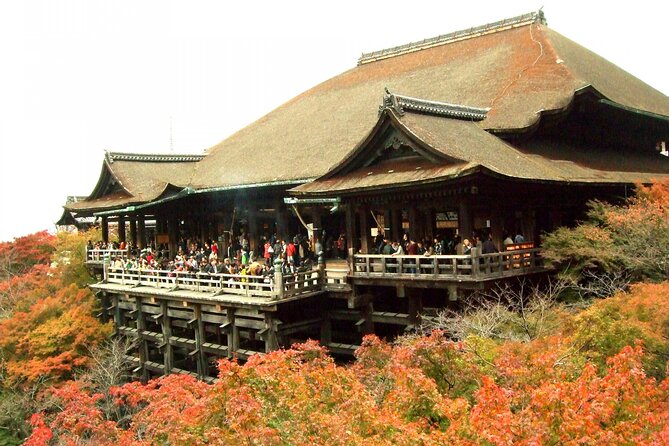
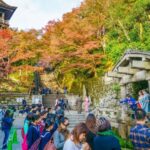
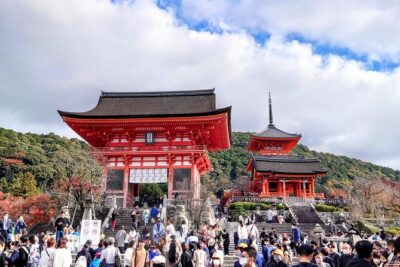
Kiyomizu-dera is one of Kyoto’s essential temple visits. Its broad wooden stage projects from the hillside and offers wide views across the city. You have about one hour, and admission is extra.
Your guide can explain the temple’s religious role and the meaning of the grounds, while you take in the famous stage and surrounding buildings. The approach includes slopes and busy lanes, so this is not a good day for flimsy footwear.
After the temple, you walk through Sannenzaka and Ninenzaka. These traditional streets are lined with wooden buildings, small shops, sweets, souvenirs, and food stops. You have about an hour to explore independently.
This is one of the tour’s most useful stretches because it gives you free time. You can browse for gifts, look for local snacks, or simply enjoy the old-style streets without needing to follow a lecture. The same popularity that makes the area appealing also brings crowds, especially around the narrow slopes.
Yasakanoto, a five-story Kyoto landmark
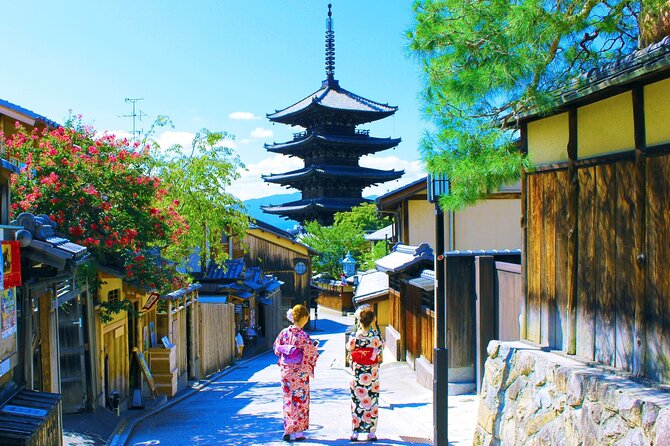
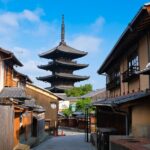
Yasakanoto is a five-story pagoda and one of the most recognizable sights in the Higashiyama area. The tour allows only five minutes and views it from outside.
That may sound short, but the pagoda fits naturally into your walk between Ninenzaka, Sannenzaka, and Gion. It is a quick photograph rather than a full stop.
This is a good example of how the tour works. You collect many small visual moments that would be easy to miss while navigating on your own, but you do not get extended time at every site.
Ending in Gion
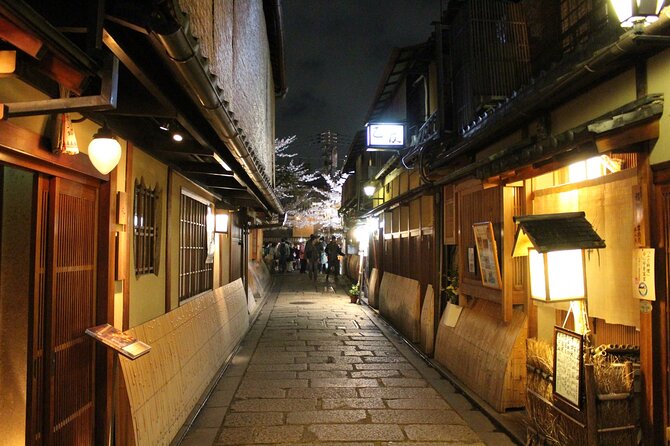
The final stop is Gion, Kyoto’s traditional geisha district. You have about 20 minutes to walk through its old lanes and see the architecture associated with tea houses and evening entertainment.
You may see a maiko or geiko, but the tour does not promise a sighting. If you do encounter one, keep your distance and follow local etiquette. These are working professionals, not costumed performers placed there for photographs.
Ending in Gion is smart. The district is a good place to continue your evening, find dinner, or explore at your own pace. The official endpoint is in Gionmachi Minamigawa, and your guide explains how to reach your next destination after the tour.
Transport, walking, and the real cost
The advertised price is $179.07 per person. That can be reasonable for a private guide, especially if you are dividing the cost among several people and want help covering a difficult route in one day.
You should not treat that figure as the complete cost. Temple admission is listed separately at about ¥1,500 per person. Public transportation may add about ¥1,000 per person. Taxi use is estimated at ¥7,000 to ¥9,000 per cab for all rides, with a figure of about ¥8,000 per booking also provided.
A taxi holds four people, including the guide. If your party has four paying participants, you need two taxis because the guide takes one place. For a group of six or seven, transport costs can therefore rise quickly. Ask for a clear transport estimate before departure.
Bring Japanese yen. Some temples and taxis may not accept credit cards. An IC card such as Suica can also be useful, and one tour experience advises arriving with at least ¥10,000 and an IC card carrying about ¥1,500. That is practical advice for a day with admissions, snacks, and unexpected transport needs.
The physical effort is just as important as the money. The route includes temple grounds, shrine paths, slopes, old streets, and transfers. Plan on a full walking day. Past participants have covered roughly 15,000 to 20,000 steps, so comfortable shoes are essential.
Guides can make or break the day
The strongest part of this experience is the guide. Names repeatedly praised include Tammy, Yoshi, Hiromi, Akemi, Mieko, Taka, Chihiro, Hori, Fuji, Abe-san, and Kumi. You cannot assume you will receive a particular guide unless the operator confirms it, but these names give you an idea of the service style available.
Tammy is described as warm, patient, efficient, and good at making transfers easy. Yoshi has been praised for excellent English, humor, thoughtful restaurant suggestions, and adjusting the day to family interests. Hiromi is known for temple explanations and taking photographs, while Akemi has helped visitors fit in personal shopping requests.
That personal attention is valuable. A private guide can explain why a shrine differs from a temple, help you use local transport, and answer questions that a large group tour cannot handle easily. You are also less likely to lose time figuring out where to go next.
The guide does not remove every limitation. Lunch is not a flexible part of the published route, and the itinerary cannot be freely reshaped. Tell the operator about food restrictions when booking, not halfway through the day.
Who should book this Kyoto day tour
I would choose this tour if you have only one day in Kyoto, are visiting for the first time, or want a strong overview before exploring on your own. It also suits families and small groups that value a private guide and do not want to manage every transfer.
It is particularly useful for cruise ship passengers who can reach Kyoto Station independently. The tour itself does not include pickup, so you must be comfortable getting to the stated meeting point at Kitaoji Station.
I would hesitate if you dislike early starts, crowds, stairs, or a fixed timetable. Temple lovers who want quiet time for gardens and architecture may prefer a shorter tour built around fewer places. On very hot summer days, ask about the Plan B route, which uses fewer steps and includes Chishakuin Temple and Sanjusangendo Temple.
The tour requires good weather. If poor weather cancels the experience, you are offered another date or a full refund. You can cancel for a full refund up to 24 hours before the start time.
My verdict on value
At $179.07 per person, this is not a budget sightseeing day. Add admissions, transport, food, and possible extra taxi costs, and the total rises. Yet the price buys something specific: a local English-speaking guide, private attention, and a route that links Kyoto’s far-flung highlights in one day.
I see the best value for groups of four to seven, provided you understand the taxi surcharge issue. Solo visitors or couples may find the per-person price harder to justify unless saving time matters more than saving money.
Book it if your goal is to see Kyoto’s main sights efficiently and learn enough along the way to make the rest of your stay easier. Skip it if you want slow temple visits, long meals, or freedom to change plans on the spot. For a first-day overview, this is a demanding but useful introduction, with Gion waiting at the end for a more relaxed evening.
FAQ
How long does the tour last?
The tour lasts approximately eight hours and begins at 9 a.m.
Where does the tour start and end?
You meet at Kitaoji Station in Kyoto. The tour ends at 571 Gionmachi Minamigawa in the Gion area.
Is hotel pickup included?
No. Pickup service is not included, so you must reach the meeting point independently.
Are temple admission fees included?
No. Temple admission fees are listed separately at about ¥1,500 per person.
How much should I budget for transportation?
Public transportation is listed at about ¥1,000 per person. Taxi costs are estimated at roughly ¥7,000 to ¥9,000 per cab for all rides. A taxi holds four people, including the guide, so groups of four or more need two taxis.
Is the tour suitable for children?
Infants under three years old are free. Children aged three and above are charged the adult rate. Most people can participate, but the route includes substantial walking, slopes, and steps.
Can I cancel for a refund?
Yes. You can cancel at least 24 hours before the start time for a full refund. Changes or cancellations made less than 24 hours before the tour are not accepted for a refund. If poor weather causes the operator to cancel, you are offered another date or a full refund.
More 1-Day Tours in Kyoto
More Private Tours in Kyoto
More tours in Kyoto we've reviewed




1-Day Tours, compared.
 ★ 5.0PERFECT KYOTO 1-Day Bus TourFrom $129
 ★ 4.8Kyoto: Fushimi Inari, Kinkakuji, Bamboo Grove 1 Day Bus TourFrom $122510 minutes - 9 hours
 ★ 4.0Kyoto 1 Day Tour from KyotoFrom $168
 ★ 4.5Kyoto and Nara Day Trip from KyotoFrom $194
 ★ 4.0From Tokyo 1-Day Kyoto English-guided Tour by Bullet TrainFrom $452
 ★ 5.0Kyoto Customized Private Tour: See Top Attractions in 1 DayFrom $132