
Reviewed · NIJO CASTLE TOURS
Nijo Castle and Imperial Palace Visit with Guide
Nijo Castle gives you a rare look at the world of the shogun, while Kyoto Imperial Palace shows the other side of Japan’s old power structure. In just two and a half hours, you move from Tokugawa politics to the imperial court, with a guide explaining the symbols and customs that are easy to miss alone. I especially like the included public transit and the way guides such as Mia, Mie, and Choko use humor, stories, and visual aids to make the past easier to follow.
I also like the small-group format, advertised for fewer than eight people, with a maximum of 11 noted in the tour details. It keeps questions easy and gives you more personal attention than a large bus tour. The main consideration is pace: you get about an hour at each site, and both stops involve walking, so comfortable shoes matter.
In This Review
- Key points to know before booking
- Why these two Kyoto sites belong together
- Meeting at Nijo Castle’s white gate
- Inside Nijo Castle: where the shogun’s power becomes visible
- The public-transit transfer to Kyoto Imperial Palace
- Kyoto Imperial Palace and the imperial side of the story
- The guide makes or breaks this experience
- Is the $79.18 price good value?
- Who will enjoy this tour most
- Timing, weather, and cancellation details
- Should you book Nijo Castle and the Imperial Palace?
- FAQ
- How long does the Nijo Castle and Imperial Palace tour last?
- Where does the tour begin?
- Where does the tour end?
- Are admission fees included?
- Is public transportation included?
- Is this a private tour or a group tour?
- Can I cancel for a refund?
Key points to know before booking
- Two very different historic sites: Nijo Castle presents the shogun’s political world, while the Imperial Palace represents Japan’s imperial household.
- A short, focused tour: Plan on about 2 hours 30 minutes, including the transfer by public transportation.
- Guide quality is central: Mia is praised for her humor, visual aids, and clear explanations, while Choko and other guides are also described as friendly and well-informed.
- Admission and transit are covered: You do not need to buy separate tickets or pay for the ride between the sites.
- Start and finish in different places: Meet at Nijo Castle and finish in front of the Imperial Palace in Kyoto Gyoen National Garden.
- Good for history-minded first-time visitors: The tour connects the shogunate, Emperor Meiji, court life, and Japanese culture in a compact visit.
Why these two Kyoto sites belong together
Kyoto can sometimes feel like a collection of beautiful buildings without a clear story connecting them. This tour helps solve that problem by placing Nijo Castle and the Imperial Palace side by side.
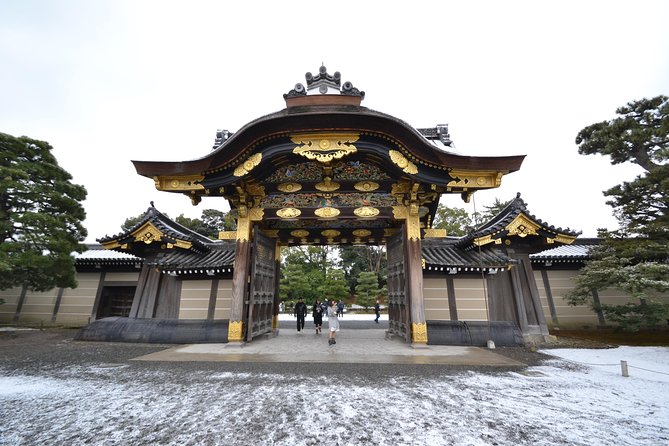
Nijo Castle was built by Tokugawa Ieyasu, the founder of the Tokugawa shogunate. The shogun held military and political power, even though the emperor remained the formal head of Japan. At the castle, you learn how that system worked and how the shogun used architecture, ceremony, and symbolism to control the room.
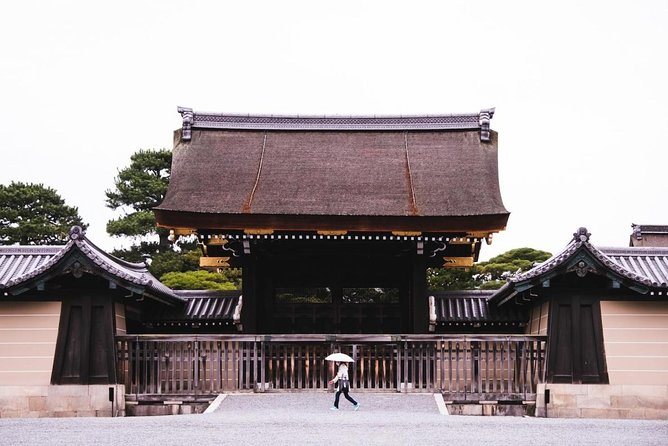
The Imperial Palace offers a different view. It was the home of Japan’s emperors during Kyoto’s long period as the imperial capital. The palace grounds help explain the role of the imperial family and the shift in power that took place during the Meiji period.
I like this pairing because it gives you more than two unrelated sightseeing stops. You see the contrast between military rule and imperial tradition, then learn how Japan moved from the Tokugawa era toward modern government. Without that link, the castle and palace can blur together as old wooden buildings. With a guide, the political story becomes much easier to grasp.
A few more Kyoto tours and experiences worth a look
Meeting at Nijo Castle’s white gate
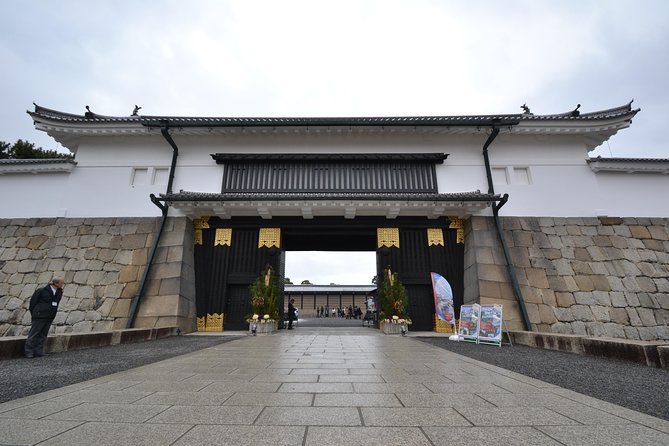
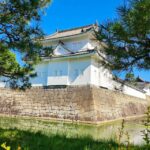
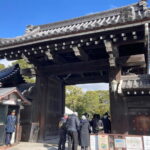
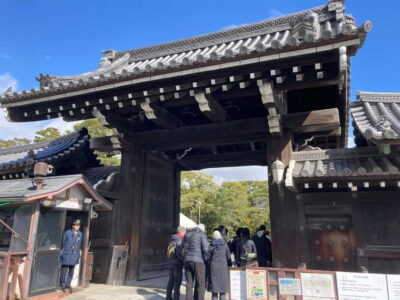
The tour begins at Nijo Castle, at 541 Nijojocho in Nakagyo Ward. The meeting point is in front of the large white main gate, a useful landmark that should make the start fairly simple to find. You will not be collected from your hotel, so allow time to reach the castle by public transportation.
The opening hour is important because it sets the tone for the rest of the visit. Your guide introduces the castle, the Tokugawa shogunate, and the purpose of the site before leading you through the grounds and buildings. Guides such as Mia have been praised for explaining not only what you are seeing, but also why it mattered.
That difference is worth paying for. A room may look plain at first glance, but its position, decoration, and intended audience could reveal how the shogun received a feudal lord or conducted a formal meeting. The guide’s job is to point out those details before you walk past them.
Inside Nijo Castle: where the shogun’s power becomes visible
The best part of the castle visit is the interior of Ninomaru Palace. The tour includes entry, and you go inside rather than viewing the castle only from the gardens. This matters because the palace rooms show how political authority was performed through space.
You can expect your guide to explain the castle’s connection to the shogun and the meetings held there. Several guides have focused on the location and purpose of shogun meetings, as well as the symbolism found throughout the site. If you have watched a historical drama about the samurai era, the setting may feel familiar, but the guide helps separate entertainment from the actual political structure.
The castle is also known for its famous floors that make a birdlike squeak when walked on. The supplied details do not promise a specific explanation of this feature, so I would not book the tour solely for that one moment. Still, the interior visit is a major advantage over a casual walk around the outer grounds.
Expect about an hour here. That is enough for an organized introduction and a look at the main areas, but it is not enough for a slow, independent exploration of every corner. If you want to photograph every garden path or read every sign, you may find the schedule tight.
The public-transit transfer to Kyoto Imperial Palace
After Nijo Castle, you travel with the guide to Kyoto Imperial Palace by public transportation. The fare is included, which makes the transition easier and keeps the advertised price closer to your final cost.
This transfer is also part of the tour’s appeal. You are not left to figure out the route between two major sites on your own, and the guide stays with you. One of the practical strengths of the experience is that the move between locations has been described as easy, provided you are comfortable walking and using city transit.
The change of setting gives the tour a useful rhythm. Nijo Castle is tied to the shogun’s military government. The Imperial Palace shifts the focus to the emperor, court tradition, and the older roots of Kyoto as Japan’s capital.
Remember that the tour starts and ends in different places. If you have a restaurant booking, train connection, or afternoon activity, plan from the Imperial Palace rather than from Nijo Castle. The final stop is in front of the Imperial Palace within Kyoto Gyoen National Garden.
Kyoto Imperial Palace and the imperial side of the story
The second guided portion lasts about an hour. The palace grounds are spacious and formal, and your guide helps you understand the role of the buildings and the imperial family. The emphasis is not simply on architecture. It is on how the emperor and court fit into Japan’s changing political system.
Guides have been praised for explaining the transfer of power to Emperor Meiji, the imperial family, and the family line. Some also bring visual aids to clarify people, events, and relationships. That can be especially useful if you do not already know the difference between the emperor’s ceremonial position and the shogun’s practical control during the Tokugawa period.
The palace is also a good place to ask questions. The strongest guide feedback points to a comfortable balance: enough historical detail to make the buildings meaningful, but not so much that the hour becomes a lecture. Mia, in particular, is repeatedly described as animated, funny, and able to answer specific questions without losing the main thread.
One caution is that access can be affected by events. On at least one occasion, the Imperial Palace was closed for an event, although the castle portion still went ahead. The supplied information does not explain the exact replacement plan, so it is sensible to accept that the schedule or access may change if official closures occur.
Other guided tours in Kyoto




The guide makes or breaks this experience
This is not a tour built around audio devices or a printed route. The guide is the main reason to book it. You are paying for interpretation, context, and help seeing connections between the two sites.
The most praised guides are Mia, also spelled Mie or Miya in some accounts, and Choko. The names may vary by guide assignment, so you should not assume a particular person will lead your departure. Still, the repeated strengths are clear: strong English, warmth, humor, clear historical explanations, and a willingness to answer questions.
Mia is especially noted for using visual aids. That is useful when the subject involves several shoguns, emperors, political changes, and unfamiliar names. A quick image or diagram can make a complicated succession or power shift much easier to remember.
The personal approach also appears to extend beyond the monuments. One guide recommended a Kobe beef restaurant, and that suggestion became a memorable part of the visitor’s time in Kyoto. You should treat restaurant advice as a pleasant extra rather than a promised feature, since it depends on the guide you receive.
The tour may operate as a private booking for your party, but the operational details also describe a small group of fewer than eight and a maximum of 11 people. That is an important distinction. If having only your own group is essential, confirm the arrangement before booking. Either way, the stated group size is far more manageable than a large coach tour.
Is the $79.18 price good value?
At $79.18 per person, the tour is not the cheapest way to enter Nijo Castle and the Imperial Palace. You could visit independently and spend less on guiding, especially if you already know the history or prefer wandering at your own pace.
The value improves if you want both sites in one short outing. Admission fees are included, and so is public transportation between the castle and palace. You also get an English-speaking guide for roughly two hours of site visits, plus the transfer.
That means you are paying for more than entry tickets. You are paying to understand what you are looking at, avoid navigation problems between the locations, and ask questions in real time. For a first Kyoto visit, that can be worthwhile, particularly if your schedule is tight.
A private or very small group arrangement makes the price easier to justify for families and couples. One family described the one-to-one format as worth the money, and a group that happened to be alone with its guide received an especially personal experience. If your booking becomes a larger small group, the value will depend more heavily on the guide’s ability to keep everyone involved.
Who will enjoy this tour most
I would recommend this experience to you if you want a clear introduction to Kyoto’s political and imperial past without spending half a day in a classroom. It suits first-time visitors, families with questions, and anyone who has trouble making sense of Japanese history from signs alone.
It is also a strong choice if you enjoyed the historical world shown in Shogun. The tour does not turn the castle into a television set, but the buildings and political setting give that era a real place and structure.
You may want to skip it if you prefer complete independence, long photography stops, or a slow garden visit. The schedule is fixed, the two site visits are each about an hour, and the transfer takes up part of the 2.5-hour window.
The tour is not described as difficult, and most people can participate. Still, you should wear comfortable shoes. You will walk through large historic grounds and move between locations using public transit. Food and drinks are not included, and there is no hotel pickup or drop-off.
Timing, weather, and cancellation details
You can choose a morning or afternoon departure, which makes it easier to fit the tour around a temple visit, meal, or train schedule. The activity requires suitable weather. If poor weather causes cancellation, you will be offered another date or a full refund.
Free cancellation is available up to 24 hours before the start time. Changes or cancellations made less than 24 hours before the scheduled start are not accepted for a refund, so check your plans before the cutoff.
Confirmation is sent within 48 hours of booking, subject to availability. Service animals are allowed, and the meeting point is near public transportation.
Should you book Nijo Castle and the Imperial Palace?
Book it if you want history explained clearly and efficiently. The strongest parts are the access to Nijo Castle’s interior, the contrast between shogun and emperor, the included transit, and guides who make serious material easy to follow.
I would give this tour extra weight if you have only a few days in Kyoto or if Japanese political history is new to you. Mia, Mie, Choko, and the other praised guides appear to bring the warmth and humor that keep a short tour from becoming dry.
Skip it if you want to set your own pace or if you already have a strong grasp of the sites. For everyone else, $79.18 is a fair price for two major locations, included admission and transport, and a focused explanation that can turn beautiful buildings into understandable history.
FAQ
How long does the Nijo Castle and Imperial Palace tour last?
The tour lasts approximately 2 hours 30 minutes. The guided visit includes about one hour at Nijo Castle, about one hour at Kyoto Imperial Palace, and public transportation between the two sites.
Where does the tour begin?
You meet your guide in front of the main white gate of Nijo Castle at 541 Nijojocho, Nakagyo Ward, Kyoto, 604-8301, Japan.
Where does the tour end?
The tour ends in front of Kyoto Imperial Palace in Kyoto Gyoen National Garden at 3 Kyotogyoen, Kamigyo Ward, Kyoto, 602-0881, Japan.
Are admission fees included?
Yes. Entrance fees for Nijo Castle and Kyoto Imperial Palace are included in the tour price.
Is public transportation included?
Yes. Public transportation used during the transfer from Nijo Castle to Kyoto Imperial Palace is included.
Is this a private tour or a group tour?
The experience is described as a private tour for your party, while the operating details also describe a small group of fewer than eight people and a maximum of 11 travelers. Confirm the exact group arrangement when booking if a private-only experience matters to you.
Can I cancel for a refund?
Yes. You can cancel at least 24 hours before the local start time for a full refund. Cancellations or changes made less than 24 hours before the start are not accepted for a refund.
More Guided Tours in Kyoto
More Nijo Castle Tours in Kyoto
More tours in Kyoto we've reviewed





Nijo Castle Tours, compared.
 ★ 4.7Kyoto: Nijo-jo Castle and Ninomaru Palace Guided TourFrom $161 hour
 ★ 5.0Kyoto: Nijo, Kinkaku-ji, Arashiyama, Kiyomizu & Fushimi InariFrom $51
 ★ 4.7Kyoto: Imperial Palace & Nijo Castle Guided Walking TourFrom $493 hours
 ★ 4.5Kyoto Imperial Palace & Nijo Castle Guided Walking Tour – 3 HoursFrom $55
 ★ 4.6Kyoto: Nijo Castle and Kyoto Imperial Palace Guided TourFrom $633 hours
 ★ 4.9Kyoto: Nijo Castle World Heritage Guided Tour with AdmissionFrom $401h 30m