
Reviewed · NIJO CASTLE TOURS
Kyoto: Nijo-jo Castle and Ninomaru Palace Guided Tour
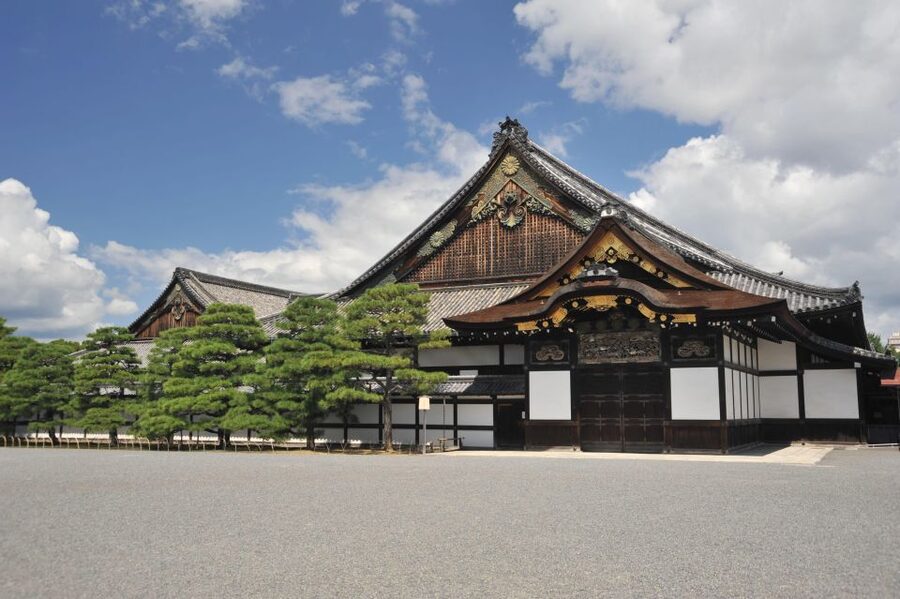
Nijo Castle’s greatest surprise is that it feels less like a fortress and more like a stage for power. Built for Tokugawa Ieyasu in 1603, it was the shogun’s Kyoto residence and office, and the Ninomaru Palace still shows how politics, ceremony, art, and daily life worked together.
I like two things here. First, a good guide explains the meaning behind the murals, room order, decorations, and samurai customs instead of leaving you to admire them without context. Second, this tour can include restricted areas that ordinary castle visitors cannot enter. The one-hour length also fits neatly into a busy Kyoto day.
The main consideration is cost. The $16 tour price does not include castle admission, which must be paid separately in cash on site. The palace is also warm in summer, has no air conditioning, and does not allow photography or drinks inside.
In This Review
- Key points at a glance
- Why Nijo Castle feels different from Kyoto’s temples
- The East Main Gate and the start of the tour
- Karamon Gate: the first lesson in status and symbolism
- Ninomaru Palace, the heart of the experience
- Restricted rooms and the value of a guide
- Ninomaru Garden and the outdoor portion
- What the guides add to the visit
- Price, admission, and overall value
- Who should book this one-hour tour
- Practical planning for your visit
- Final call: is Nijo Castle with a guide worth it?
- FAQ
- How long is the Nijo Castle guided tour?
- What does the tour include?
- Is Nijo Castle admission included in the tour price?
- What language is the tour conducted in?
- Where is the meeting point?
- Can children join the tour for free?
- What happens if I arrive late?
Key points at a glance
- Enter through the East Main Gate: Meet at the reception area beside General Reception, on the left after you enter.
- See the shogun’s working world: The Ninomaru Palace reveals rooms for meetings, ceremony, waiting, and private life.
- Look closely at the decoration: Guides point out painted tigers, dragons, symbolism, political messages, and details easy to miss alone.
- Get access beyond the standard route: The tour may include two areas normally closed to the public.
- Plan for a separate cash payment: Castle admission is not included in the $16 guide fee.
- Expect clear English and a focused pace: The tour lasts 60 minutes, with guides such as Ai, Miki, Kaoru, Ayu, and Don often praised for lively explanations.
Why Nijo Castle feels different from Kyoto’s temples
Kyoto is full of temples and shrines that invite quiet reflection. Nijo Castle offers something different: a look at government in action.
Tokugawa Ieyasu built the castle in 1603, the year he became the first shogun of the Edo Period. The castle was not simply a military stronghold. It was also his Kyoto base, a place to receive powerful visitors, manage affairs, and display authority.
That distinction helps you read the site. The grand gates and polished rooms are not decoration for decoration’s sake. They communicate rank. The order in which people entered, waited, bowed, and met the shogun was built into the design.
The Tokugawa Shogunate ended in 1867, and Nijo Castle then became an imperial palace. Later, it was given to Kyoto City and opened as a historic site. The buildings survived with enough of their structure and decoration intact to make the castle one of the clearest places in Japan to see how feudal power looked and operated.
I find this background especially useful because the castle can seem quiet and formal at first. With the political story in mind, every gate and room becomes easier to understand.
A few more Kyoto tours and experiences worth a look
The East Main Gate and the start of the tour
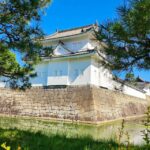
Your visit begins at Nijo Castle’s East Main Gate. Enter through the gate, then go to the reception area next to General Reception, on the left side after entering. You should notify the staff that you have arrived.
This detail matters. The meeting point is not simply outside the castle, and you cannot join once the tour has started. I would arrive well before the scheduled time, allowing enough time to find the entrance, pay the separate admission fee, and reach the reception area without rushing.
The precise meeting coordinates are 35.012586265298516, 135.75085333862305. Your booking confirmation provides the meeting details, but the East Main Gate instruction is the key point to remember.
The tour is conducted only in English. Paid participants receive earphones, which help when the palace is crowded or the guide is speaking from a short distance. A child aged 0 to 12 may join free with each paid adult, but free children do not receive an earphone. If a child needs one, an adult ticket is required.
Karamon Gate: the first lesson in status and symbolism
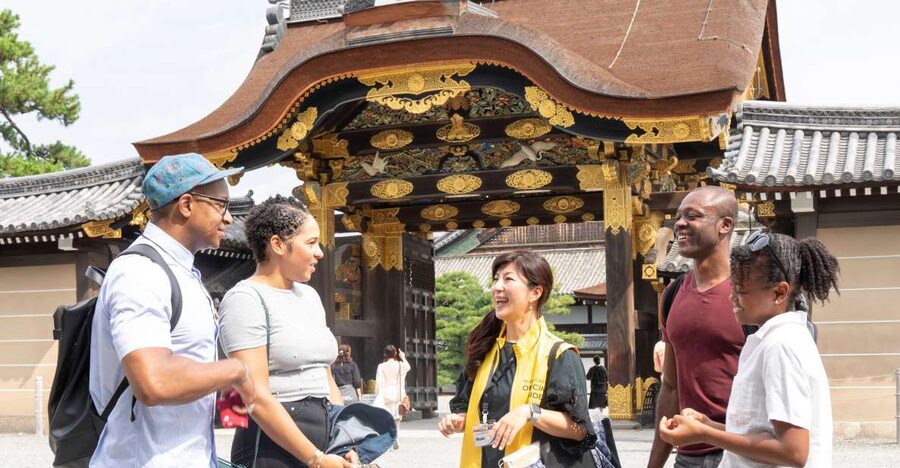
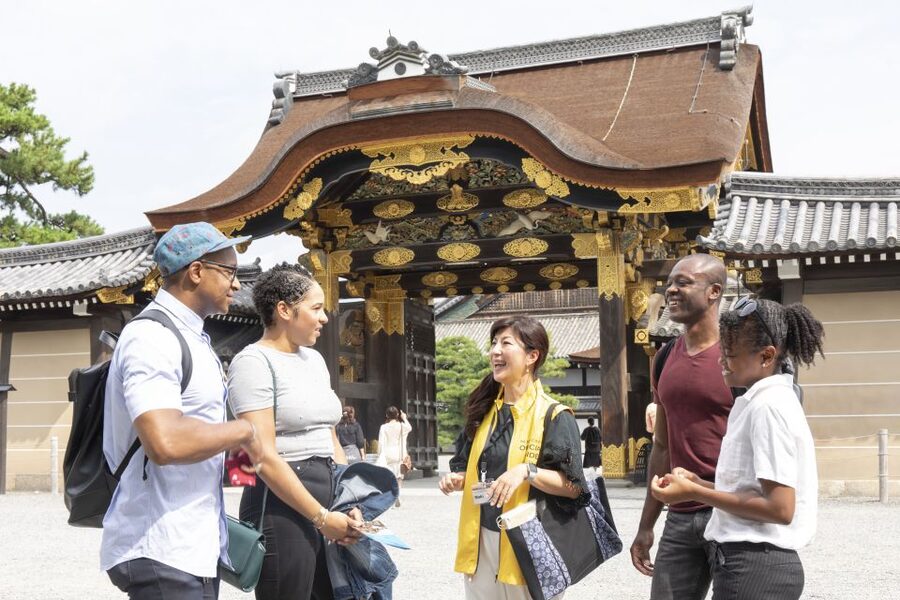
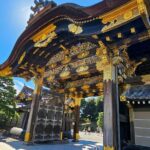
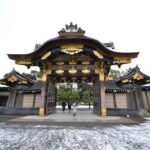
From the East Main Gate, the route continues toward the Karamon Gate, the ornate entrance to the Ninomaru section.
This is a good place to pay attention before stepping inside the palace. The gate’s decoration sets the tone for what follows: Nijo Castle uses architecture to announce importance. A guide can point out the symbols and explain why this entrance received such careful treatment.
You will likely hear broader background about the shogunate, the emperor, and the balance of power in Japan. That context is one of the strongest reasons to take the tour. Without it, you might see a beautiful gate. With it, you begin to see a formal statement about who belonged here and how authority was presented.
The tour guides are often praised for making this material easy to follow. Ai, Miki, Kaoru, Ayu, and Don are among the guides singled out for clear English, energy, humor, and careful answers to questions. The style can vary by guide, but the common thread is a strong effort to explain rather than simply lead you from doorway to doorway.
Ninomaru Palace, the heart of the experience
The main event is Ninomaru Palace, once the shogun’s residence and office during visits to Kyoto.
You remove your shoes before entering and follow the palace route through a series of rooms. The famous floors produce a soft chirping sound as you walk. These are often called nightingale floors, and they served as a security feature, making it difficult for an intruder to move silently.
Inside, the rooms are arranged according to use and rank. Some were meant for formal meetings. Others served as waiting rooms or spaces for officials. The closer a person could get to the shogun, the more important that person was. A guide helps you understand this progression, so the palace becomes a diagram of social order.
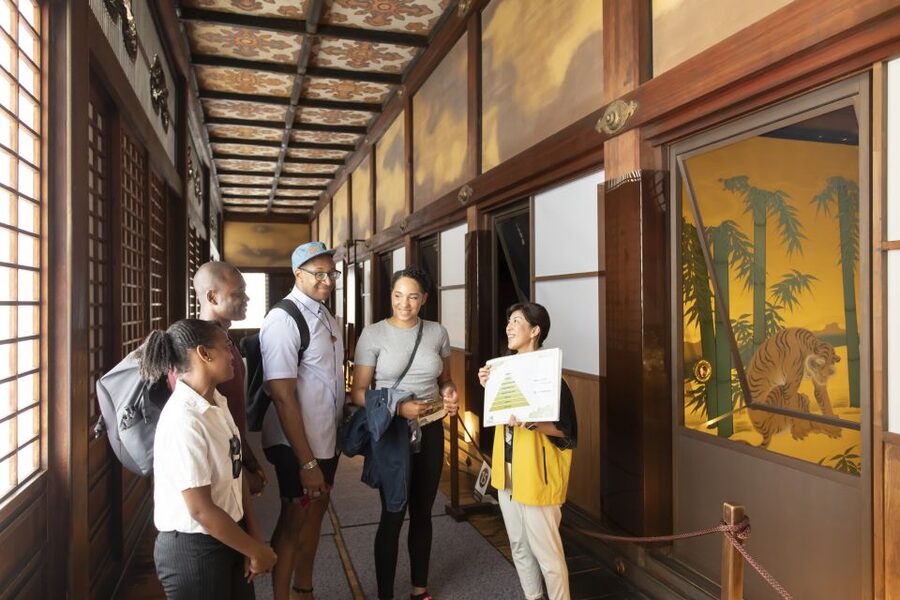
The wall paintings deserve your attention. Look for powerful animals, plants, birds, and scenes chosen to convey strength, dignity, good fortune, or status. One guide may point out tigers that look slightly unusual, while another may explain the political meaning of a particular image. The point is not to memorize every symbol. It is to recognize that the paintings were part of the palace’s message.
The palace also gives you a glimpse of daily routine. Guides explain where the shogun sat, how officials approached him, and how meals and household duties were managed. One particularly memorable subject is the risk of poisoning, a reminder that court life involved more than ceremony and fine decoration.
Photography is not allowed inside the palace. You also cannot bring water into the interior, and there is no air conditioning. In Kyoto’s hot months, the palace can feel uncomfortable, especially during a heat wave. I would drink water before entering, carry a bottle for the outdoor portions, and dress for the weather.
The restriction on photographs can disappoint people who want a visual record. Still, it encourages you to look carefully rather than move through the rooms with a camera held out. The guide’s explanation becomes the main way you carry the experience with you.
Restricted rooms and the value of a guide
The special appeal of this tour is the chance to enter areas normally unavailable to the public.
The exact access can depend on the day and operating conditions, but the experience may include two additional spaces connected with the shogun’s private quarters. That is a real benefit over simply walking the standard route alone.
I would not book the tour only for the restricted access, since it is not described as a guaranteed private visit to every closed room. The stronger reason is the combination of extra access and interpretation. A guide can explain why a room mattered, what its decoration signaled, and how it fitted into the shogun’s household.
A self-guided visit lets you set your own pace, and you can spend longer in the gardens. But many rooms in Ninomaru Palace are easier to appreciate with someone pointing out their purpose. Several guides are also good at keeping a group together in busy passages and speaking clearly through an earphone.
The tour is not a private tour by default. Group size can vary. Some departures are small, while the palace itself may be crowded. If you are alone, a guide can also help with practical things such as taking a photograph outdoors.
Other guided tours in Kyoto




Ninomaru Garden and the outdoor portion
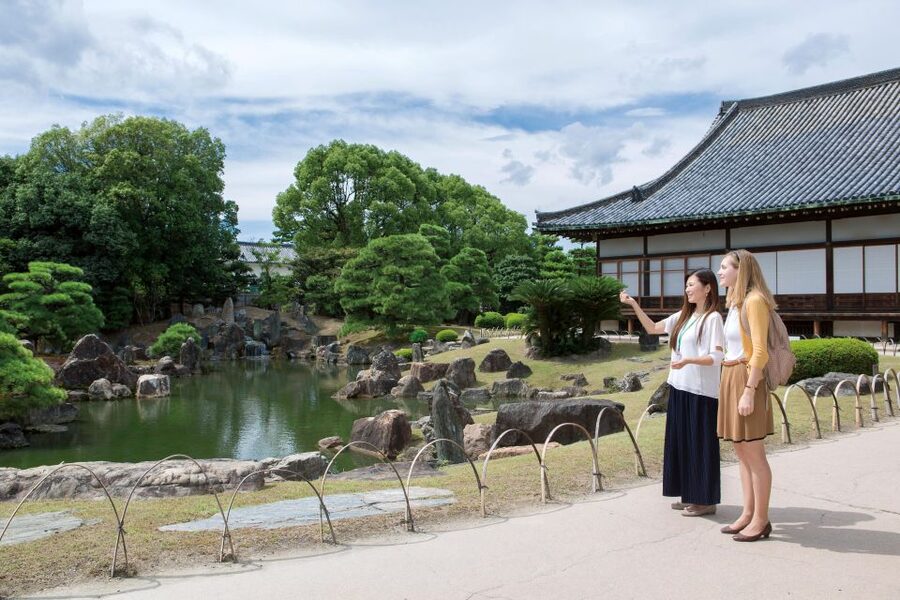
After the palace, the route includes Ninomaru Garden.
The garden gives you a needed change of pace after the formal interior. Here you can pause, look back at the palace buildings, and see how the open grounds balance the controlled rooms and gates. The garden is part of the castle’s design, not a separate attraction tacked onto the side.
The 60-minute route covers the East Main Gate, Karamon Gate, Ninomaru Palace, and Ninomaru Garden. That is enough time for a useful introduction, but not enough for every corner of the grounds. If you want to explore the wider castle area, allow extra time after the guided portion.
This is where the tour’s short format works well. You get the main historical explanation, then you can wander on your own instead of being held to a long group schedule. I like that balance. The guided hour gives structure, while the remaining visit can be slower and more personal.
The outdoor section is also where weather matters most. Summer can be very hot, and light rain does not stop the tour. Wear comfortable shoes, bring water for outside, and use the garden time to recover from the warm palace interior.
What the guides add to the visit
The quality of the experience rests heavily on the guide. The strongest guides do more than recite dates.
Ai has been praised for explaining the castle in detail while keeping the pace comfortable. Miki is known for high energy, clear English, and pointing out details that are easy to miss. Kaoru is often described as expressive, funny, and good at explaining the period and samurai customs. Don brings a lively account of Japanese history and the castle’s political role.
Ayu is noted for being attentive in hot weather, while other guides have helped solo participants, answered many questions, and kept groups organized through crowded palace rooms.
You should expect a live English tour rather than a recorded audio guide. The guide may talk about the shogun and emperor, court intrigue, power struggles, room functions, artwork, architecture, and the meaning of symbols. The best moments come when a small detail connects the building to a larger story.
The language is English only, so this is not the right choice if you need a Japanese-language or multilingual tour. The supplied earphones go only to paid participants, another reason to consider an adult ticket for an older child who needs to hear every explanation.
Price, admission, and overall value
The tour costs $16 per person, but Nijo Castle admission is separate. The admission fee has been listed as 1,300 yen and must be paid in cash on site, so carry Japanese currency and allow time to pay before the tour begins.
That makes the total cost higher than the headline price. I would compare it with the value of your time, not just the ticket total. Nijo Castle is a major historic site, and the palace’s meanings are not always obvious from the rooms and signs alone. For $16, the guide adds a focused explanation and may provide access to places you cannot see independently.
The value is strongest for first-time visitors, people interested in Japanese political history, and anyone who wants to understand the palace rather than simply photograph its exterior. If you already know the Tokugawa period well and prefer a quiet, self-guided visit, you may decide that the extra fee is less important.
The one-hour length keeps the cost reasonable for an itinerary packed with Kyoto sights. It also reduces the risk of spending half a day on one attraction when you want to visit temples, gardens, or markets elsewhere.
Who should book this one-hour tour
I would choose this experience if you:
- Want a clear introduction to the Tokugawa Shogunate and the end of feudal rule
- Care about architecture, painted screens, room functions, and symbolism
- Prefer asking questions instead of reading every sign yourself
- Want a chance to see restricted sections
- Have only a short amount of time in Kyoto
- Are visiting with a child who can stay with an adult during the tour
I would think twice if you need photography inside, dislike warm interiors, or want a leisurely tour of every castle garden. The palace has no air conditioning, drinks are not allowed inside, and the English guide moves according to a fixed 60-minute schedule.
The tour also suits families in a useful way. One child aged 0 to 12 can join free with each paid adult, but the child must stay with an adult. More than one free child is not covered, and each additional child needs an adult ticket.
Practical planning for your visit
Book a start time that gives you a cushion before any later reservation. You must be present when the tour begins, and late arrival means you cannot participate.
Enter only through the East Main Gate and go to the reception area beside General Reception. Do not wait outside the castle or head directly to the palace. The staff needs to know you have arrived.
Bring cash for admission. Wear shoes that are easy to remove, since you enter the palace without shoes. Carry water for the outdoor sections, but finish or leave it before entering the palace.
Inside, expect no photographs and no air conditioning. During July and August, heat can affect your comfort. The castle is closed for the Ninomaru Palace on December 26 through January 3, and it also closes on Tuesdays in July, August, December, and January because of the palace closure. Check the available dates before you commit to your Kyoto schedule.
Free cancellation is available up to 24 hours before the start time for a full refund. That flexibility is useful if your Kyoto plans are still shifting.
Final call: is Nijo Castle with a guide worth it?
Yes, I would book it if you want the story behind the rooms, gates, and paintings. The palace is impressive on its own, but the guide explains why the layout mattered, how the shogun used the building, and what the decoration was meant to communicate.
The separate admission fee and one-hour limit are the main drawbacks. Still, the price is fair for a focused English explanation and possible access to restricted areas. Go early, carry cash, prepare for a warm palace in summer, and leave yourself time to explore the gardens after the tour.
FAQ
How long is the Nijo Castle guided tour?
The guided portion lasts 60 minutes.
What does the tour include?
It includes a guided visit to the East Main Gate, Karamon Gate, Ninomaru Palace, and Ninomaru Garden.
Is Nijo Castle admission included in the tour price?
No. Castle admission is separate and must be paid in cash on site. The admission fee has been listed as 1,300 yen.
What language is the tour conducted in?
The tour is conducted only in English.
Where is the meeting point?
Enter through Nijo Castle’s East Main Gate and gather at the reception area next to General Reception, on the left after entering. You should notify the staff that you have arrived.
Can children join the tour for free?
Each paid participant can bring one child aged 0 to 12 for free. The child must be accompanied by an adult. Earphones are provided only to paid participants, so a child who needs an earphone requires an adult ticket.
What happens if I arrive late?
You cannot join the tour after it has started. Arrive well before the scheduled beginning so you have time to enter, pay admission, and reach the reception area.
More Guided Tours in Kyoto
More Nijo Castle Tours in Kyoto
More tours in Kyoto we've reviewed





Nijo Castle Tours, compared.
 ★ 5.0Kyoto: Nijo, Kinkaku-ji, Arashiyama, Kiyomizu & Fushimi InariFrom $51
 ★ 4.7Kyoto: Imperial Palace & Nijo Castle Guided Walking TourFrom $493 hours
 ★ 4.5Kyoto Imperial Palace & Nijo Castle Guided Walking Tour – 3 HoursFrom $55
 ★ 4.6Kyoto: Nijo Castle and Kyoto Imperial Palace Guided TourFrom $633 hours
 ★ 5.0Nijo Castle and Imperial Palace Visit with GuideFrom $79
 ★ 4.9Kyoto: Nijo Castle World Heritage Guided Tour with AdmissionFrom $401h 30m