
Reviewed · SAMURAI & KENDO EXPERIENCES
Samurai Training with Modern day Musashi in Kyoto
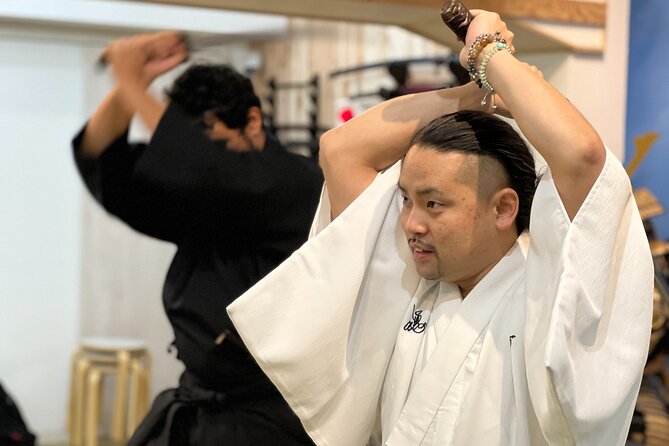
The most interesting part of this Kyoto activity is that you train inside a working martial arts dojo, not a stage set built for a quick photo. Yushin Sensei, a master with more than 20 years of experience, leads the lesson with help from Jordan and other instructors.
I like the hands-on sword practice and the chance to wear proper dōgi, obi, and hakama while learning a real kata. I also like the small-class plan, which aims for six people per class, though a class can reach nine when bookings are arranged that way.
The main point to understand before booking is that mat cutting with a real katana is not currently offered. You will handle training swords and watch the master perform, but this is a safety-focused introduction to samurai swordsmanship, not a cutting workshop.
In This Review
- Key points to know before booking
- Entering a working Kyoto dojo
- Putting on dōgi, obi, and hakama
- Learning what samurai swordsmanship involves
- Drawing, sheathing, and wielding the katana
- Practicing a short kata
- Watching Yushin Sensei’s sword performance
- How authentic is the experience?
- Is $132.65 a fair price?
- Who should book this Kyoto activity?
- Booking, timing, and cancellation details
- Should you book Samurai Training with Modern Day Musashi?
- FAQ
- Where does the samurai training take place?
- How long does the session last?
- What will I wear during the activity?
- Will I use a real katana?
- Can I cut a mat with a real katana?
- Is the activity suitable for children?
- What is the cancellation policy?
Key points to know before booking
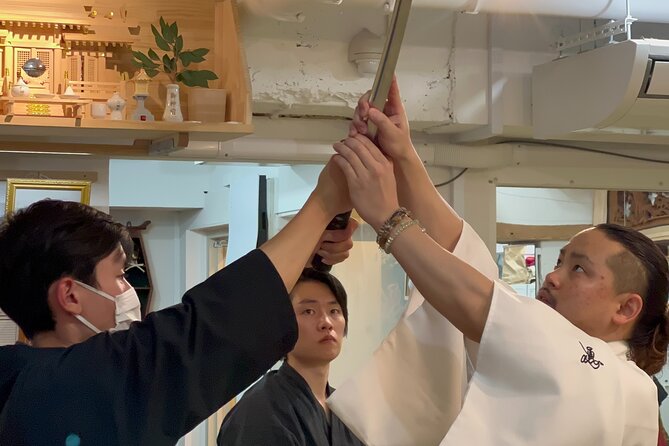
- Train in a real dojo: The session takes place at Yushinkan in central Kyoto, complete with a Shinto shrine and student name plaques.
- Learn a genuine kata: You practice a short sword form, including how to draw, wield, and return the katana safely.
- Meet Yushin Sensei: The master leads the teaching and performs a powerful two-katana demonstration.
- Dress for the part: You put on dōgi, obi, and hakama before training, making this a good photo opportunity as well as a lesson.
- Expect a compact class: The intended group size is six, with a maximum of nine participants.
- Plan about two hours: The advertised duration is 1 hour 45 minutes, but the session can run from 1.5 to 2 hours depending on group size.
Entering a working Kyoto dojo
Yushinkan sits at 452-4 Matsugaechō in Nakagyo Ward, central Kyoto. The dojo is near public transportation, and the activity begins and ends at the same location, which makes it easy to fit into a day of sightseeing around central Kyoto.
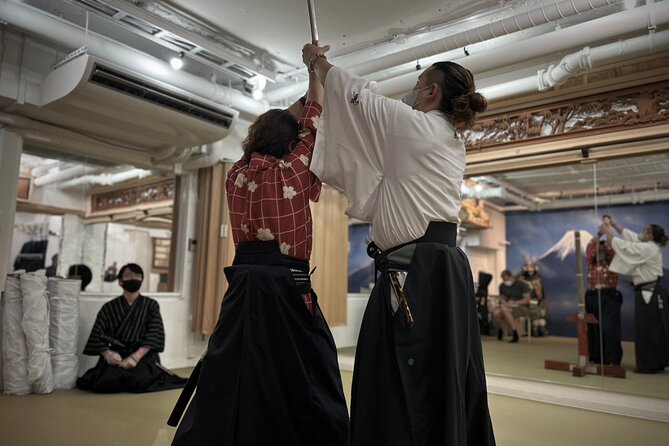
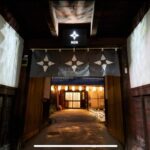
The setting matters. You are not simply handed a plastic sword and asked to pose. The dojo has the feel of an active martial arts school, with a Shinto shrine and wooden plaques bearing the names of students. That gives the room a sense of purpose before the lesson even begins.
I would allow a few extra minutes to find the entrance, particularly if you are navigating central Kyoto for the first time. The meeting address is precise, but the dojo is in the basement level of a larger complex, so do not expect a prominent street-front attraction.
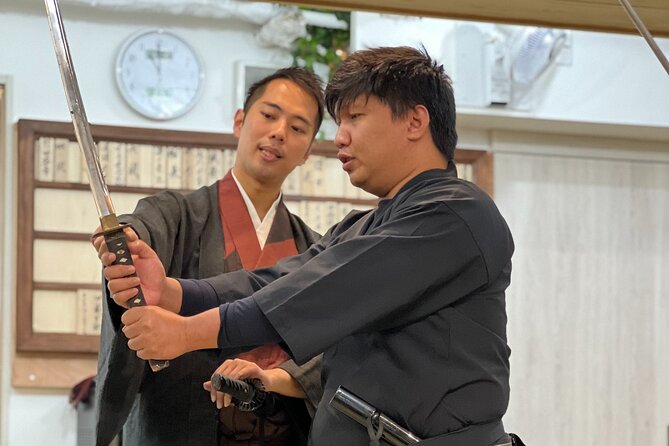
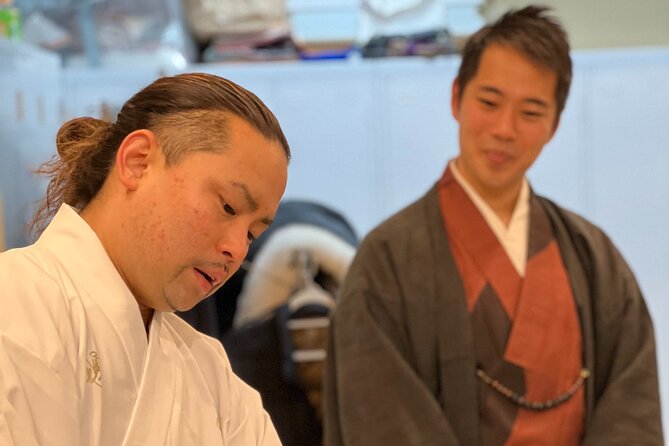
Once inside, the tone is both serious and friendly. The instructors explain what you are doing, demonstrate the movements, and make corrections. Jordan often helps bridge the language gap for English-speaking participants, while Yushin Sensei provides the central instruction and demonstrations.
A few more Kyoto tours and experiences worth a look

Putting on dōgi, obi, and hakama
The session begins with samurai training clothing. You wear a dōgi, obi, and hakama, the traditional garments associated with Japanese martial arts practice.
This is more than a costume change. The clothing helps you understand that sword practice involves posture, movement, and etiquette, not just swinging a blade. The hakama also changes how you step and turn, so even the simple movements require more care than you might expect.
It is one of the strongest parts of the activity for families and teenagers. You get memorable photographs, but the clothing also helps set the right mood for the lesson. Several families have found that children who arrived mainly for the novelty became interested in the form and history as the class continued.
Wear something that allows comfortable movement underneath the training clothes. You should also be prepared to stand, step, turn, and repeat movements for much of the session. A moderate level of physical fitness is recommended, and participants must be at least 12 years old.
Learning what samurai swordsmanship involves
Before you begin the sword movements, the instructors introduce samurai culture, swordsmanship, and the role of the katana. The lesson covers safe handling as well as background on who used samurai swords and how swords were made.
This context keeps the activity from becoming a simple dress-up session. You learn why the sword is handled with care, how it is treated as part of a disciplined practice, and why small details of form matter.
The class also touches on the parts of a Japanese sword and the way historical swords were made. Depending on the group, you may have time to ask questions about sword construction, samurai customs, and the difference between display, training, and cutting swords.
The teaching style is interactive rather than lecture-heavy. You are expected to listen, watch, try the movement, and then adjust it. That makes the short session feel active, though the amount of historical detail depends on the questions and pace of your group.
If you are already involved in karate or another martial art, you may appreciate the attention to footwork and posture more than someone looking only for a souvenir photograph. Still, no previous sword training is required according to the activity details.
Drawing, sheathing, and wielding the katana
The practical lesson begins with the basic handling of the sword. You learn how to draw it, how to hold and wield it, and how to return it to the sheath.
These movements look simple when performed by Yushin Sensei. They are less simple when you try them yourself. The class focuses on controlled motion, safe spacing, and the correct sequence rather than speed or force.
The training swords are intended for safe practice. Information from the dojo describes the practice blades as iaito, allowing you to work with a more genuine sword shape while avoiding the danger of a sharpened cutting blade. This distinction is important. You are learning the mechanics and discipline of the art, not using a live blade for unsupervised practice.
The instructors pay close attention to form. They correct hand position and movement, then let you repeat the sequence. That personal correction is a major reason the class can feel more substantial than a typical tourist demonstration.
Class size affects how much individual attention you receive. The stated target is six participants per class, although the maximum is nine and a class may be larger than six when only a small number of parties are booked. A smaller group should give you more time with the instructors, while a full class may mean more waiting between turns.
Practicing a short kata
The highlight for many people is learning an actual kata, or formal sequence. A kata links the basic actions into a set pattern, giving you something clear to practice instead of a loose collection of sword gestures.
You learn the order of the movements and repeat them under instruction. The aim is not to become a samurai in 20 minutes. The value is seeing how Japanese sword practice depends on precision, balance, timing, and calm attention.
The kata also gives the session a satisfying shape. You begin with clothing and explanation, move into basic handling, and then use those skills in a complete form. By the end, you have learned a sequence that you can remember and show in photographs or video.
The pace is compact but not necessarily rushed. The activity is listed at about 1 hour 45 minutes, with the full session taking roughly 1.5 to 2 hours depending on the number of participants. If your group has many people, expect the practice portion to include some observation while others take their turn.
I like this format because it offers a real skill to take away. You will not leave with advanced swordsmanship, but you will understand the difference between posing with a katana and following a disciplined form.


Watching Yushin Sensei’s sword performance
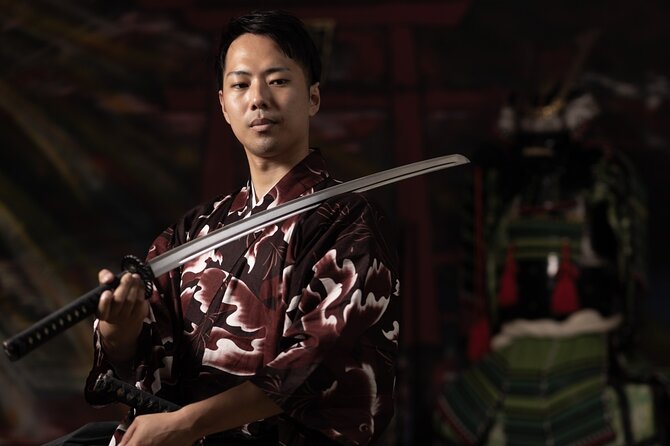
After the teaching portion, Yushin Sensei demonstrates his skill. The advertised feature is a two-katana performance, an unusual finale that gives you a clear look at the gap between beginner practice and master-level control.
The demonstration is not just an action scene. It lets you watch the posture, economy, and timing that the earlier exercises were trying to introduce. After practicing a few careful motions yourself, you can better appreciate how difficult the master’s performance is.
The activity information specifically says that mat cutting with a real katana is not currently available. Some older descriptions of the experience refer to cutting demonstrations, but you should not book this session expecting to cut a mat yourself. The current focus is training with practice blades and watching the master’s performance.
You may also see a historical katana and learn about its components, depending on how the session is presented. This adds useful substance for anyone interested in Japanese swords beyond the theatrical image of the samurai.
How authentic is the experience?
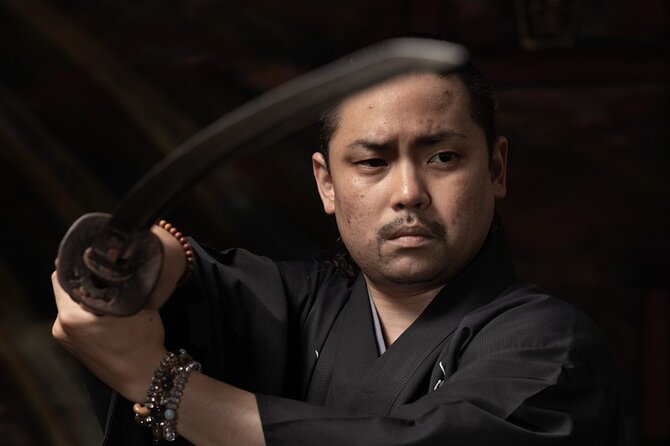
The word authentic can be overused in Kyoto, but here it has a practical meaning. You train in an actual dojo, with instructors connected to the school, rather than in a rented performance room. The shrine, student plaques, formal clothing, and repeated attention to etiquette all support that setting.
At the same time, this is still an experience designed for short-term visitors. You receive a compact introduction, not a full martial arts course. The kata is adapted to fit a single session, and the instructor’s demonstrations are part of the appeal.
That balance is worth keeping in mind. If you want a serious first look at iaido-style practice, this can be a strong choice. If you already have years of sword training, you may find the lesson basic, though the master’s performance and explanations can still be worthwhile.
The English support is another plus. Jordan and other English-speaking staff help explain the movements and answer questions, while Yushin Sensei brings the Japanese instruction and demonstration. The result should work well for international visitors who want more than a silent show.
Is $132.65 a fair price?
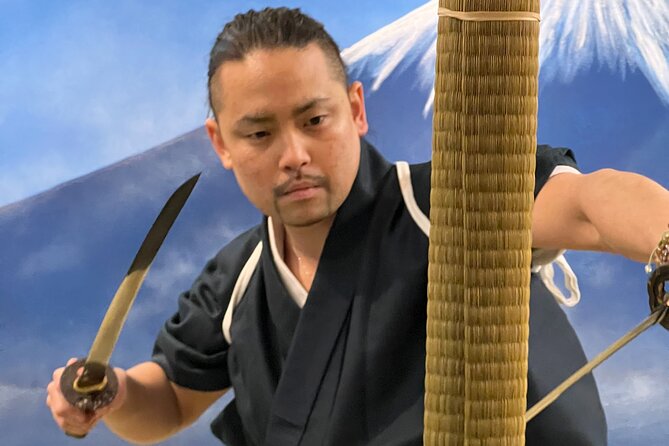
At $132.65 per person, this is not a bargain activity. You are paying more than you would for a standard cultural demonstration or a quick costume photograph.
The value comes from the combination of guided instruction, dojo access, traditional clothing, practice with an iaito, cultural explanation, and a master’s performance. You also get direct corrections rather than sitting in a crowd and watching from a distance.
For a family, the total price can rise quickly, so I would book it because the group genuinely wants to participate, not simply because the children like samurai films. For one or two adults interested in martial arts, Japanese culture, or sword construction, the price is easier to justify.
The small-group format helps support the cost. Six people is a useful target for an activity that depends on individual form correction. Since the maximum can reach nine, I would treat the class size as a helpful feature rather than a guarantee of a private lesson.
The strongest value is educational and personal. You are paying for access to a working practice space and instruction from a master, not for a long list of sightseeing stops. That makes it a better fit for a curious, active participant than for someone seeking a passive show.
Who should book this Kyoto activity?
I would recommend it to adults, teenagers, families with children aged 12 and older, and anyone who has wanted to try Japanese swordsmanship in a serious setting.
It suits you especially well if you enjoy:
- Japanese martial arts and traditional culture
- Hands-on activities rather than museum visits
- Learning the background behind an object or practice
- Small-group teaching and personal correction
- Taking photographs in traditional clothing
- Meeting instructors who can answer questions in English
It may be less suitable if you want real blade cutting, a long historical lecture, or a physically demanding training course. The session is introductory, and the current program does not offer mat cutting with a real katana.
You should also consider the 1.5 to 2 hour commitment. The time is manageable in a Kyoto itinerary, but the activity is more than a quick photo stop. Plan to concentrate, move around, and take the instruction seriously.
Booking, timing, and cancellation details
Confirmation is sent within 48 hours of booking, subject to availability. Mobile tickets are accepted, and the activity returns to the same central Kyoto meeting point.
You must be at least 12 years old, and a moderate fitness level is recommended. Free cancellation is available if you cancel at least 24 hours before the scheduled start time. Inside that 24-hour window, the payment is not refunded, and changes are not accepted.
I would avoid booking this immediately before a train, flight, or timed attraction. The listed duration is approximate, and a larger class can take closer to two hours.
Should you book Samurai Training with Modern Day Musashi?
Book it if you want to handle a sword safely, learn a real kata, wear traditional training clothing, and see a master demonstrate two-katana technique in a working Kyoto dojo.
Skip it if your main goal is to cut mats with a sharpened blade. That part is not currently offered, and the training swords are chosen for safe practice.
For most first-time visitors, this is a well-balanced introduction to samurai culture and swordsmanship. The dojo setting, patient form correction, English support, and Yushin Sensei’s performance give the session more substance than a standard tourist photo opportunity. At $132.65, it is a considered purchase, but a good one for families, martial arts fans, and curious adults who want to take part rather than simply watch.
FAQ
Where does the samurai training take place?
The activity takes place at Yushinkan in central Kyoto, at 452-4 Matsugaechō, Nakagyo Ward, Kyoto 604-8034, Japan.
How long does the session last?
The advertised duration is about 1 hour 45 minutes. The full activity can take approximately 1.5 to 2 hours, depending on the number of participants.
What will I wear during the activity?
You will put on samurai training clothing consisting of a dōgi, obi, and hakama.
Will I use a real katana?
The training uses iaito, which are intended for safe practice and are not sharpened cutting swords. You learn how to draw, sheath, hold, and wield the sword under instruction.
Can I cut a mat with a real katana?
No. Mat cutting with a real katana is not currently offered.
Is the activity suitable for children?
Participants must be at least 12 years old. A moderate level of physical fitness is recommended.
What is the cancellation policy?
You can receive a full refund if you cancel at least 24 hours before the experience start time. Cancellations or changes made within 24 hours are not accepted and are not refunded.
More Samurai & Kendo Experiences in Kyoto
More tours in Kyoto we've reviewed








Samurai & Kendo Experiences, compared.
 ★ 5.0Kyoto Samurai ExperienceFrom $119
 ★ 4.9Kyoto: Kendo and Samurai Experience with Uniform and GearFrom $1032 hours
 ★ 4.5Skip the lines Basic Ticket at SAMURAI NINJA MUSEUM KYOTOFrom $28
 ★ 4.9Kyoto: Samurai Class, Become a Samurai WarriorFrom $70
 ★ 5.0Ninja 1-hour Hands-on Lesson by Japanese master in Kyoto -EntryFrom $80
 ★ 4.8Kyoto: Ninja Weapon Forging ExperienceFrom $1482h 30m