
Reviewed · NARA DAY TRIPS
Kyoto and Nara UNESCO Highlights Full-day Tour From Osaka
Kyoto’s wooden lanes, Fushimi Inari’s endless red gates, and Nara’s friendly deer make this a busy but rewarding day out from Osaka. You visit three of Japan’s most recognizable cultural sights without figuring out several train connections on your own.
I like the strong mix of temples, streets, and nature, and I like having a bus between cities instead of managing Kyoto and Nara rail routes in one day. Guides including Lu, Leo, Jason, and Ms. Zhao have been praised for clear explanations, humor, and practical help.
The trade-off is time. This is a highlights tour, not a slow cultural walk, and the group can reach 40 people. You’ll also do plenty of walking, including uphill streets at Kiyomizu-dera, while traffic or hot weather can shorten the sightseeing schedule.
In This Review
- Key points at a glance
- Why this Kyoto and Nara route works from Osaka
- Starting at Nipponbashi or Kyoto Station
- Kiyomizu-dera and Kyoto’s old lanes
- Fushimi Inari’s famous torii gates
- Nara Park and Todaiji before the day ends
- What the guide adds to a mostly independent day
- Transport, heat, and the long day
- What is included and what will cost extra
- Who should book this day tour
- Should you book it?
- FAQ
- Where does the tour start in Osaka?
- Can I join the tour in Kyoto?
- Where does the tour finish?
- How long is the tour?
- Are temple admission fees included?
- Is lunch included?
- What happens if I arrive late?
Key points at a glance
- Three major stops in one day: Kiyomizu-dera, Fushimi Inari, and Nara Park with Todaiji.
- A useful Osaka base: Meet at Nipponbashi, then return to Osaka at the end of the day.
- Plenty of independent time: The main stops are largely free-time visits, supported by bus commentary and guide instructions.
- A compact cultural route: Kyoto’s old streets, Shinto torii gates, and Nara’s deer all appear in one outing.
- Budget-friendly pricing: At $62.75 per person, transport and a multilingual guide are included, while temple entry and lunch cost extra.
- Plan for heat and hills: Bring water, cash, comfortable shoes, and patience for traffic.
Why this Kyoto and Nara route works from Osaka
At $62.75 per person, this tour offers a practical way to see two famous destinations in one day. Your price covers the shared air-conditioned bus, designated pickup and drop-off, and a guide speaking English, Mandarin, and Japanese.
That matters in Kansai. Kyoto and Nara are easy to reach from Osaka separately, but combining them means watching train times, changing plans around temple hours, and walking back to stations after a long day. Here, the bus handles the main transfers.
You should think of this as a sightseeing sampler. You get roughly two and a half hours at Kiyomizu-dera and its surrounding lanes, about 70 minutes at Fushimi Inari, and around 90 minutes in Nara Park. That is enough to see the main sights and take photos, but not enough for every temple, museum, or side street.
The tour uses a shared group format with up to 40 people. That keeps the cost low, but it also means you must follow meeting times closely. The guide may explain places on the bus and then give you a set time to explore independently.
A few more Osaka tours and experiences worth a look

Starting at Nipponbashi or Kyoto Station
The Osaka meeting point is at Nipponbashi Exit 2, at 8:40 in the morning. The listed meeting address is 1-chōme-3-6 Nipponbashi, Chuo Ward. You should arrive 15 minutes early and look for a yellow flag marked Gogoday.
There is also a Kyoto pickup at the Kyoto-Hachijoguchi Bus Loading Area at 9:50. You can begin in Osaka or Kyoto, but the final drop-off for this tour is Osaka only. That detail is easy to miss, so do not plan to finish the day in Kyoto.
The operator asks you to provide the name used on the booking when you meet the guide. It also asks for your email address after booking because the booking platform may hide it from the local operator. Save the meeting-point photos and directions before leaving your hotel.
No refund is offered for arriving late or missing the bus. This is not a good morning for a casual departure. Osaka traffic and a busy meeting area can eat up time quickly.
Kiyomizu-dera and Kyoto’s old lanes
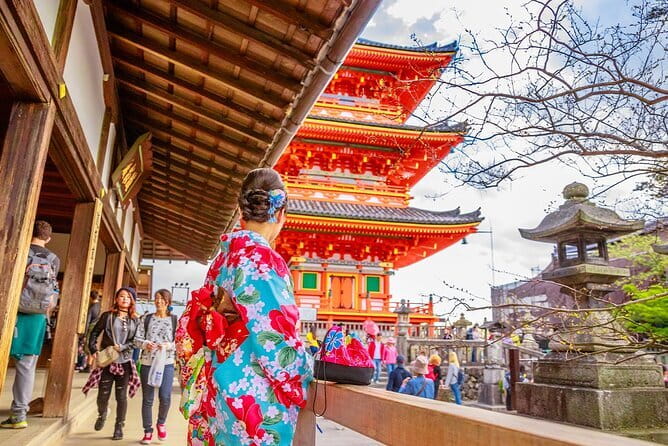
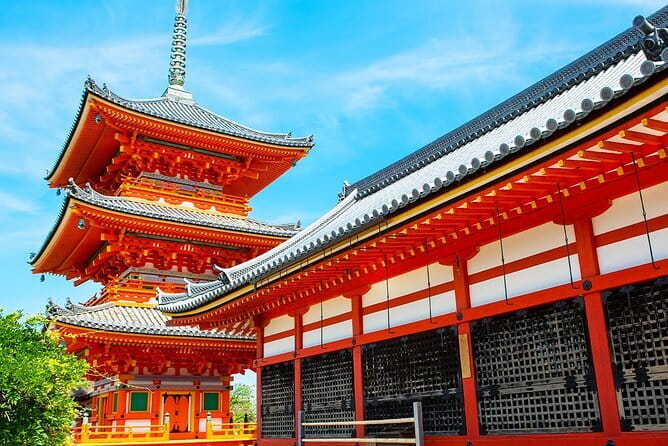
The first major stop begins at about 10:00 and lasts around two and a half hours. Kiyomizu-dera is the day’s best broad view, with its hillside setting and seasonal trees around the temple grounds.
Entry to Kiyomizu-dera is not included. The stated cost is $5 per person. Bring cash, since some places on the route may not accept cards.
The temple itself is only part of the experience. The route also takes you through Ninenzaka and Sannenzaka, two sloping lanes lined with traditional wooden buildings, shops, and places to pause for photos. Ishibe Alley offers a quieter stretch, with a more intimate feel than the main shopping lanes.
You also get time around Gion and Hanamikoji Street. These areas are known for old wooden architecture and Kyoto’s traditional entertainment district. Treat them as living streets rather than a stage set. Walk respectfully, keep voices low, and do not block doorways while taking pictures.
This is where the tour’s walking demand becomes clear. Kiyomizu-dera sits uphill, and the lanes are not flat. One review specifically cautioned about uphill walking, so supportive shoes matter more than stylish ones.
Two and a half hours sounds generous, but it goes fast. You need to divide it between the temple, the lanes, photos, and any food or shopping. If you stop often, you may need to skip a side street. If you move quickly, you can get a good sense of this part of Kyoto without feeling rushed at every turn.
The main limitation is that this visit is not a deep temple study. The schedule favors seeing several nearby areas rather than spending a long, quiet period inside Kiyomizu-dera. That is a fair trade for a day that also includes Fushimi Inari and Nara.
Fushimi Inari’s famous torii gates
Around 1:30 in the afternoon, the bus reaches Fushimi Inari Taisha for about 70 minutes. Admission is free.
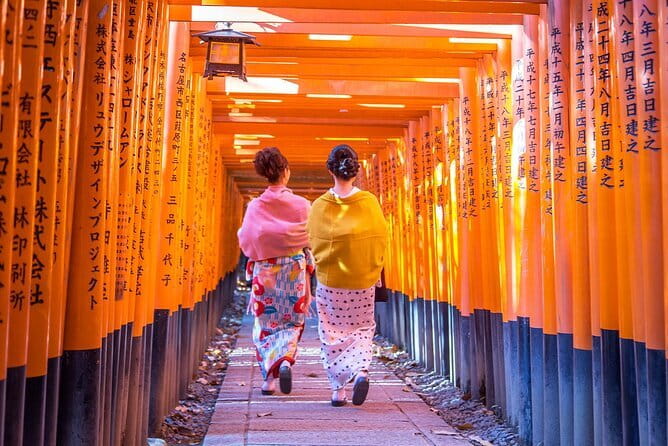
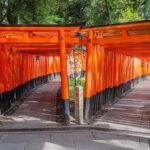
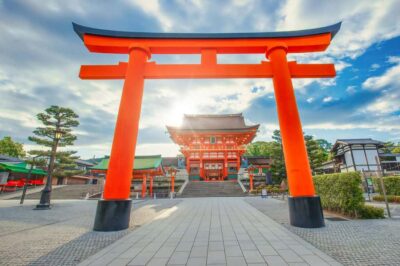
Fushimi Inari is famous for Senbon Torii, the long corridors of orange-red gates that climb into the wooded hillside. You do not need to complete the entire mountain route to understand the appeal. Even the early section gives you the classic repeated-gate views that make this shrine one of Kyoto’s essential stops.
The 70-minute window is useful for a first look, but it is short if you hope to walk far uphill. You will need to make a choice quickly: spend time photographing the entrance and lower torii, or push farther along the path and turn back before the bus departure.
The shrine is a Shinto site, so take a moment to notice the fox statues and the gate inscriptions. The fox is associated with Inari, the deity connected with rice and prosperity. A guide may add context during the bus ride or at the stop, but much of this visit is self-directed.
Fushimi Inari is also where timing discipline matters most. The path can tempt you to keep walking, especially once the gates begin to repeat around each bend. Set an alarm on your phone and leave enough time to return to the bus parking area.
Nara Park and Todaiji before the day ends
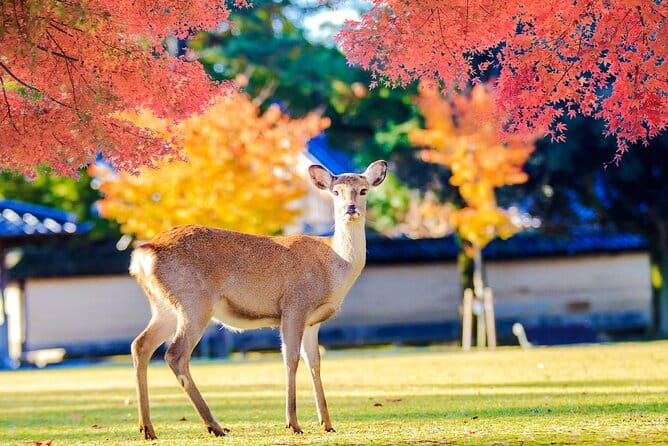
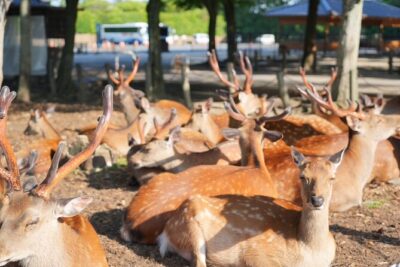
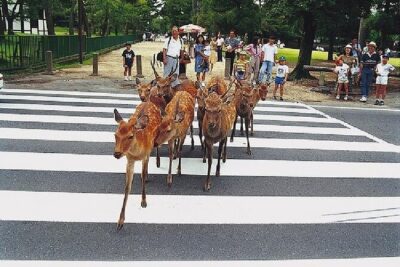
The bus reaches Nara Park at about 4:00, with around 90 minutes for the final stop. This is the tour’s most playful moment. Deer roam through the park, and you can get close to them as you walk between the area’s major sights.
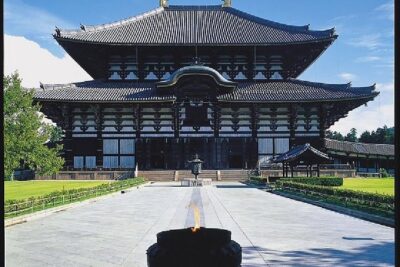
Nara Park sits near Mt. Wakakusa and includes major cultural sites such as Todaiji Temple and Kasuga Taisha Shrine. This tour focuses especially on Todaiji, home to the world’s largest bronze Buddha.
Todaiji entry costs $7 per person and is not included. Carry cash for this and small purchases, including deer crackers if you choose to feed the deer. Keep food under control and follow local guidance around the animals. The deer are accustomed to people, but they are still animals, not tame pets.
The 90-minute stop forces a decision. You can spend time with the deer, enter Todaiji, and admire the great Buddha, but you will not have hours for every corner of the temple grounds. One useful caution is that late-day timing can affect the visit. If the day runs behind, or if closing approaches, Todaiji may receive less time than you hoped.
Still, this is a strong final stop because it feels different from Kyoto. Kiyomizu-dera gives you hillside views and old streets. Fushimi Inari gives you a striking Shinto path. Nara adds open parkland, deer, and a huge Buddhist temple. The contrast helps the day feel varied rather than like a string of similar temple visits.
A few more Osaka tours and experiences worth a look

What the guide adds to a mostly independent day
The guide’s role is important, but you should understand the format. This is not a private walking tour with constant narration at every sight. The bus transfers provide a chance for explanations, and the guide organizes meeting times, directions, and return instructions. Once you arrive, you usually explore on your own.
That arrangement suits me when I want structure without being led every step. Several guides have been singled out for making the day easier. Lu has been described as punctual, funny, and able to explain in both English and Chinese. Leo has been praised for humor and clear historical background. Jason has provided instructions and suggestions in English and Japanese, while Ms. Zhao has been noted for friendly help at all three destinations.
The practical benefit is simple: you can focus on the sights instead of worrying about which bus or train comes next. Some guides also use WhatsApp or a group message to share links and help the group stay in touch.
Because the group may include people from several countries, explanations can take longer in multiple languages. That is useful if you need multilingual support, but it may feel less personal than a single-language tour.
Transport, heat, and the long day
The stated duration is about 9 hours and 20 minutes. With an early start, three major stops, and a return to Osaka, this is a full day in every sense.
The bus is listed as air-conditioned, but one important warning comes from the operating conditions. On a very hot day, a bus may not be allowed to keep its engine running while parked in a residential area. One passenger found the vehicle uncomfortably hot under those conditions, while another reported that the bus did not provide working air conditioning.
I would prepare for heat rather than assume the bus will always be cool. Carry water, a hat, sunscreen, and a small towel during warm months. Summer temperatures in the low 90s Fahrenheit were reported during one outing, and the walking portions offer limited relief.
The bus parking area may also be some distance from the sights. You will walk between the parking point and the main attractions, adding to the total distance. Wear shoes that handle slopes and pavement well.
Traffic, weather, and other unexpected problems can change the plan. Sightseeing time may be reduced, or an attraction may be canceled for safety. Do not schedule a flight, dinner reservation, or other fixed activity immediately after the expected return.
What is included and what will cost extra
The price includes:
- Pickup and drop-off at designated Osaka or Kyoto points
- Shared bus transportation
- A multilingual guide
- Mobile ticketing
You pay separately for lunch, Kiyomizu-dera entry, and Todaiji entry. Based on the stated fees, the two temple admissions add $12 per person, bringing the basic cost to about $74.75 before lunch or snacks.
That remains a reasonable price for a one-day route linking Osaka, Kyoto, and Nara. The value is strongest if you want transportation and a basic plan more than extended guided interpretation. If you already know the train system and prefer several hours at one temple, independent travel may give you more control.
Bring cash. The tour specifically warns that some locations may not take credit cards, and cash is also useful for food, drinks, or deer crackers.
Who should book this day tour
I would recommend this tour to a first-time visitor based in Osaka who wants a broad look at Kyoto and Nara without arranging separate day trips. It is also useful if you have only one open day and want to collect the major sights quickly.
Families may appreciate the deer in Nara, while couples and photographers will find plenty of strong visual stops in Kyoto. The bus also helps if you would rather avoid several train changes.
I would hesitate to recommend it to anyone who dislikes fixed schedules, group tours, uphill walking, or hot outdoor conditions. It is also not ideal if your main goal is a slow visit to Todaiji or a long hike through Fushimi Inari.
Book at least 24 hours before departure if you want the option of a full refund. Changes or cancellations made within 24 hours are not accepted for a refund.
Should you book it?
Book this tour if your priority is efficient sightseeing from Osaka. For $62.75, you get a well-packed day with three very different settings, transport between them, and guides who can make the route easier to follow.
Skip it if you want to linger. The schedule is tight, the group may be large, and the guide-led portion is lighter than the word tour might suggest. Arrive early, budget another $12 for temple fees, carry cash and water, and treat the day as a carefully organized introduction to Kyoto and Nara rather than a relaxed exploration.
FAQ
Where does the tour start in Osaka?
The Osaka meeting point is at 1-chōme-3-6 Nipponbashi, Chuo Ward, near Nipponbashi Exit 2. The listed Osaka pickup time is 8:40 in the morning.
Can I join the tour in Kyoto?
Yes. A second meeting point is at the Kyoto-Hachijoguchi Bus Loading Area at 9:50 in the morning.
Where does the tour finish?
The only drop-off location for this trip is in Osaka, at the Nipponbashi meeting address. You cannot finish the tour in Kyoto.
How long is the tour?
The full experience lasts approximately 9 hours and 20 minutes.
Are temple admission fees included?
No. Kiyomizu-dera admission is listed at $5 per person, and Todaiji Temple admission is listed at $7 per person. Fushimi Inari Shrine has free admission.
Is lunch included?
No. Lunch is not included, so you should plan to bring money for food and drinks.
What happens if I arrive late?
The guide asks you to arrive 15 minutes early and look for a yellow Gogoday flag. There is no refund for late arrivals or no-shows.
More Full-Day in Osaka
More Osaka & Hiroshima Departures in Osaka
More Nara Day Trips in Osaka

More tours in Osaka we've reviewed




Nara Day Trips, compared.
 ★ 5.0World Heritage Kyoto & Nara Uji Authentic Matcha ExperienceFrom $129
 ★ 4.7Kyoto/Osaka: Nara, Fushimi Inari Taisha, Arashiyama Bus TourFrom $529 - 10 hours
 ★ 4.4Osaka/Kyoto: Arashiyama, Nara & Fushimi Inari Shrine w/LunchFrom $61
 ★ 5.0Nara Early Morning Tour (Kyoto or Osaka Departure Available)From $61
 ★ 4.5Kyoto and Nara Day Trip from KyotoFrom $194
 ★ 4.5Nara Afternoon Tour from Kyoto or OsakaFrom $102