
Reviewed · HISTORICAL TOURS
Kyoto Heritage Run – Venture through historical Kyoto landmarks
Kyoto Heritage Run lets you cover about 10 kilometers of the city before the streets fill up, combining a steady jog with stops at the Imperial Palace, Heian Shrine, Yasaka Shrine, Gion, and the Kamo River. Guides Francis and Areo bring both fitness coaching and local history, so this is more than a run with a few photo stops.
I like the early 8:30 a.m. start, which helps you see major sights at a calmer hour, and I like the route’s mix of famous places and quieter riverside lanes. The main consideration is simple: three hours on foot and 10 kilometers require a moderate fitness level. This is sightseeing for people who are happy to keep moving.
In This Review
- Key points to know before booking
- Why this Kyoto run works so well
- Starting near Nijo Castle at 8:30 a.m.
- From the Imperial Palace to the Kamo River
- Heian Shrine and the great torii
- Running beside the Shirakawa River
- Maruyama Park, Yasaka Shrine, and Gion
- Finishing by the Kamogawa
- How hard is the 10-kilometer route?
- What the $97.55 price buys you
- Who should book this morning run?
- My booking verdict
- FAQ
- Where does the Kyoto Heritage Run start?
- What time does the tour begin?
- How long is the tour?
- How far do you jog?
- Which sights are included?
- Is the end point the same as the start?
- Is water or lunch included?
- What happens if the weather is poor?
Key points to know before booking
- A 10-kilometer route covers a lot of Kyoto: You visit major landmarks without spending a full day on buses and crowded streets.
- Francis and Areo combine two skills: Expect guidance from a fitness professional and an experienced Kyoto guide.
- The Imperial Palace includes Tabata-style exercises: The tour adds short bursts of exercise rather than offering only a continuous jog.
- The prettiest stretch follows the Shirakawa River: Weeping willows and small stone bridges give this section a quieter feel.
- The group is limited to 12 people: That makes conversation and route guidance easier than on a large sightseeing tour.
- The finish is not at the starting point: The route begins near Nijo Castle and is described as ending around Gion Shijo and the eastern side of the Kamogawa, so plan your onward transport carefully.
Why this Kyoto run works so well
I like this tour because it solves a common Kyoto problem: the city has too many worthwhile sights and not enough time. A normal walking tour may cover one or two districts at a relaxed pace. This route links central Kyoto with the Imperial Palace, eastern shrines, Gion, and two rivers in roughly three hours.
You are not simply running past everything. The group stops for a short history of Kyoto, pauses at major landmarks, and includes Tabata-style exercises in the Imperial Palace area. That makes the morning feel active without turning it into a race.
The route also gives you a useful first look at Kyoto’s layout. You begin near Nijo Castle in the central city, move east to the Imperial Palace, cross the Kamo River, continue toward Heian Shrine, and then work south through Maruyama Park and Gion. If this is your second full day in Kyoto, it can help you decide where to return later at a slower pace.
Other historical tours in Kyoto
Starting near Nijo Castle at 8:30 a.m.
Meet at Nijojo-mae Station, opposite Nijo Castle, at 8:30 a.m. The mobile ticket is convenient, and the meeting point sits near public transportation. You see Nijo Castle from the outside, not as a full interior visit, so do not book this run expecting a castle tour.
That outside view still gives the route a strong opening. Nijo Castle was the former residence of the Tokugawa shoguns from 1603 to 1868, and its position at the start places the run in the political story of old Japan. Your guides begin with a warm-up and a short introduction to Kyoto City before the group sets off.
The small group limit of 12 matters here. Francis and Areo can keep an eye on the pace, answer questions, and explain what you are seeing without using a microphone or forcing everyone to cluster tightly around them.
The early start is one of the tour’s best practical choices. Kyoto’s famous districts can become crowded later in the day, while a morning run gives you more room on the route. You should still expect a city setting, not a remote trail. The appeal is seeing Kyoto’s historic core at moving speed.
From the Imperial Palace to the Kamo River
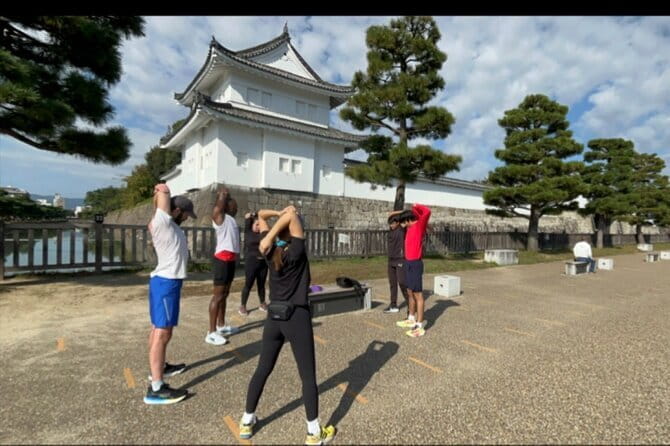
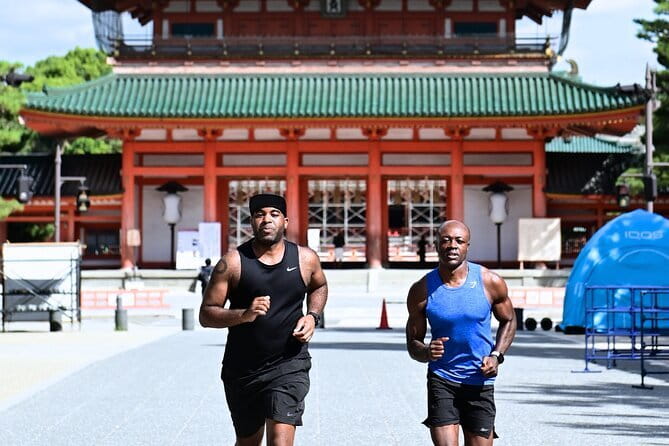
The first major stop is Kyoto Imperial Palace and its surrounding park. The palace served as the residence of Japan’s emperors when Kyoto was the capital, so it gives the morning a different historical angle from Nijo Castle. You move from shogunal power to imperial power within the same outing.
The grounds also provide room for the tour’s Tabata-style exercises. Tabata training uses short, intense intervals, and adding these exercises here breaks up the run. It also means the physical demand may come in bursts rather than at one constant pace.
I would treat this part as guided exercise, not a serious training session. The supplied details do not state the exact exercise format, intensity, or rest periods. If you have concerns about high-intensity movement, tell the fitness guide before beginning. The tour calls for moderate physical fitness, so it is not designed for someone seeking an easy sightseeing stroll.
After leaving the palace grounds, the route heads toward the Kamo River. This crossing adds a useful change of scenery. The river is tied to Kyoto’s past conflicts, yet today it gives the route open views and a natural break between the central palace district and the eastern landmarks.
Heian Shrine and the great torii
Heian Shrine is the next principal stop. You make a brief visit rather than spending a long period exploring every part of the shrine complex. That is a fair trade for a tour designed to cover many sites, but it also means you should return separately if Heian Shrine is high on your list.
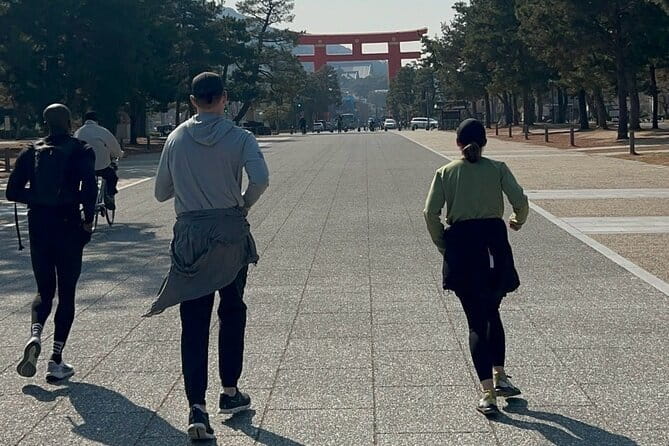
The shrine is known for its large-scale architecture, and the route takes you through the immense torii gate. This is one of the more dramatic visual moments of the morning. The gate helps mark the transition into the Okazaki area and gives you a clear sense of the scale of Kyoto’s ceremonial spaces.
Because the stop is brief, listen closely to the guide’s explanation and use the pause wisely. You have time for photographs, but this is not a slow cultural lecture or a detailed shrine visit. The value comes from seeing Heian Shrine as one piece of a larger route.
Running beside the Shirakawa River
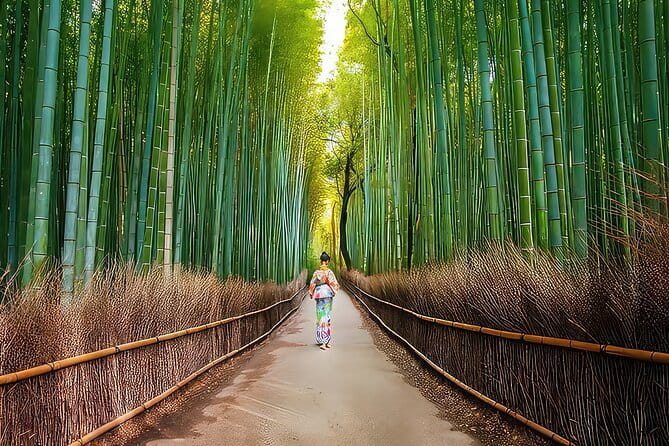
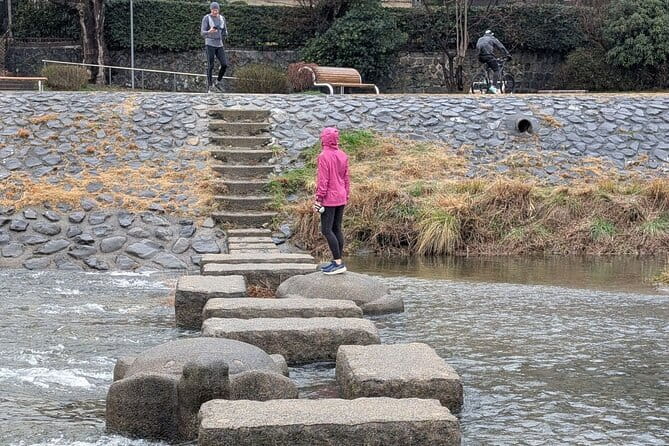
The route becomes especially appealing along the Shirakawa River. The banks are lined with weeping willows and small stone bridges, details that create a more intimate side of Kyoto than the city’s biggest monuments.
This is the section where the run feels least like a checklist. You still move through a well-known part of eastern Kyoto, but the river path gives the group a calmer setting for conversation and observation. The combination of water, willows, and old bridges also makes this a good stretch for photographs if the group pauses.
I would not assume the entire route follows quiet paths. The tour links several central districts, and the supplied information describes city streets, riverbanks, shrine grounds, and park areas. You should be comfortable jogging through an urban environment and adjusting your pace near other pedestrians.
Maruyama Park, Yasaka Shrine, and Gion
Maruyama Park provides another change of pace. The park is associated with Yasaka Shrine and offers a more open setting after the river route. The tour winds down through this area rather than treating it as a long standalone sightseeing stop.
Yasaka Shrine is one of Kyoto’s best-known religious sites, and its location makes it a natural gateway into Gion. You get the cultural value of seeing the shrine in context, then continue toward the district where traditional arts associated with geisha culture remain part of Kyoto’s identity.
The Gion section is best understood as a route through a living neighborhood, not a promise of a private geisha encounter. The tour description says you pass through the district en route. Keep your camera respectful and follow local signs and guidance, especially in narrow lanes.
This part also shows why the run is more useful than a simple road workout. You move between parks, shrines, riverbanks, and old districts in one morning. You might not have time for every detail, but you get a strong sense of how these parts of Kyoto connect.
Finishing by the Kamogawa
The tour ends with stretches near the eastern bank of the Kamogawa, with the route also identifying Gion Shijo as the conclusion. The final stretching is a sensible touch after 10 kilometers, particularly if you plan to keep sightseeing afterward.
Pay close attention to the end point when planning your day. The supplied details clearly state that the end is not the same as the starting point, even though another meeting-point note says the activity ends back at the meeting point. The detailed route description places the finish around Gion Shijo and the eastern bank of the Kamogawa. I would confirm the exact drop-off location with Kyoto Fitness before setting a tight train connection or restaurant reservation.
This finish is useful for continuing into central or eastern Kyoto. It also means you do not have to retrace the whole route to return to Nijo Castle. Still, bring a little flexibility for the walk to your next stop.
How hard is the 10-kilometer route?
The distance is the key booking decision. Ten kilometers is about 6.2 miles, and the tour lasts approximately three hours because it includes warm-up, history, stops, exercises, and stretching. You are not expected to sprint, but you will be active for most of the morning.
The stated requirement is a moderate physical fitness level. That should guide your choice more than the sightseeing label. You should be comfortable jogging this distance, standing during stops, and handling short exercise intervals.
This format may suit you if you run regularly, enjoy brisk city walks, or want an active way to see Kyoto. It may not suit you if you have limited mobility, dislike exercise in public, or want long, unhurried time inside each shrine and park.
Service animals are allowed. No lunch or bottled water is included, so bring your own water and consider eating before the 8:30 a.m. start. The tour information does not list luggage storage, showers, changing rooms, or a pace choice, so do not count on those services.
What the $97.55 price buys you
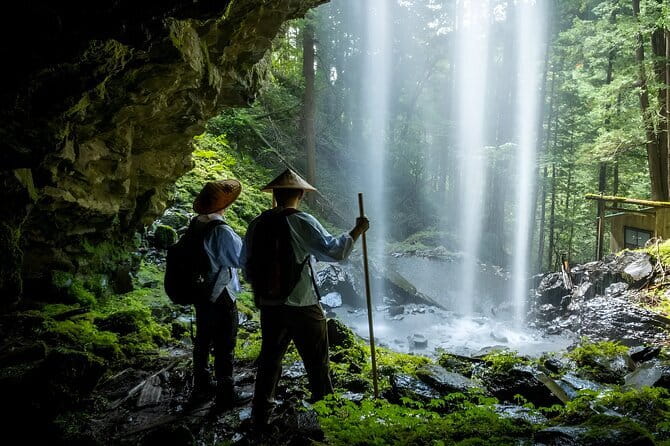
At $97.55 per person, this is not the cheapest way to see Kyoto’s landmarks. You could visit many of the same public areas independently for less, especially if you are already comfortable navigating Kyoto.
The value lies in the combination. You get a fitness professional, an experienced guide, route planning across roughly 10 kilometers, warm-up and stretching, historical context, and access to a small group capped at 12 people. For someone who wants exercise and sightseeing in the same morning, that can be a fair price.
The tour also saves planning time. You do not have to work out how to connect Nijo Castle, the Imperial Palace, Heian Shrine, the Shirakawa River, Maruyama Park, Yasaka Shrine, Gion, and the Kamogawa. You simply follow the route and let the guides manage the transitions.
I would not book it for the fee alone. Book it if the active format is important to you. If you mainly want shrine interiors, palace details, or time for shopping in Gion, a standard walking tour will probably give you more depth.
Who should book this morning run?
This is a strong fit for a first or second Kyoto morning, especially if you want to get your bearings fast. The route touches several parts of the city and gives you a useful overview before you return to your favorites later.
It also suits couples, friends, and solo visitors who enjoy meeting a small group through a shared activity. The positive feedback attached to this experience gives special weight to the guides’ ability to show lesser-known places alongside major sights, and to the friendly conversation along the route.
You should think twice if you are visiting during very hot, wet, or otherwise poor weather. The experience requires good weather, and Kyoto Fitness may cancel for conditions that make the run unsuitable. In that case, you are offered another date or a full refund.
Free cancellation is available up to 24 hours before the start time. A cancellation or change within 24 hours is not refunded or accepted, so keep the local cut-off time in mind.
My booking verdict
I would book Kyoto Heritage Run if you can comfortably handle 10 kilometers and want a practical, active introduction to central and eastern Kyoto. The route’s greatest strength is its range: imperial grounds, rivers, shrines, a park, Gion, and the Kamo River all fit into one guided morning.
I would skip it if your priority is a slow cultural visit or if you need a gentle pace. For the right person, $97.55 buys more than sightseeing. It buys a well-planned morning, useful local orientation, and a chance to see Kyoto before the day’s crowds take over.
FAQ
Where does the Kyoto Heritage Run start?
The tour starts at Nijojo-mae Station, opposite Nijo Castle, at Nijojocho, Nakagyo Ward, Kyoto, 604-8301, Japan.
What time does the tour begin?
The start time is 8:30 a.m.
How long is the tour?
The experience lasts approximately three hours.
How far do you jog?
The route covers approximately 10 kilometers.
Which sights are included?
The route includes Kyoto Imperial Palace, Heian Shrine, Yasaka Shrine, Maruyama Park, Gion, the Kamo River, the Shirakawa River, and an outside view of Nijo Castle.
Is the end point the same as the start?
No. The additional information states that the end point is not the same as the start. The route description identifies Gion Shijo and the eastern bank of the Kamogawa as the conclusion, so confirm the exact finish location before booking onward transport.
Is water or lunch included?
No. Lunch and bottled water are not included.
What happens if the weather is poor?
The tour requires good weather. If it is canceled because of poor conditions, you are offered a different date or a full refund.
More Historical Tours in Kyoto
More tours in Kyoto we've reviewed



Historical Tours, compared.
 ★ 5.0World Heritage Kyoto & Nara Uji Authentic Matcha ExperienceFrom $129
 ★ 5.0Kyoto Gion Historical Walking TourFrom $40
 ★ 5.0Historical Kyoto E-Bike TourFrom $99
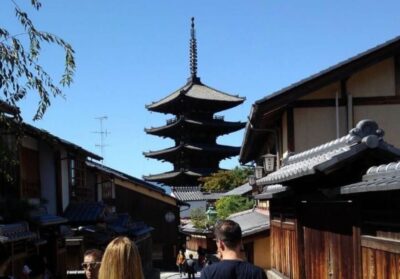 ★ 4.9Kyoto: Private 2.5 Hour Historical Walking TourFrom $802 hours
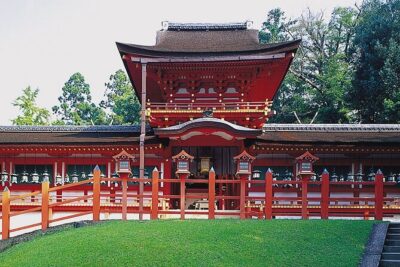 ★ 4.8From Kyoto: Nara History Guided Half Day Bus Tour with LunchFrom $776 hours
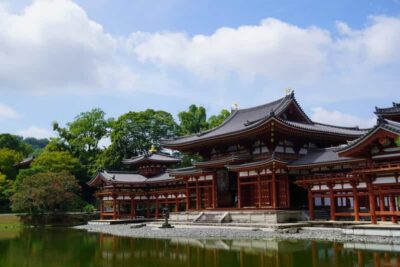 ★ 4.6Uji: UNESCO Heritage & Tea Ceremony Walking TourFrom $663 hours