
Reviewed · GION & GEISHA WALKS
Kyoto: Meet-and-Greet, Maiko Show and Experience
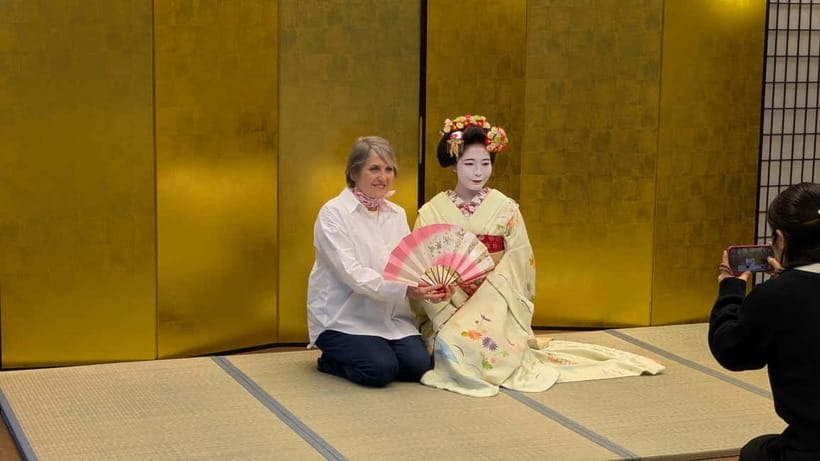
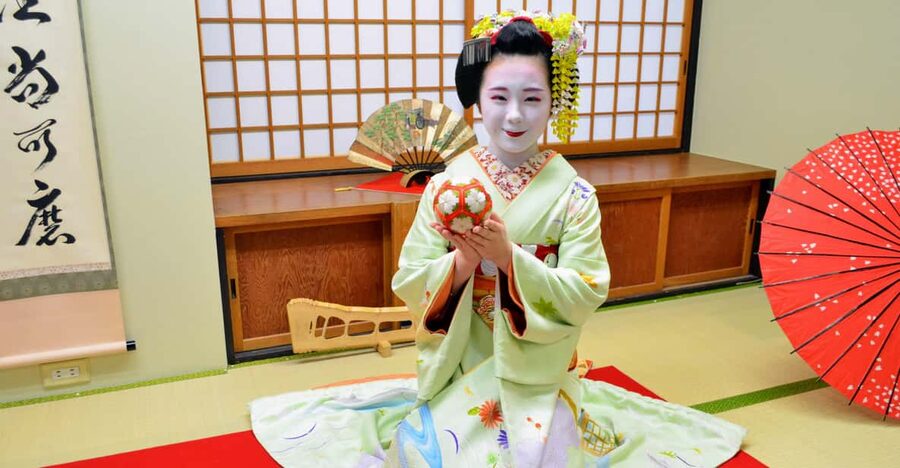
A young maiko enters in a formal kimono, elaborate hair ornaments, and white makeup, then performs two traditional dances only a few steps from the audience. This 45-minute Kyoto show gives you a clear, respectful look at a world that is hard to see by chance in Gion.
I like the small group of up to 30 people, which keeps the performance easy to see and leaves room for questions. I also like the English-speaking moderator, who explains the clothing, training, and difference between a maiko and a geiko without turning the experience into a mystery show. The main drawback is simple: the dances last only 8 to 10 minutes, so anyone hoping for a full evening performance may find the photo session too long.
In This Review
- Key points at a glance
- Meeting a maiko without chasing one through Gion
- Getting to the Kyoto Handicraft Center
- The opening: costume, context, and a respectful welcome
- Two dances in 8 to 10 minutes
- The Q&A is where the experience gains depth
- The 10 to 15 minute photo session
- What $44 buys you
- Browse Japanese crafts after the show
- Who will enjoy this Kyoto experience?
- Should you book the maiko show?
- FAQ
- How long does the Kyoto maiko experience last?
- Where does the experience meet?
- How early should I arrive?
- Is the activity conducted in English?
- How many people can join?
- Are the seats reserved?
- Can I take photographs?
- Is a professional photographer included?
- Is transportation included?
Key points at a glance
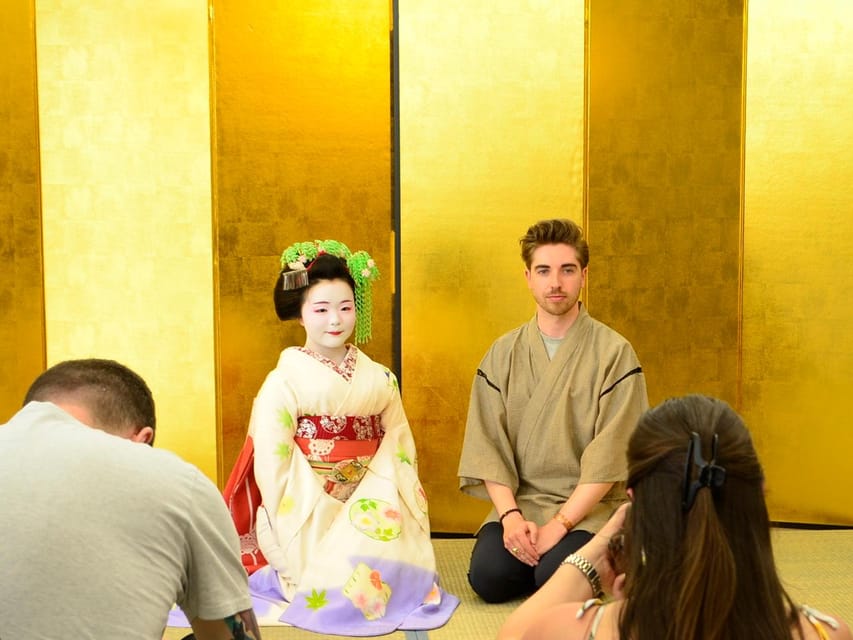
- Two traditional dances up close: The dancing lasts 8 to 10 minutes in total, with free seating so everyone can watch.
- A useful English introduction: The moderator explains the maiko’s attire, training, work, and place in Kyoto culture.
- Real question-and-answer time: You can ask about her life, work, training, and path toward becoming a geiko.
- A personal photo opportunity: The final 10 to 15 minutes are set aside for a commemorative photograph with your own camera or phone.
- Convenient Handicraft Center setting: You can browse Japanese crafts and gifts before or after the show.
- Good value for a short cultural stop: At $44 per person, it is reasonably priced for an intimate performance, explanation, Q&A, photo, and souvenir.
Meeting a maiko without chasing one through Gion
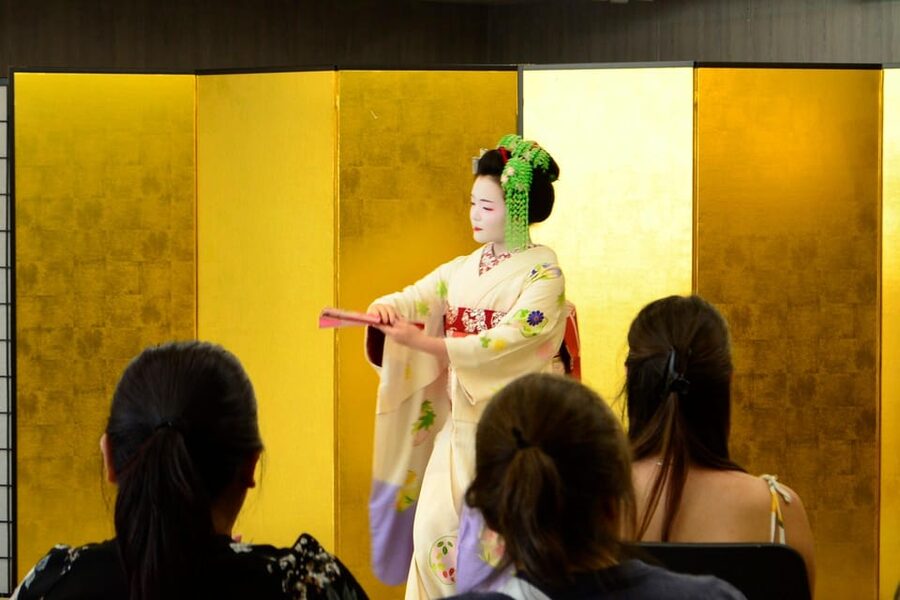
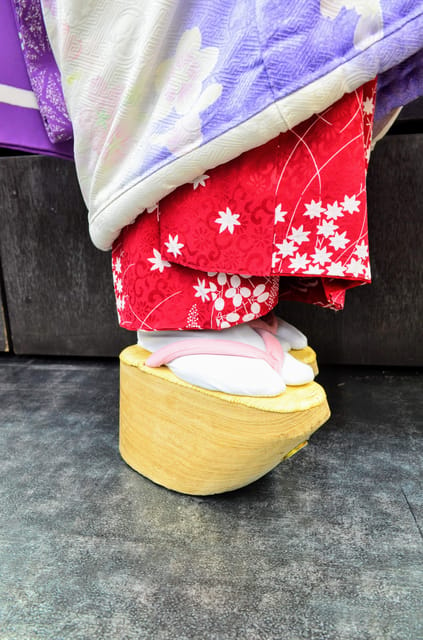
A maiko is a young apprentice geiko, the Kyoto term often used for geisha. She trains in dance, music, tea ceremony, conversation, etiquette, and hospitality before becoming a geiko. Her appearance is part of that training and tradition: formal kimono, distinctive hair ornaments, carefully arranged hair, and white face makeup with red and black details.
The setting matters. You are not wandering around Gion hoping to spot a maiko between appointments, and you are not interrupting someone on the way to work. Instead, the maiko arrives for a scheduled cultural presentation at the Kyoto Handicraft Center. That makes the meeting more comfortable for you and more respectful of her role.
This is a public group activity, not a private appointment. The room holds up to 30 people, but that is still a manageable size for this kind of show. Several people praised the chance to sit close enough to see the details of the costume and movement, while still having time to ask questions.
The venue is practical rather than theatrical. The Kyoto Handicraft Center is an arts and shopping center, so the room can feel more corporate than traditional. One useful trade-off is that the building gives you somewhere to browse before or after the performance, including Japanese paintings, dolls, crafts, and other locally made goods.
A few more Kyoto tours and experiences worth a look

Getting to the Kyoto Handicraft Center
The meeting point is the west building of the Kyoto Handicraft Center. Enter on the first floor, take the elevator to the second floor, and look for the MEET MAIKO welcome sign.
Reception opens 30 minutes before the scheduled start. Arrive at least 10 minutes early, especially if you want a good seat. Seating is free rather than assigned, and everyone can sit down, so arriving early helps you settle in without a last-minute scramble.
Allow extra time for the journey. Kyoto taxis can be difficult to catch in high season, and city buses may be crowded. This is a short activity, but arriving late can cut into the part you most want to see. Late entry is allowed, though it is better for everyone if you arrive before the maiko begins dancing.
The venue is wheelchair accessible. Children from birth through age two may attend free if they do not need their own seat. Since this is a quiet performance followed by conversation, parents should consider how comfortably young children can manage 45 minutes in a seated room.
The opening: costume, context, and a respectful welcome
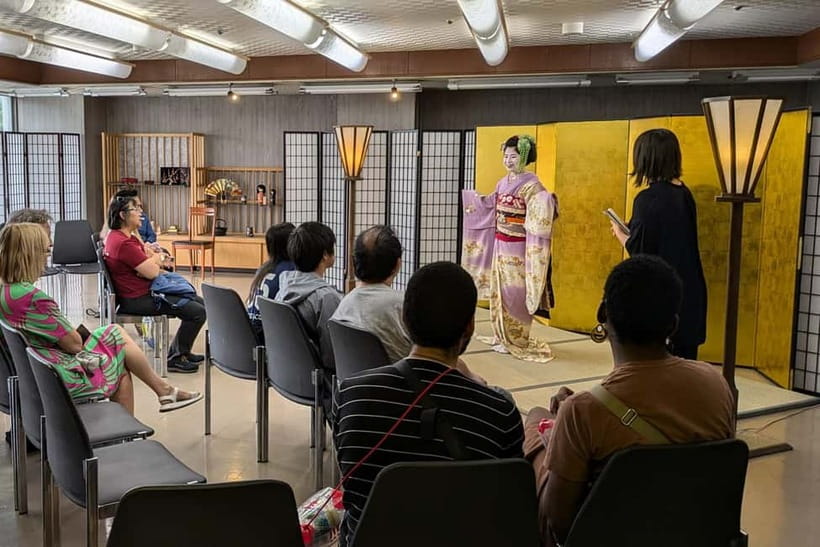
The host begins with an introduction and invites the maiko onto the stage. This first section is important because the costume can otherwise become a visual spectacle without much meaning.
The English-speaking staff explains the maiko’s attire and gives a short background to the tradition. You learn why the hair, ornaments, kimono, makeup, and general presentation look so different from everyday Japanese dress. The explanation also places the maiko’s work in context: she is still training while entertaining at teahouses and banquet halls.
The best version of this introduction stays grounded in the person behind the costume. Sessions have included interpreters such as Mina, whose role is to explain the tradition and translate questions and answers. The quality of the moderator matters here. A good interpreter keeps the conversation clear while allowing the maiko’s own personality to come through.
This is also where expectations should be set. You are meeting an apprentice, not watching a long theatrical production. The point is to learn how maiko training works and to see a small piece of the performance tradition in person.
Two dances in 8 to 10 minutes
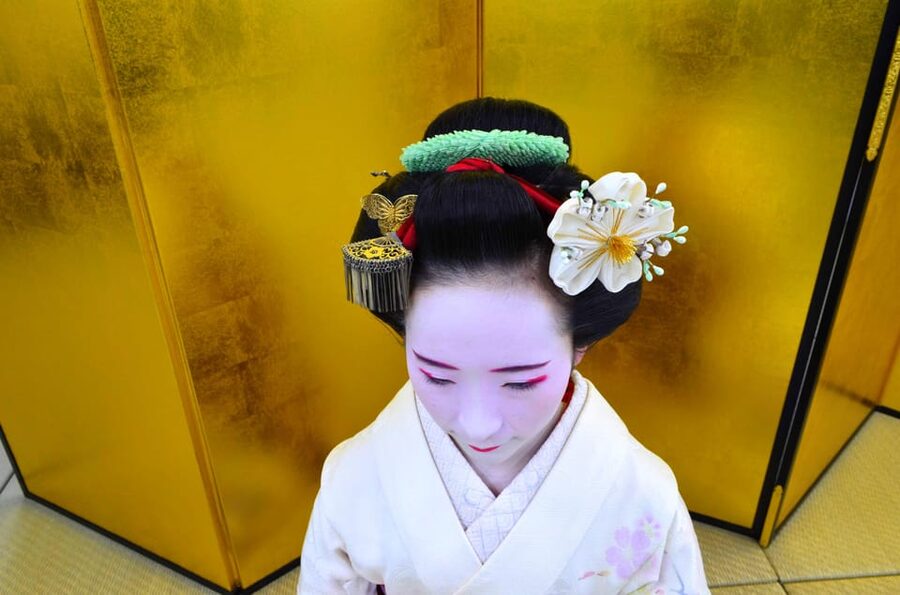
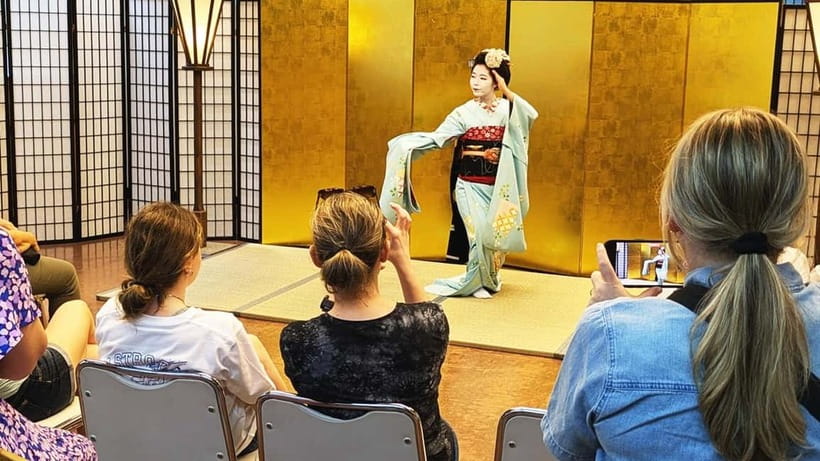
The maiko performs two traditional dances, lasting about 8 to 10 minutes altogether. The short length lets you see the controlled gestures, posture, hand movements, costume, and music without asking you to commit to a long formal program.
The dances are the visual heart of the activity. You may notice how little movement is wasted. A turn of the head, a raised sleeve, or a carefully held pose can carry as much weight as a larger step. The kimono changes the way the body moves, and the hair ornaments and sleeves add to the effect.
Your seat is not assigned, but all participants can sit. With a capacity of 30, the room is small enough for a good view in most seating positions. Photography is allowed during the event, so you can take pictures of the performance if you do so quietly and without blocking anyone else.
Here is the chief limitation: the performance portion is brief. Some people would prefer another dance instead of the photo session. If you are buying a ticket mainly for stage entertainment, the 8 to 10 minutes may feel light for $44. If you want a balanced introduction with conversation and a photograph, the schedule makes more sense.
The atmosphere can also depend on the group. One session had children making noise during the performance, which created an uncomfortable moment in the room. The host tried to manage it, but no moderator can guarantee perfect silence in a family-friendly public activity.
The Q&A is where the experience gains depth
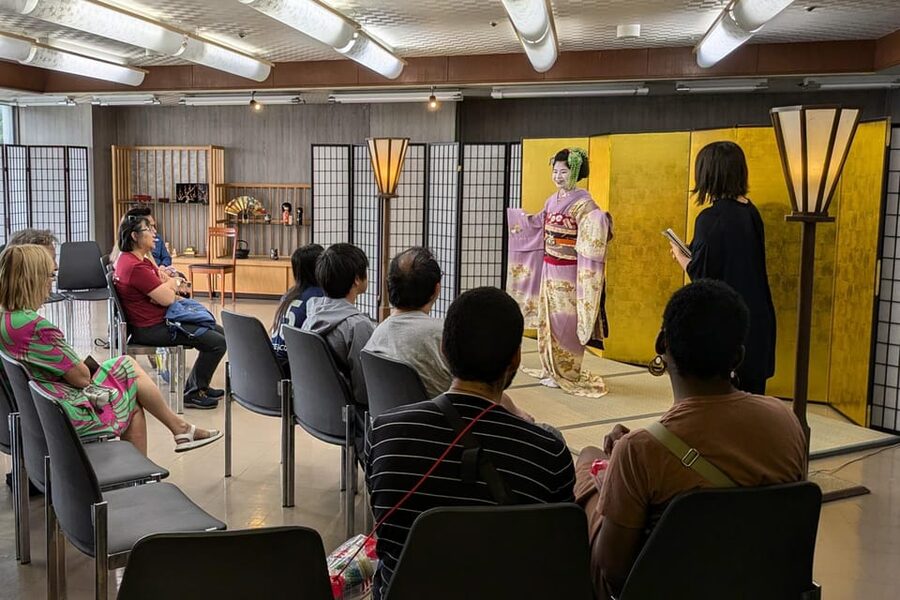
After the dances, the host opens a question-and-answer session with the maiko. Questions are translated between Japanese and English, allowing you to ask directly about her life, training, work, and hopes of becoming a geiko.
This section is more useful than a standard scripted lecture because it gives you a chance to follow your own curiosity. You might ask about the length of training, the daily demands of learning traditional arts, the meaning of parts of the costume, or what led her to choose this path. The exact questions depend on the audience, but the format gives the presentation a human scale.
Several sessions featured maiko who were only 18. That can make the conversation more moving, but it is worth keeping your questions thoughtful. The maiko is sharing part of a demanding professional tradition, not appearing as a fictional character.
The moderator also helps with modern context. The explanation is not limited to old customs. It can address how maiko life works today and how an apprentice develops her own style before becoming a geiko. For many people, this conversation becomes the most informative part of the activity.
The timing is fairly tight. One person found that questions felt rushed when the group wanted to ask many of them. With up to 30 people and a fixed 45-minute schedule, not everyone can have a long personal conversation. Keep questions concise so more people get a turn.
A few more Kyoto tours and experiences worth a look




The 10 to 15 minute photo session
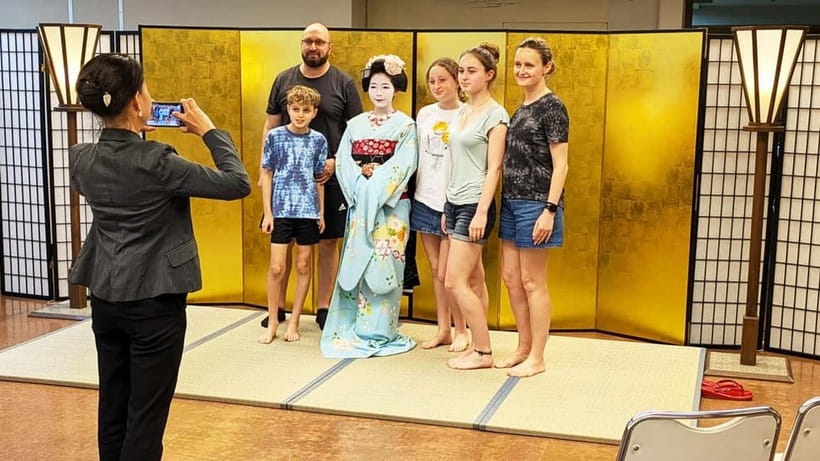
The final part is a commemorative photo with the maiko. You use your own smartphone or camera, and the staff helps arrange the picture. A photographer is not included, so you need to bring your own device or ask someone in your party to take the shot.
This is a practical souvenir rather than a professional portrait session. You may have only a short moment, but the staff organizes the process so each participant or group can take a photograph. If you are attending as a family or couple, decide in advance who will hold the camera.
The photo session is also the part that divides opinion. I see its value if meeting the maiko is the main reason you booked. It gives you a clear memory of the occasion and lets you stand near the performer after seeing her dance. If your priority is performance time, you may wish the schedule used these minutes for another dance.
Photography is permitted during the event, not just at the end. Be considerate with flashes and phone screens, and follow any instructions from the staff. The main attraction is the maiko herself, so the best photographs will come from watching first and snapping second.
Before you leave, you receive a small souvenir gift. It is modest, but it is a pleasant finishing touch and included in the ticket.
What $44 buys you
The price is $44 per person. For a 45-minute activity, that is not the cheapest cultural stop in Kyoto, but the ticket covers several elements that are difficult to arrange independently: a live maiko performance, English interpretation, a question period, a photo opportunity, and a small gift.
The value improves if you care about access and explanation rather than simply seeing a costume. You are paying for a structured meeting that avoids the uncertainty and possible intrusion of trying to approach a maiko in Gion. The group is limited to 30, and the small room gives the encounter a more personal feel than a large stage show.
The value is weaker if you want a long dance performance, a traditional teahouse setting, a meal, or a private meeting. None of those are included. Transportation, a local guide, food, drinks, and a professional photographer are also extra or unavailable as part of this activity.
I would compare it with the rest of your Kyoto plans. If you already have a longer evening performance booked, this may feel repetitive. If you have no other chance to learn about maiko culture, the compact format makes a good introduction.
Browse Japanese crafts after the show
The Kyoto Handicraft Center adds a useful second stop without requiring another trip across town. After the presentation, you can shop for Japanese goods and browse displays of locally made art and crafts.
The shopping area is not part of the performance itself, so do not expect the room to look like a traditional teahouse. That plain setting is the main visual weakness. Still, it gives you a chance to buy a physical reminder of Kyoto, and the center contains items that are more interesting than generic airport souvenirs.
Take time to look at the display cabinets. Some museum-level pieces are marked not for sale, but they are worth seeing. You can browse before the show as well, though leave enough time to reach the second-floor meeting area and find your seat.
Who will enjoy this Kyoto experience?
This activity suits first-time visitors who want a clear introduction to maiko culture without booking a full evening of entertainment. It works well for couples, families with older children, and anyone interested in Japanese dance, dress, hospitality, or traditional arts.
It is especially useful if you want interaction. The Q&A lets you ask questions rather than simply watch from a distance, and the final photograph gives the activity a personal ending. The English-speaking staff also makes this a practical choice if you do not speak Japanese.
You may want to skip it if you expect a candlelit, highly traditional room, a long dance program, or a private encounter. The Handicraft Center is convenient and respectable, but the surroundings can feel commercial. You should also be comfortable sharing the room with other people and accepting that the length of the Q&A depends on the group.
Book early when your schedule is crowded or when visiting during a busy season. The capacity is only 30, and transport problems can make a fixed start time harder to meet than it looks.
Should you book the maiko show?
Book this experience if you want a short, well-explained meeting with a real maiko, especially when a longer geiko performance does not fit your budget or itinerary. The dances are beautiful but brief. The strongest part is the combination of explanation, direct questions, and a respectful photo session.
At $44, I consider it fair value for a compact cultural experience with English support. Go in expecting an intimate introduction, not a full stage production. If that balance suits you, the Kyoto Handicraft Center show can become one of the most memorable 45 minutes in your Kyoto schedule.
FAQ
How long does the Kyoto maiko experience last?
The stated duration is 45 minutes. Some sessions may run closer to an hour depending on the flow of the Q&A.
Where does the experience meet?
Meet at the Kyoto Handicraft Center West Building. On the first floor, take the elevator to the second floor and look for the MEET MAIKO welcome sign.
How early should I arrive?
Reception opens 30 minutes before show time. You should arrive at least 10 minutes before the scheduled start.
Is the activity conducted in English?
Yes. The event is conducted in English, with English-speaking staff handling the introduction and translation.
How many people can join?
The capacity is 30 people. This is a shared group activity, not a private plan.
Are the seats reserved?
No. Seating is free, with seats available for all participants.
Can I take photographs?
Yes. Photography is allowed during the event, and you may take a commemorative photograph with the maiko using your own camera or smartphone.
Is a professional photographer included?
No. A photographer is not included, so bring your own camera or phone for the photo session.
Is transportation included?
No. Transportation and shuttle fees are not included. Meals, drinks, a local guide, and a professional photographer are also not included.
More Shows & Entertainment in Kyoto
More Gion & Geisha Walks in Kyoto



More tours in Kyoto we've reviewed







Gion & Geisha Walks, compared.
 ★ 4.7Kyoto Geisha Walking Tour: Gion District & Hidden GemsFrom $252 hours
 ★ 4.7Kyoto: Gion Geisha District Walking Tour – Stories of GeishaFrom $202 hours
 ★ 4.9Best of Kyoto: Gion, Geisha, Pagodas & CobblestonesFrom $242 hours
 ★ 4.5Night Walk in Gion: Kyoto’s Geisha DistrictFrom $211h 40m
 ★ 5.0Kyoto Night Foodie Tour in Gion (9+ dishes + 6 Sake tastings)From $163
 ★ 5.0Kyoto Gion Geisha District Walking Tour – The Stories of GeishaFrom $25