
Reviewed · GION & GEISHA WALKS
Kyoto: Tea Ceremony with Maiko
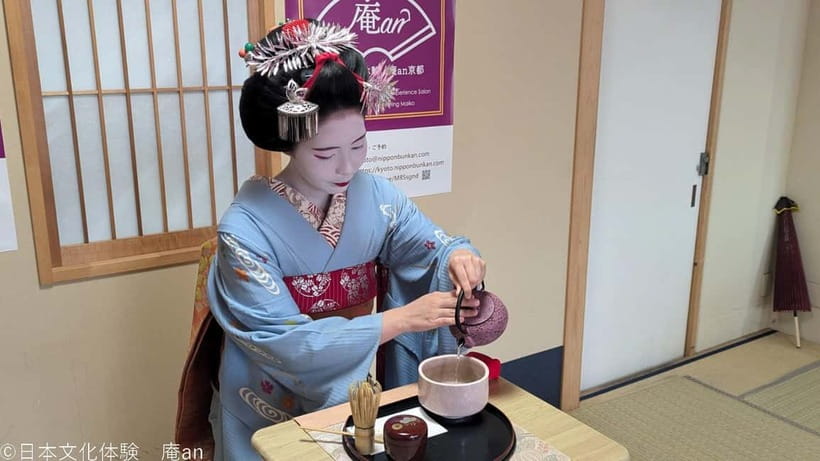
Meeting a maiko while learning to make matcha gives you two classic Kyoto experiences in one short visit. This 45-minute program near Gojo Station offers a direct, respectful way to ask questions, watch a tea demonstration, and take a photo beside a performer in full dress.
I like the close-up Q&A, which turns a brief appearance into a real introduction to the maiko world. I also like the price: at $28, you get the ceremony, sweets, tea, photo opportunity, and a Senjafuda charm without giving up half a day.
The main consideration is language. The instructor works in Japanese, with English translation provided as much as possible when requested, so the quality of explanations may depend on the interpreter available that day. The building also has stairs and no elevator.
In This Review
- Key points to know before booking
- Meeting a maiko near Gojo Station
- A 45-minute introduction to Kyoto culture
- Watching the matcha demonstration
- The Q&A is the real connection
- The difference between maiko and geiko
- Photos without chasing a performer
- What the $28 price really buys
- Language, stairs, and timing details
- Who will enjoy this best
- Should you book the Gojo tea ceremony?
- FAQ
- How long does the tea ceremony experience last?
- Where is the meeting point?
- Is the experience always hosted by a maiko?
- Is English available?
- What is included in the price?
- Do children pay the full price?
- Can I cancel for a full refund?
Key points to know before booking
- A short Kyoto cultural stop: The program takes about 30 to 40 minutes, with roughly 45 minutes allowed for departure from the room.
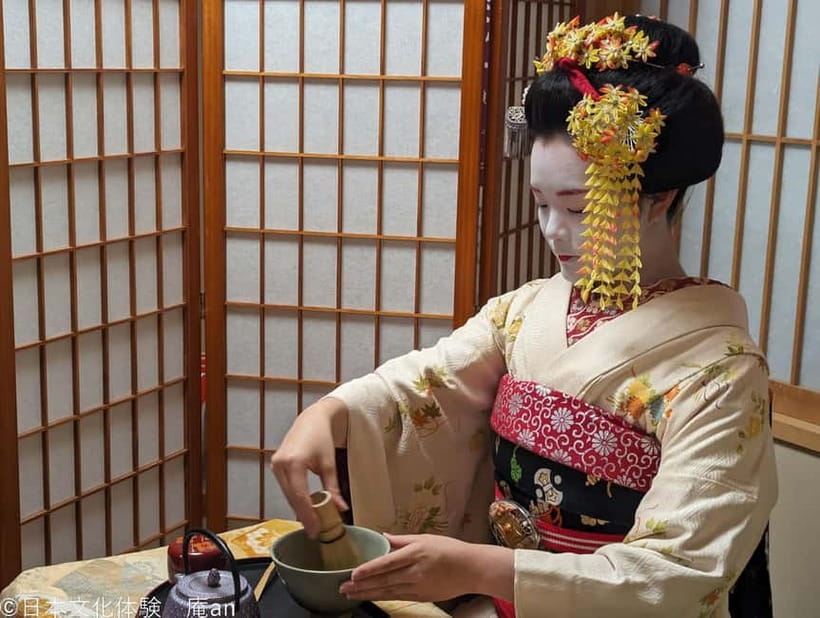
- You make your own matcha: A maiko first demonstrates the method, then guides you as you prepare your tea.
- Ohigashi sweets are included: You receive two small, dried Japanese sweets with the matcha.
- Ask direct questions: The Q&A is designed to explain the maiko’s daily life and path toward becoming a geiko.
- Photo and Senjafuda included: You can take a commemorative photo beside the maiko and receive a lucky paper charm.
- Maiko is not guaranteed: Depending on the date, a geiko may host the program instead.
Meeting a maiko near Gojo Station
The location is one of this experience’s strongest practical features. You are about a one-minute walk from Exit 1 of Gojo Station on the Subway Karasuma Line, and the entrance faces Gojo-dori.
That puts you close to central Kyoto and within easy reach of Kyoto Station. If your sightseeing schedule is tight, this is far easier to fit in than a long excursion to a distant tea house or entertainment district.
The venue is in a building, not an ochaya or a traditional Japanese home. That matters because you should arrive expecting a simple, organized event space rather than tatami rooms, gardens, or an old Kyoto townhouse.
The setting is described as relaxed, with friendly staff. A useful arrival tip is to use Exit 1, walk straight, cross a small street, and look for the location above the Carnival supermarket. You will need to go up the stairs, so allow a few extra minutes to find the entrance.
A few more Kyoto tours and experiences worth a look

A 45-minute introduction to Kyoto culture
The schedule is compact and clear. The opening greeting from the maiko leads into the tea ceremony, followed by the question-and-answer session. Around the 30-minute mark, the formal program ends, and you take your photo before receiving the Senjafuda.
The room departure time is listed as about 45 minutes from the start. That extra time likely allows for the photo and farewell, but you should not plan an immediate connection directly afterward. Late arrivals cannot be accommodated, and the event does not wait for people delayed by trains, meals, or other sightseeing.
This short format is useful if you have only a morning or afternoon in Kyoto. It also suits families and first-time visitors who want a cultural activity without committing to a long formal ceremony.
At the same time, the program is intentionally brief. You are getting an introduction rather than a full evening of maiko entertainment or a traditional tea-school lesson. If you want a long performance, a historic house, or a private conversation lasting an hour or more, this may feel limited.
Watching the matcha demonstration
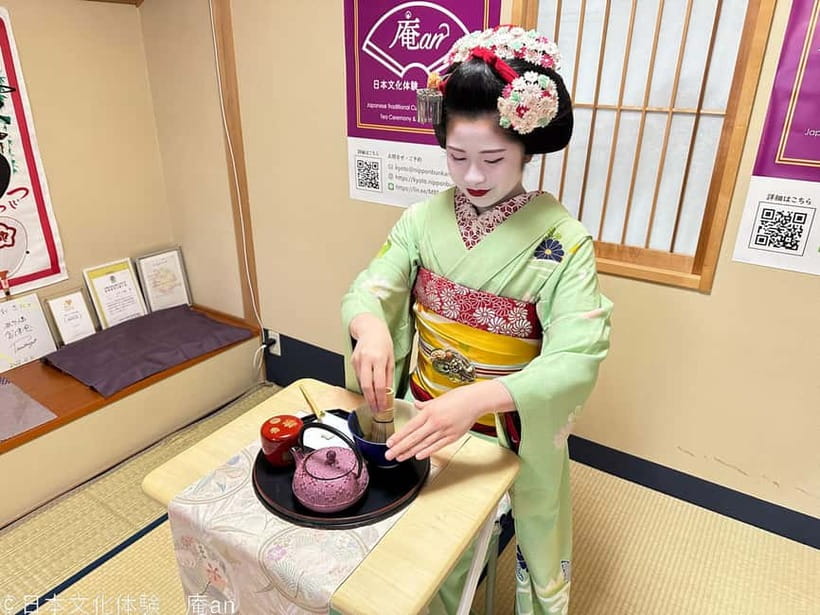
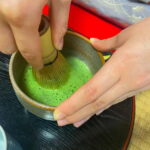
The tea portion begins with the maiko showing you how to prepare matcha. She explains the basic process, then you make your own bowl of tea.
That hands-on step is important. Watching someone whisk matcha is pleasant, but preparing it yourself gives you a better sense of the care and rhythm involved. You do not need previous experience, and the activity is presented as easy to follow.
The tea is served with two ohigashi. These are small, dried Japanese sweets, often chosen to balance the bitterness of matcha with a restrained sweetness. They are not a large snack, so eat beforehand if you are hungry. Their role is to accompany the tea, not replace a meal.
The experience also offers sake in some descriptions and individual accounts mention a sake service, but sake is not included in the listed core package. I would treat tea and sweets as guaranteed, and consider any extra food, drink, dance, or game dependent on the date and format.
The Q&A is the real connection
The question period gives this activity more substance than a simple photo encounter. You can ask about the maiko’s daily life and learn about her path toward becoming a geiko.
That direct exchange is especially useful because many visitors know the appearance of a maiko but little about the person behind the makeup, hairstyle, kimono, and performance tradition. A thoughtful question can help you understand the discipline and training involved without turning the meeting into a staged photo stop.
The quality of this part depends on communication. The instructor is Japanese-speaking, and English assistance is provided as much as possible if you request it. Several accounts describe staff helping with interpretation, including during a session with Maiko Masaya-san.
I recommend preparing two or three questions in advance. Ask about a normal day, training, the difference between maiko and geiko, or what she enjoys most about the work. Short, specific questions are easier to translate and more likely to produce useful answers.
Because the program is shared, you may not have unlimited time for private questions. The experience may also take place while people are having lunch or dinner, so the atmosphere may be less formal than you expect.
The difference between maiko and geiko
The program may be hosted by either a maiko or a geiko, depending on the event date. You should check the date details and avoid booking if seeing a maiko specifically is your only reason for attending.
A maiko is an apprentice geiko, known for distinctive dress, hairstyle, and ornamentation. A geiko is an accomplished professional performer. Both offer a valuable connection to Kyoto’s traditional entertainment culture, but they are not the same role.
This flexibility helps the operator schedule the program, but it creates an important expectation check. The title of the experience highlights a maiko, yet the host can change. That is not necessarily a problem, but it should be clear before you pay.
The format also may change by event date. One especially full account described sake, a dance performance, a game, and conversation in addition to tea and photos. Those extras are not part of the basic included list, so you should regard them as possible variations rather than promises.
A few more Kyoto tours and experiences worth a look
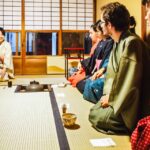
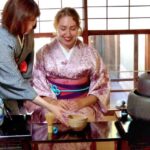
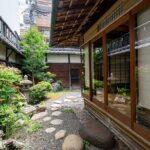
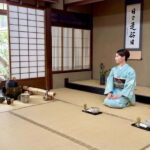
Photos without chasing a performer
The photo opportunity comes at the end, after the tea and Q&A. You can take a commemorative photo close beside the maiko, which gives you a clear keepsake from the meeting.
I like the structure because the photo is not the entire point of the event. You first receive an explanation and have a chance to interact, then take the picture. That feels more respectful than treating a maiko as a passing street attraction.
The description makes clear that this is a scheduled encounter, not an attempt to spot or follow a maiko in Kyoto’s entertainment districts. You get close access in an appropriate setting, with staff organizing the session.
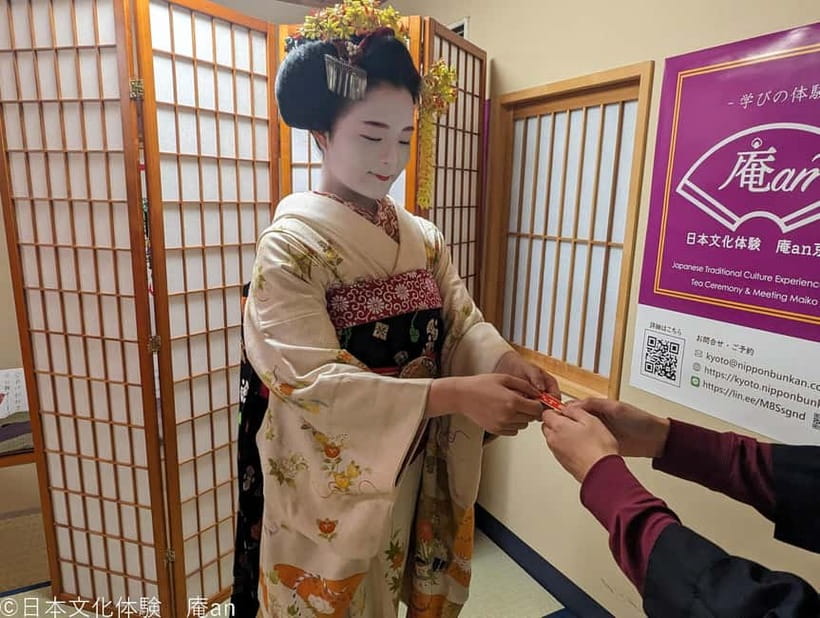
The Senjafuda is another small but meaningful touch. The maiko gives you this lucky paper charm before leaving. It is easy to carry, and it adds a personal reminder beyond the photograph.
What the $28 price really buys
At $28 per person, the value is strong if you want several small experiences in one appointment. Your fee covers the maiko or geiko tea ceremony, two ohigashi, matcha, the photo opportunity, and the Senjafuda.
The price also reflects the short duration. You are not paying for a half-day cultural tour, a meal, or a private performance. Instead, you are buying a focused introduction that fits neatly between visits to Kyoto Station, Gojo, or nearby central sights.
For a couple or small family, the cost can be easier to justify than a more expensive formal tea ceremony. You receive instruction, conversation, and a keepsake rather than only watching a demonstration.
Children who need their own seat pay the same fee as one adult. Children under two who sit on a parent’s lap are free. That makes the arrangement worth checking carefully if you are traveling with young children, since the savings apply only to the youngest children who do not need their own seat.
Language, stairs, and timing details
The official language is Japanese. English translation is offered as much as possible if you contact the operator and request it, but you should not assume that every explanation will be delivered in fluent English.
For many visitors, this will be manageable because the tea-making demonstration is visual and practical. The staff can also explain the sequence and help with translation, as reported during sessions with Masaya-san. Still, the Q&A will be more satisfying if you prepare simple questions and confirm your language needs ahead of time.
The building has no elevator. You must use stairs to reach the venue, so this activity may not suit anyone unable to climb them.
Arrive early. The event cannot be held for latecomers, and no refund is provided for missing it because of a delay. The meeting point is close to the subway, but finding the correct entrance can take longer than expected if you do not know to look above the supermarket.
The operating hours are 10:00 AM to 5:00 PM. Reservations made after 5:00 PM are processed the following day. Cancellation is free up to eight days in advance, but changes within seven days and later cancellations can bring a fee. The operator does not cover your transport costs if the reservation is canceled.
Who will enjoy this best
I would choose this for a first visit to Kyoto when time is short and you want a cultural activity that feels more personal than a museum display. It also works well for visitors curious about maiko life but uncomfortable with the idea of trying to photograph performers in public.
It is a good match for:
- Couples wanting a distinctive Kyoto photograph
- Families with children old enough to sit through a short ceremony
- Visitors staying near Kyoto Station or central Kyoto
- People who enjoy hands-on activities
- Anyone curious about the difference between maiko and geiko
I would be more cautious if your priority is a traditional house, a garden, a private tea master, or an elaborate stage performance. The building is modern and functional, and the session is short.
You should also consider your expectations around authenticity. The meeting is a genuine scheduled cultural introduction, but it is presented for visitors in a commercial venue. That does not make it worthless. It simply means you are receiving an accessible explanation of Kyoto’s traditions rather than entering the private world of an ochaya.
Should you book the Gojo tea ceremony?
I would book it if you want a short, affordable introduction to Kyoto culture with real interaction. The strongest parts are the chance to make your own matcha, ask direct questions, meet a maiko or geiko at close range, and leave with both a photo and Senjafuda.
I would skip it if you need a guaranteed maiko, full English instruction, step-free access, or a traditional Japanese setting. Check the host for your chosen date, request English help in advance, and arrive early enough to find the stairs.
At $28, this is a practical choice for a tight Kyoto schedule. It will not replace a longer cultural evening, but it can give you a memorable look at maiko life without consuming a large part of your day.
FAQ
How long does the tea ceremony experience last?
The scheduled duration is 45 minutes. The main program ends at about 30 minutes, followed by the photo opportunity, Senjafuda gift, and room departure.
Where is the meeting point?
The venue is about a one-minute walk from Exit 1 of Gojo Station on the Subway Karasuma Line. The entrance faces Gojo-dori and is located above the Carnival supermarket.
Is the experience always hosted by a maiko?
No. Depending on the event date, the host may be a maiko or a geiko.
Is English available?
The instructor speaks Japanese. English translation is provided as much as possible if requested, so contact the operator before the experience if you want language assistance.
What is included in the price?
The price includes the tea ceremony with a maiko or geiko, matcha, two dried Japanese sweets called ohigashi, a photo opportunity, and a Senjafuda lucky charm.
Do children pay the full price?
Children who require their own seat pay the same fee as one person. Children under two years old who sit on a parent’s lap are free.
Can I cancel for a full refund?
You can cancel up to eight days in advance for a full refund. Later cancellations and reservation changes within seven days may involve a fee.
More Tea Ceremony Experiences in Kyoto
More Gion & Geisha Walks in Kyoto

More tours in Kyoto we've reviewed




Gion & Geisha Walks, compared.
 ★ 4.7Kyoto Geisha Walking Tour: Gion District & Hidden GemsFrom $252 hours
 ★ 4.7Kyoto: Gion Geisha District Walking Tour – Stories of GeishaFrom $202 hours
 ★ 4.9Best of Kyoto: Gion, Geisha, Pagodas & CobblestonesFrom $242 hours
 ★ 4.5Night Walk in Gion: Kyoto’s Geisha DistrictFrom $211h 40m
 ★ 5.0Kyoto Night Foodie Tour in Gion (9+ dishes + 6 Sake tastings)From $163
 ★ 5.0Kyoto Gion Geisha District Walking Tour – The Stories of GeishaFrom $25