
Reviewed · ARASHIYAMA & BAMBOO TOURS
Kyoto’s Arashiyama Bamboo Grove: 3-Hour Guided Tour
Kyoto’s famous bamboo grove is only the beginning. This three-hour walking tour takes you through Arashiyama’s bamboo paths, Tenryuji Temple, Togetsu Bridge, Kimono Forest, and Okochi Sanso Garden, giving you more context than a quick photo stop.
I like the small group limit of nine, which makes it easier to ask questions and keep a sensible pace. I also like the guides’ flexible approach. Naoki, Miya, Atsushi, Vincent, and Cecilia are praised for clear English, local knowledge, patience, and the ability to adjust the walk to suit the group.
The main drawback is cost clarity. The tour is listed at $28 per person, but Tenryuji and Okochi Sanso entrance fees are additional, totaling ¥1,800 per person. You also need to reach the meeting point at Tully’s Coffee by Randen Arashiyama Station.
In This Review
- Key points to know before booking
- Why this Arashiyama walk works better than a quick bamboo stop
- Starting beside Randen Arashiyama Station
- Walking through the Sagano Bamboo Forest
- Tenryuji Temple brings context to the scenery
- Okochi Sanso Garden and its extra ¥1,000 fee
- Togetsu Bridge and Kimono Forest add local character
- The guide can shape the experience
- What $28 really gets you
- Who should book this three-hour tour
- Practical details that affect your day
- Should you book it?
- FAQ
- How long does the Arashiyama tour last?
- Where does the tour begin?
- Where does the tour end?
- What attractions are included?
- Are entrance fees included in the tour price?
- How many people can join the group?
Key points to know before booking
- The bamboo grove is part of a wider Arashiyama walk: You also visit Tenryuji Temple, Togetsu Bridge, Kimono Forest, and Okochi Sanso Garden.
- Groups are capped at nine people: This is a useful middle ground between a private tour and a large coach outing.
- Several guides receive strong praise: Naoki, Miya, Atsushi, Vincent, and Cecilia are singled out for patience, humor, flexibility, and clear English.
- The advertised price is not the full cost: Add ¥800 for Tenryuji and ¥1,000 for Okochi Sanso.
- The tour lasts about three hours: It is long enough to cover the main sights without taking up an entire day in Kyoto.
- You return to the starting point: Meet at Tully’s Coffee beside Randen Arashiyama Station and finish there as well.
Why this Arashiyama walk works better than a quick bamboo stop
Arashiyama is often treated as a single attraction: walk through the bamboo, take a picture, and leave. That misses much of what makes the district worthwhile. The grove is the best-known part, but the surrounding temples, gardens, river views, bridges, and traditional details give the area its character.
This tour links those pieces in one outing. You walk through the bamboo forest, see the grounds of Tenryuji Temple, cross or view the historic Togetsu Bridge area, pass the decorative Kimono Forest, and spend time at Okochi Sanso Garden. The route gives you a clearer sense of how nature, religious sites, and Kyoto’s older customs fit together.
I especially like this format for a first day in Kyoto. A guide can help you get your bearings and explain the difference between a temple and a shrine, the role of local religious traditions, and the meaning behind the places you are seeing. Several guides are described as strong with Japanese history, religion, and culture, which is useful when the scenery alone does not explain what you are looking at.
You should still keep your expectations in check. This is a walking tour, not a private cultural seminar. The tour has about three hours to cover several stops, so some visits are brief. If you want long, quiet time in every garden or temple hall, you may prefer to explore Arashiyama on your own.
A few more Kyoto tours and experiences worth a look

Starting beside Randen Arashiyama Station
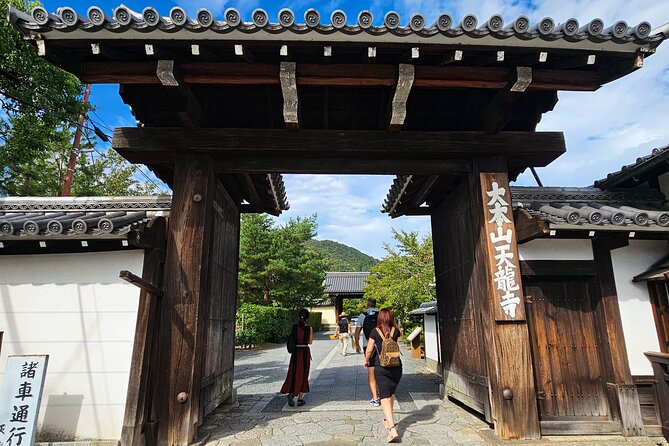
The meeting point is Tully’s Coffee at Randen Arashiyama Station, 20-2 Sagatenryuji Tsukurimichicho, Ukyo Ward, Kyoto. This is a practical location because the tour begins near public transportation and ends at the same place.
Give yourself time to find the station and coffee shop. Arashiyama is easy to reach, but the district has several transport stops and busy pedestrian areas. Having the exact meeting point saved on your phone is wise, especially if you select an early start time.
The tour offers several start times, including last-minute booking options when available. That flexibility helps if your Kyoto schedule is built around weather, temple visits, or a late arrival. Still, I would not treat last-minute availability as a guarantee during busy periods.
Because the walk ends back at the starting point, you can plan your next activity from the same transport area. The return point also makes the tour less stressful than an outing that leaves you on the opposite side of town.
Walking through the Sagano Bamboo Forest
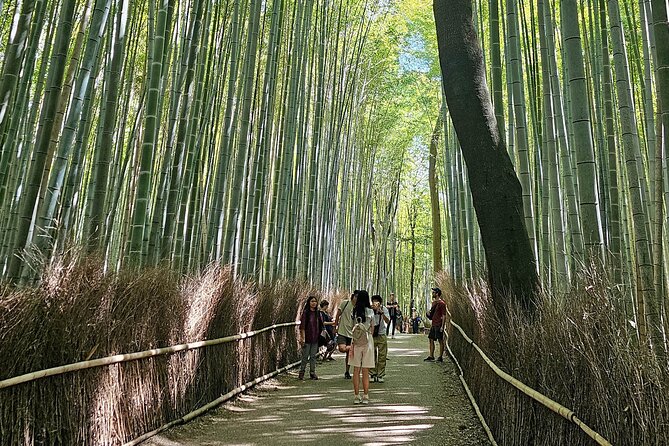
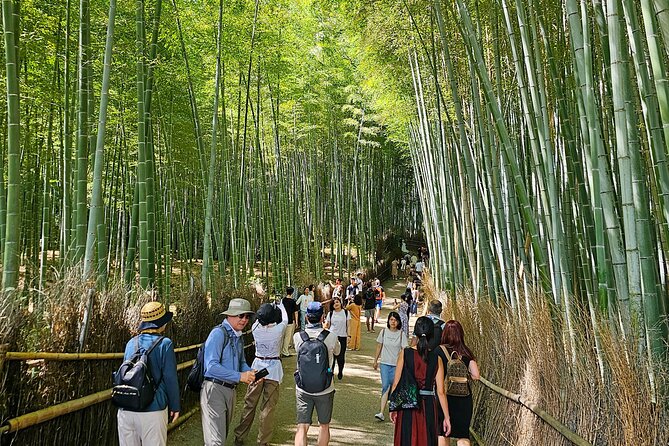
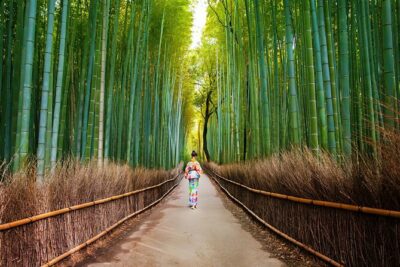
The bamboo grove is the visual star of the tour. Tall green stalks rise on both sides of the path, creating the familiar tunnel effect that draws people from around the world. It is one of Kyoto’s easiest places to photograph, but photographs do not explain why the grove matters or how it fits into the wider Sagano area.
A guide adds value here by giving the setting a sense of place. You can ask questions as you walk rather than trying to read signs or piece together information later. The guides are described as friendly, funny, and well informed, with one guide praised for having a large store of historical information.
The grove can also be busy. The tour does not promise an empty path or a private photo session. Your guide may help you move through the area efficiently, but you should expect other people and keep your camera time realistic.
I would bring comfortable shoes. The experience is entirely on foot, and the bamboo section is only one part of the route. A small water bottle is sensible too, since meals and drinks are not included.
Tenryuji Temple brings context to the scenery
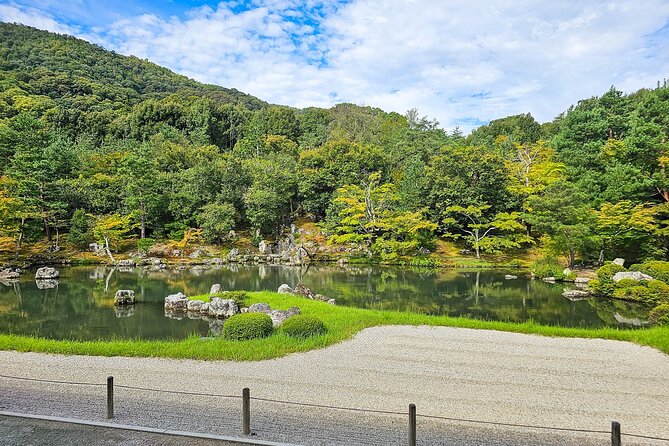
Tenryuji is scheduled for about 30 minutes. That may sound short, but it gives the tour room to visit several places instead of spending the whole morning at one temple. The temple helps show why Arashiyama is more than a scenic district.
The grounds combine religious architecture with carefully arranged natural views. Your guide can explain local customs and religious traditions while you look at the temple setting. This is where the tour’s cultural focus matters most. Without explanation, you may see a beautiful temple and garden. With a good guide, you can better understand how the site functions within Kyoto’s religious culture.
The entrance fee is listed separately at ¥800 per person. Include that amount in your budget before booking. The tour price itself is $28, but the additional admission costs mean your actual expense will be higher.
Thirty minutes is enough for an introduction, not an exhaustive visit. You may not have time to linger at every point that catches your eye. If Tenryuji is your top priority, consider returning independently after the tour, provided your schedule allows.
Okochi Sanso Garden and its extra ¥1,000 fee
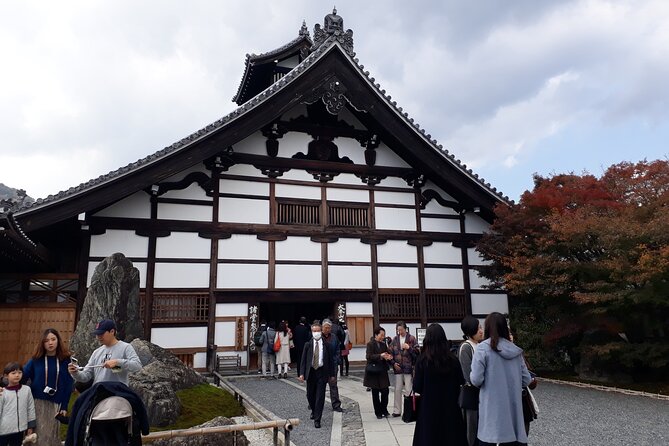
Okochi Sanso Garden receives about 30 minutes of the schedule. It offers a quieter contrast to the bamboo path and a chance to focus on gardens, mountain views, and the relationship between buildings and nature.
The garden is also the tour’s most significant extra expense. Admission costs ¥1,000 per person, and that fee is not included in the $28 tour price. You should have the payment ready and make your decision with the full cost in mind.
The garden stop suits people who enjoy visual details and calm surroundings. Your guide can point out local customs and traditions while you take in the views. The time is limited, though, so you should think of this as a guided introduction rather than a slow, unhurried garden visit.
I like having Okochi Sanso included because it keeps the outing from becoming a bamboo-only experience. The garden adds variety and gives you a different side of Arashiyama. It also makes the extra fee easier to justify if you value gardens and scenic viewpoints.
Other guided tours in Kyoto

Togetsu Bridge and Kimono Forest add local character
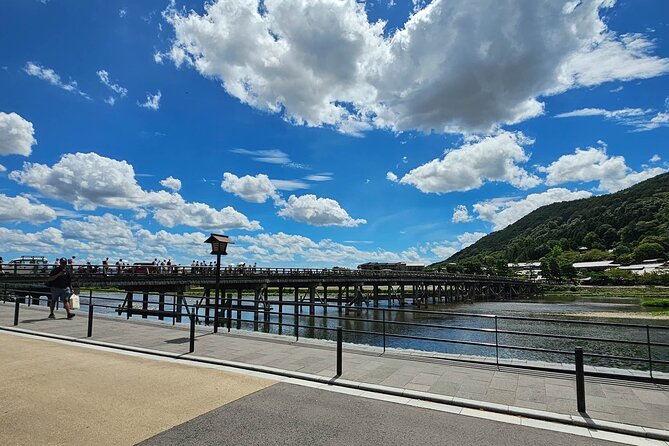
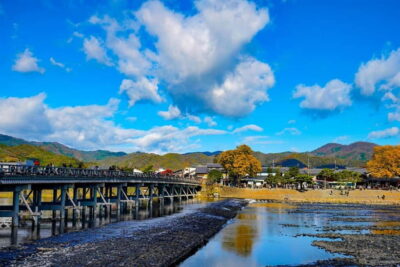
Togetsu Bridge is one of Arashiyama’s best-known sights. Its setting connects the district to the river and surrounding mountains, giving you a broader view after the enclosed bamboo paths. It is a useful reminder that Arashiyama’s appeal comes from the whole district, not one narrow grove.
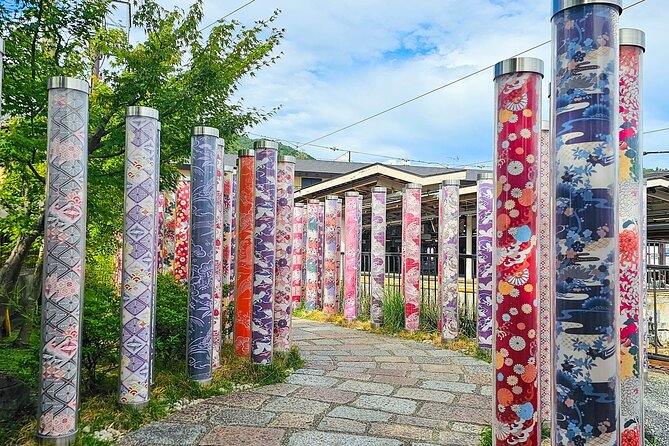
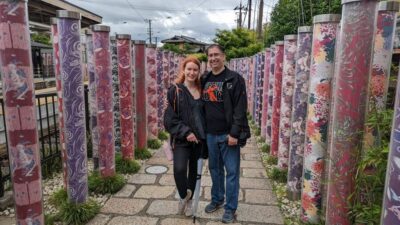
The itinerary also includes Kimono Forest, a collection of patterned textile pillars near the station area. This stop is distinct from the temple and garden visits. It gives the walk a modern, decorative note while still drawing on Kyoto’s long connection with textiles and traditional design.
These stops also help break up the walking route. You move from bamboo to temple grounds, then to garden views and recognizable public sights. That variety is helpful for families and mixed-age groups, especially when not everyone wants a long sequence of formal religious sites.
One guide was especially flexible with a family that included a reluctant teenager, helping find a matcha stop in a rest area to keep the young traveler interested. That detail says something practical about the tour style: the guide may be willing to adjust small parts of the experience when time and the group’s needs allow.
The guide can shape the experience
Guide quality is the strongest reason to book this tour rather than simply following a map. Naoki is praised for excellent English and for explaining Japanese history, religion, and culture in a way that helped one participant learn a great deal. He also tailored the tour to individual needs.
Miya is described as punctual, patient, considerate, and helpful. Those qualities matter on a walking tour, where a rushed guide can make a scenic district feel like a checklist. Atsushi is praised for making the experience educational while showing the beauty of the bamboo and gardens.
Vincent is noted for explaining the history of the temples and shrines and for offering ideas for future activities in Kyoto. He also spent extra time on additional activities when the schedule allowed. Cecilia is described as kind and informative, which is the sort of calm presence that helps a first Kyoto outing feel manageable.
Guide assignments can vary. You cannot assume you will receive a particular person unless the operator confirms it. Still, the range of positive comments points to a consistent strength: the tour depends on human explanation, and that appears to be where it delivers the most value.
What $28 really gets you
At $28 per person, the base price is reasonable for a three-hour guided walk with a small group. You are paying for an English-speaking guide and route planning through several major Arashiyama sights. You are not paying for transport from your hotel, meals, or private access.
The two additional entrance fees add ¥1,800 per person. That is important because the advertised base price does not represent the complete outing. Add your transportation to and from Arashiyama, plus any drinks or snacks, when setting your budget.
For a solo visitor or couple, the price can make sense if you want an introduction to the district without hiring a private guide. For a family, group discounts may improve the value. The group cap of nine is also worth something. You get more personal attention than on a large bus tour, while avoiding the higher cost of a private booking.
The value depends on how much explanation you want. If you are happy to walk, take photos, and read about the sites later, you can explore the area independently. If you want help with cultural context, local customs, and the practical flow between sights, the fee is easier to defend.
Who should book this three-hour tour
I would recommend this experience to first-time Kyoto visitors who want a clear introduction to Arashiyama. It is also a good fit for solo visitors who would rather not handle the district alone, couples who want a guided cultural walk, and families who benefit from a flexible guide.
The tour suits people who prefer a compact morning or afternoon activity. Three hours is enough to make the trip feel worthwhile, but short enough to leave room for another Kyoto neighborhood, dinner, or an independent temple visit.
It may be less suitable for anyone with limited walking ability, since the experience is a walking tour and no hotel pickup is offered. The information says most people can participate, but it does not provide a detailed accessibility plan. If you need specific assistance, ask the provider before booking.
Photography fans will enjoy the bamboo, bridge, Kimono Forest, and gardens, but this is not a dedicated photo tour. You will share popular sites with other people and follow the group’s pace.
Practical details that affect your day
The tour accepts mobile tickets, and confirmation arrives when you book. Free cancellation is available if you cancel at least 24 hours before the start time. Cancellations or changes made inside that window are not refunded or accepted, and the cut-off uses Kyoto local time.
Meals and drinks are not included. A stop for matcha may be possible if the guide has time and the group needs it, but you should not count on refreshments being part of the tour.
Bring comfortable footwear and keep your belongings light. You will be walking through several different settings, and a small bag is easier than luggage. Check the start time carefully, arrive at Tully’s Coffee by Randen Arashiyama Station, and remember that the tour returns there.
Should you book it?
Book this tour if you want more than a quick bamboo grove photograph. The combination of bamboo, Tenryuji, Okochi Sanso, Togetsu Bridge, and Kimono Forest gives you a useful first look at Arashiyama, while the small group keeps the experience personal enough for questions.
The strongest reason to choose it is the guide. Naoki, Miya, Atsushi, Vincent, and Cecilia are praised for clear English, cultural explanations, kindness, humor, and flexibility. Just budget for the ¥1,800 in separate temple and garden admissions, expect a steady walking pace, and remember that popular Arashiyama will not be empty.
If you want a relaxed introduction with human context, this is a sensible buy at $28. If you prefer complete freedom, long temple visits, or a private itinerary, explore independently instead.
FAQ
How long does the Arashiyama tour last?
The tour lasts approximately three hours.
Where does the tour begin?
It begins at Tully’s Coffee, Randen Arashiyama Station Shop, at 20-2 Sagatenryuji Tsukurimichicho, Ukyo Ward, Kyoto, 616-8384, Japan.
Where does the tour end?
The activity ends back at the meeting point.
What attractions are included?
The walk includes the Arashiyama Bamboo Forest, Tenryuji Temple, Togetsu Bridge, Kimono Forest, and Okochi Sanso Garden.
Are entrance fees included in the tour price?
The entrance fees for Tenryuji Temple and Okochi Sanso Garden are not included. Tenryuji costs ¥800 per person, and Okochi Sanso costs ¥1,000 per person.
How many people can join the group?
The tour has a maximum of nine participants.
More 3-Hour Experiences in Kyoto


More Guided Tours in Kyoto
More Arashiyama & Bamboo Tours in Kyoto
More tours in Kyoto we've reviewed


Arashiyama & Bamboo Tours, compared.
 ★ 4.8Kyoto: Fushimi Inari, Kinkakuji, Bamboo Grove 1 Day Bus TourFrom $122510 minutes - 9 hours
 ★ 4.1Osaka/Kyoto:Kinkakuji,Arashiyama,FushimiInariShrine,NaraParkFrom $66
 ★ 4.7Kyoto/Osaka: Nara, Fushimi Inari Taisha, Arashiyama Bus TourFrom $529 - 10 hours
 ★ 5.0Kyoto Arashiyama Walking Tour: Bamboo, Monkeys, Gardens & SecretsFrom $65
 ★ 4.8Arashiyama Bamboo, Temple, Monkeys, or Secret Sake BreweryFrom $875 hours - 330 minutes
 ★ 4.4Osaka/Kyoto: Arashiyama, Nara & Fushimi Inari Shrine w/LunchFrom $61