
Reviewed · VIP
Private Kyoto Customizable Tour With Guide and Luxury vehicle
Kyoto is a city where eight famous sights can easily consume several days, yet this private tour gives you one long day and a vehicle to connect them. You can set the agenda with your English-speaking driver-guide, or ask for help shaping a route through temples, shrines, markets, and old neighborhoods.
I like the door-to-door convenience and the chance to adjust the day around your group. I also like the built-in flexibility: guides such as Charith and Malik have been praised for handling families, photos, timing, and the practical snags of seeing Kyoto in a day. The main concern is value. At $525.87 for up to six people, the price can work well for a full group, but some buyers found the vehicle more basic than the word luxury suggested and the guide closer to a driver than a full cultural guide.
In This Review
- Key points to know before booking
- One private vehicle, eight very different Kyoto experiences
- Arashiyama: bridge views and the bamboo paths
- Kinkakuji: the Golden Pavilion beside its pond
- Fushimi Inari: red torii gates and Mount Inari
- Kiyomizudera: the wooden stage above Kyoto
- Ginkakuji: the Silver Pavilion that never became silver
- Sanjusangendo: 1,001 Kannon statues in Japan’s longest wooden hall
- Gion Corner: wooden machiya and geiko culture
- Nishiki Market: Kyoto’s kitchen in five blocks
- What the private format is really worth
- Who should book this Kyoto day
- Should you book it?
- FAQ
- How long does the private Kyoto tour last?
- What time does the tour start?
- How many people can join the private tour?
- Is hotel pickup offered?
- What sights can the tour include?
- Are entrance tickets included?
- Are meals and drinks included?
- What transport is provided?
- Is an English-speaking guide included?
- Can I cancel for a full refund?
Key points to know before booking
- Eight major Kyoto stops in one day: The route can include Arashiyama, Kinkakuji, Fushimi Inari, Kiyomizudera, Ginkakuji, Sanjusangendo, Gion, and Nishiki Market.
- Private transport for up to six: Your group travels together in an air-conditioned vehicle with WiFi on board.
- A flexible plan matters: You can name the sights you want, ask for suggestions, or adjust the balance between temples, food, shopping, and history.
- Expect a quick overview: The listed schedule allows about one hour at each stop, so this is a highlights day, not a slow temple study.
- Guide quality may vary: Several guides, including Charith and Malik, receive strong praise, while one booking described the service as a pleasant driver with limited guiding.
- Check the price against your group size: The flat group rate is easier to justify for five or six people than for one or two.
One private vehicle, eight very different Kyoto experiences
The appeal here is simple. Kyoto spreads its major sights across several districts, and public transport can turn a sightseeing day into a sequence of platform changes, walks, and crowded buses. A private air-conditioned vehicle lets you move between distant areas without splitting up your group.
That convenience is especially useful if you have children, older family members, or anyone who tires easily. One family found the guide helpful with a stroller and a child wearing a foot cast. That does not remove the walking at the temples, but it can make the movement between them much easier.
You begin at 8:30 am and have roughly eight to ten hours. The planned day gives about one hour to each of eight stops, though the exact order and selection can be adjusted. In practical terms, you should treat the route as a broad introduction to Kyoto. Seeing every listed place in depth would take far longer.
The vehicle includes air conditioning and onboard WiFi. Pickup is offered, but the supplied details do not specify every pickup area, so confirm that point when you book. Admission fees, meals, drinks, and any special ride or cruise are extra.
Other guided tours in Kyoto
Arashiyama: bridge views and the bamboo paths
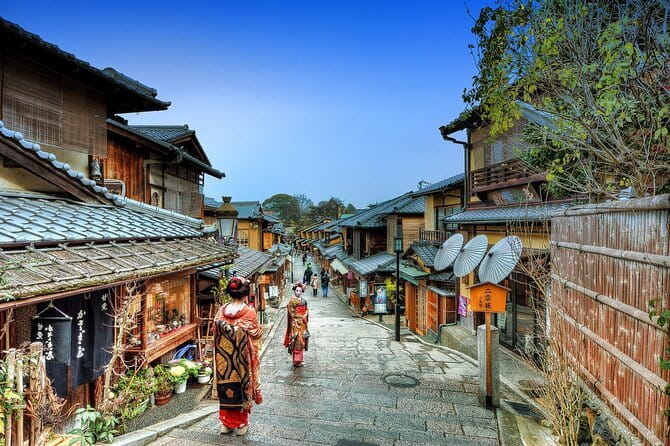
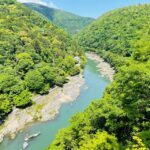
Arashiyama is a strong opening stop because it gives you scenery, a famous bridge, and one of Kyoto’s most photographed walks. Togetsukyo Bridge crosses the river with wooded hills behind it. Its name means Moon Crossing Bridge, and the setting is particularly pleasant when the trees frame the span.
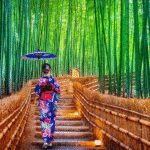
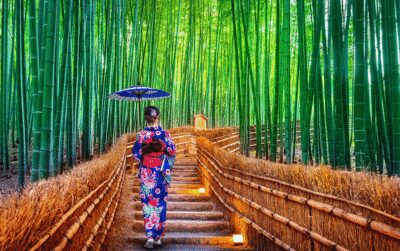
The nearby riverbank park has cherry trees, making it attractive in blossom season. You can also walk or cycle along routes through the bamboo groves. The tall stalks move in the wind, creating the quiet, enclosed feeling that makes this corner of Kyoto so popular.
The itinerary allows one hour here, which is enough for the bridge and a short bamboo walk. It is not enough for every corner of Arashiyama. If the bamboo paths are your main reason for booking, ask the guide to protect time here rather than trying to collect every stop on the list.
No admission ticket is included for this stop. The description also notes bamboo’s long role in local workshops, where it has been made into mats, cups, boxes, and baskets. That small detail helps connect the pretty walk with Kyoto’s working craft traditions.
Kinkakuji: the Golden Pavilion beside its pond
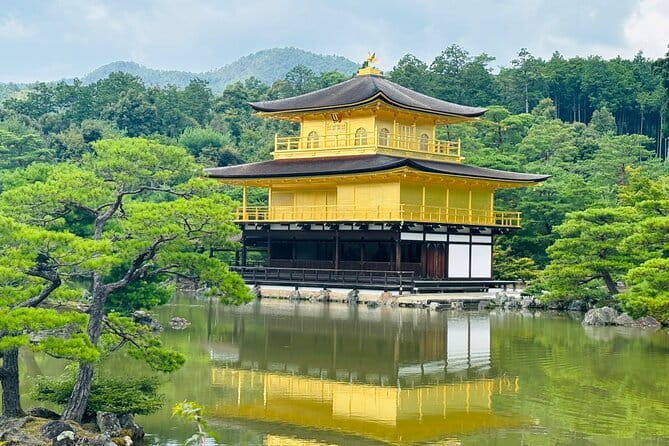
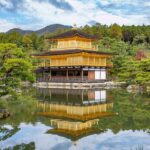
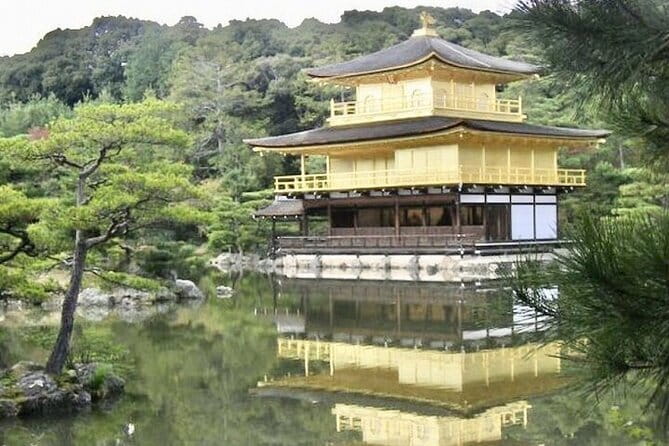
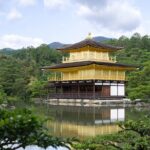
Kinkakuji is one of Kyoto’s most instantly recognizable sights. The upper two floors of this Zen temple are covered in gold leaf, and the building sits beside a large pond that reflects its bright finish when conditions are right.
The pavilion began as the retirement residence of Ashikaga Yoshimitsu. After his death in 1408, it became a Rinzai Zen temple. The present building is the surviving structure from that former residence, a useful reminder that this is not simply a decorative photo stop.
One hour lets you follow the grounds and view the pavilion from the main paths. You should not expect a quiet, private look at the building. Its fame makes it one of Kyoto’s busiest sights, and the route is generally about viewing the exterior and gardens rather than wandering through the pavilion itself.
Admission is not included. If you want detailed temple context, use your hour well by asking the guide to explain Yoshimitsu, the Zen connection, and the later relationship with Ginkakuji.
Fushimi Inari: red torii gates and Mount Inari
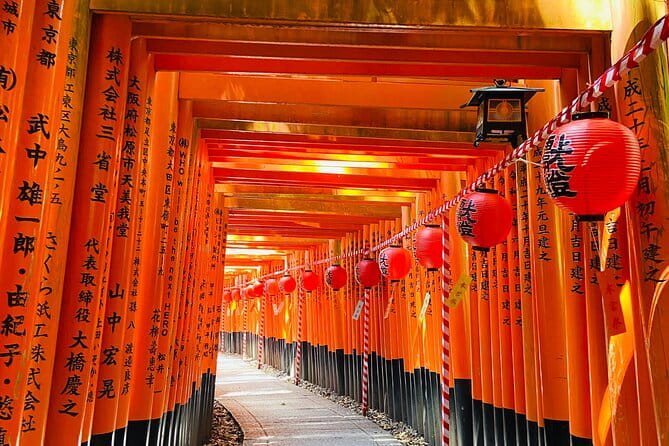
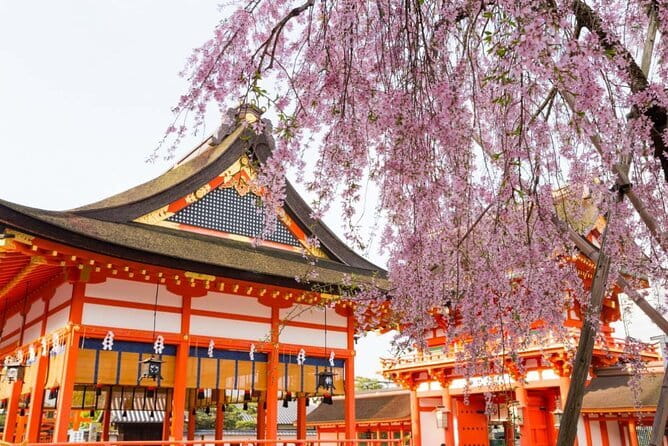
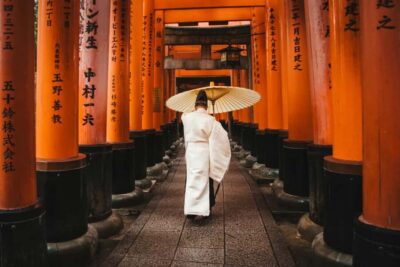
Fushimi Inari Taisha offers a very different mood. The shrine is known for thousands of red torii gates that climb through forested paths behind the main buildings. The gates lead toward Mount Inari, which rises to 233 meters within the shrine grounds.
The shrine honors Inari, the Shinto deity linked with rice, and foxes are regarded as Inari’s messengers. You will see fox statues around the grounds, an appealing detail to notice as you move through the shrine.
Admission is free. The one-hour slot is enough for the main shrine area and an initial walk beneath the torii, but not for a full climb up the mountain. If you want to reach higher sections, you will need to sacrifice time elsewhere or ask for a shorter list of stops.
This is one place where a private itinerary helps. You can decide if your priority is the main shrine, the first stretch of gates, or a longer uphill walk. Do not assume all three fit comfortably into one hour.
Kiyomizudera: the wooden stage above Kyoto
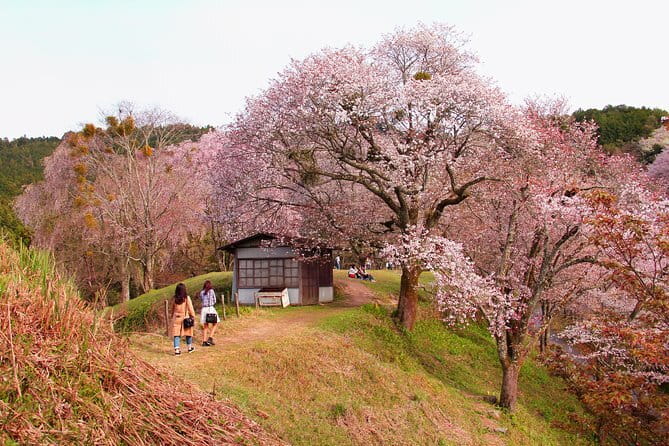
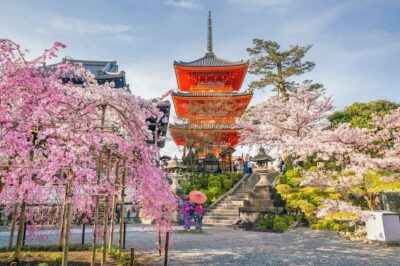
Kiyomizudera, or Pure Water Temple, dates to 780 and takes its name from the Otowa Waterfall. The temple is connected with the Hosso school of Buddhism and became a UNESCO World Heritage Site in 1994.
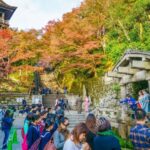
Its most famous feature is the wooden stage projecting 13 meters from the main hall above the hillside. From there, you can look across the surrounding trees, which turn colorful with cherry blossoms and autumn maple leaves.
The temple grounds are more spread out than a quick photo stop suggests. You will walk uphill and through busy approach streets, so comfortable shoes matter. The one-hour plan gives you a taste of the main view and the temple setting, but little spare time for a slow visit.
Admission is not included. If your group cares most about views, architecture, or Buddhist history, say so before the day begins. The guide can then shape the visit around what you actually want to understand.
Other private tours in Kyoto
Ginkakuji: the Silver Pavilion that never became silver
Ginkakuji is often called the Silver Pavilion, though the building was never covered in silver. Shogun Ashikaga Yoshimasa built the retirement estate in 1482, using his grandfather Yoshimitsu’s Kinkakuji as a model. After Yoshimasa died in 1490, the estate became a Zen temple.
The site is tied to the Higashiyama Culture, a period associated with refined arts and the tastes of Yoshimasa’s court. That makes Ginkakuji a useful counterpoint to the glitter of Kinkakuji. One emphasizes gold and show; the other is valued for its quieter design and cultural influence.
Admission is listed as free in the supplied details. Again, one hour is a short visit, but it can work if you focus on the pavilion, gardens, and the setting along Kyoto’s eastern mountains.
Because Ginkakuji and Kiyomizudera both lie on the eastern side of the city, your guide may be able to group them sensibly. The route remains subject to traffic and the day’s priorities.
Sanjusangendo: 1,001 Kannon statues in Japan’s longest wooden hall
Sanjusangendo gives you an indoor temple visit with a striking central feature: 1,001 statues of Kannon, the Buddhist figure associated with mercy. The main hall stretches 120 meters, making it Japan’s longest wooden structure.
The name refers to the 33 spaces between the hall’s rear columns. The temple was founded in 1164 and rebuilt after a fire destroyed the first structure about a century later.
This is a good choice when you want more than another exterior view. The long hall and rows of statues create a strong sense of order, though photography rules and other site requirements may affect how you experience the interior. Admission is not included.
The one-hour schedule should be enough for a focused visit. If your group prefers architecture, sculpture, and religious art, you may want to give Sanjusangendo more time than a market or neighborhood walk.
Gion Corner: wooden machiya and geiko culture
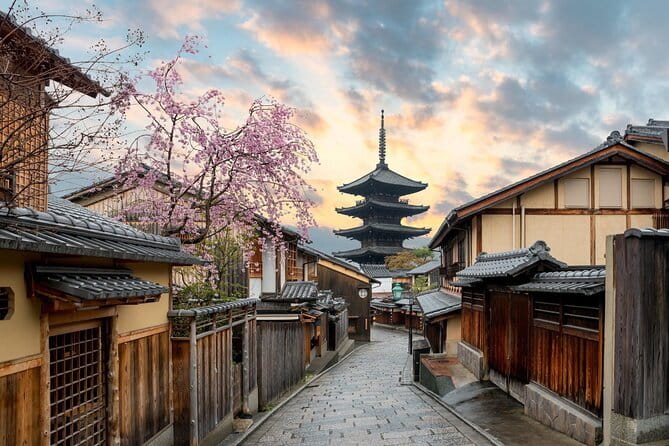
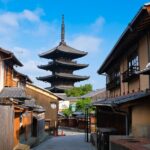
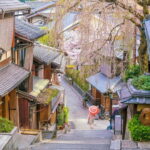
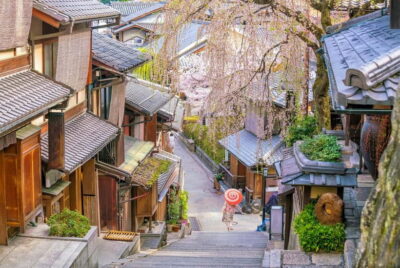
Gion is Kyoto’s best-known geisha district, located along Shijo Avenue between the Kamo River and Yasaka Shrine. Its lanes contain restaurants, shops, and ochaya, the traditional teahouses where geiko and maiko provide entertainment.
The old wooden machiya houses are part of the visual appeal. Many have narrow street fronts, only five or six meters wide, but extend far back from the road. This shape developed when property taxes were based on frontage.
You can walk through the area in about an hour, seeing traditional streets and the approach toward Kenninji Temple. Gion is a neighborhood, not a single ticketed attraction, so admission is free.
Keep your expectations sensible. A walk through Gion does not guarantee that you will see a geiko or maiko, and the area should be treated as a working neighborhood rather than a stage set. Your guide can add useful context, but respectful behavior remains your responsibility.
Nishiki Market: Kyoto’s kitchen in five blocks
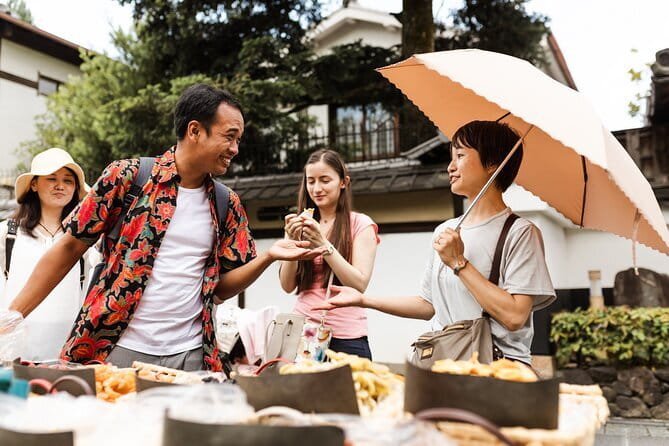
Nishiki Market is a narrow, five-block shopping street lined with more than 100 food shops and restaurants. It is known as Kyoto’s Kitchen, with stalls selling seafood, produce, knives, cookware, pickles, dried seafood, sushi, and Japanese sweets.
This is the most natural place to add a food focus to the day. Many shops specialize in one product, and the compact layout lets you see a broad range of Kyoto ingredients and kitchen traditions in a short time.
Admission is free, but food purchases are not included. Lunch, coffee, tea, and other drinks are also extra. The market can feel crowded, and the narrow passage is not ideal for lingering with a large group, so agree on a meeting point if anyone wants to browse separately.
The one-hour visit works well for sampling and shopping. It works less well if you want a sit-down meal and a careful look at every stall. Tell the guide early if Nishiki is a major priority.
What the private format is really worth
The flat price is $525.87 per group of up to six. Split six ways, that is about $88 per person before entrance fees and food. For two people, the same tour costs about $263 per person, which is a much harder value comparison.
I see the strongest value in the private vehicle, not in the word luxury. You avoid organizing several taxis, keep your group together, and can ask for route changes. That convenience has real worth on a long Kyoto day.
The guide element is less predictable. Several bookings praise Charith for a well-planned day and Malik for strong site knowledge, useful facts, and help with photographs. Another booking found the driver pleasant but felt the service lacked the guiding depth promised by the marketing. One person also wanted a more energetic and excited presentation.
For that reason, I would message the provider before the tour and state exactly what you want: detailed history, short explanations, photography help, family assistance, or simply efficient transport. A clear request may help match your expectations with the person assigned.
The tour has a 4.5 rating from 29 reviews, but the spread matters more than the average. Most of the strongest comments praise punctuality, planning, clean transport, responsiveness, and the ability to see major sights in one day. The sharpest criticism concerns guide quality, cancellation communication, and the vehicle not feeling luxurious enough.
Who should book this Kyoto day
I would consider this tour for a group of four to six that wants to cover many major sights without managing Kyoto’s transport system. Families may benefit from the private vehicle and the ability to adjust walking time. A group with a clear wish list can also make good use of the customizable format.
It is less suitable if you want a slow, scholarly visit to each temple. Eight one-hour stops create a fast pace, and entrance fees plus meals add to the advertised price.
You should also be comfortable with some uncertainty about the guide’s style. The experience may be excellent with a guide such as Charith or Malik, yet the supplied feedback shows that the service can feel more like private driving on some days.
Free cancellation is available up to 24 hours before the 8:30 am start time. Changes or cancellations inside that window are not accepted for a refund. Service animals are allowed, the tour is near public transportation, and most people can participate.
Should you book it?
Book this private Kyoto tour if your group values comfort, a flexible route, and a single busy day covering Arashiyama, Kinkakuji, Fushimi Inari, Kiyomizudera, Ginkakuji, Sanjusangendo, Gion, and Nishiki Market. The price makes the most sense when shared by five or six people.
Skip it if you are a couple watching costs closely, or if you want a true luxury vehicle and a guide who gives long, detailed talks at every stop. Before paying, confirm the pickup area, ask what vehicle will be used, and explain whether you want guiding or mainly transportation. That small check can decide if this is a smart Kyoto shortcut or an expensive ride between temples.
FAQ
How long does the private Kyoto tour last?
The tour lasts approximately eight to ten hours.
What time does the tour start?
The stated start time is 8:30 am.
How many people can join the private tour?
The price covers one private group of up to six people.
Is hotel pickup offered?
Pickup is offered. The supplied details do not specify every eligible pickup location, so confirm your address when booking.
What sights can the tour include?
The listed stops are Arashiyama, Kinkakuji Temple, Fushimi Inari-taisha Shrine, Kiyomizudera Temple, Ginkakuji Temple, Sanjusangendo Temple, Gion Corner, and Nishiki Market Shopping District.
Are entrance tickets included?
Not all tickets are included. Admission is not included for Arashiyama, Kinkakuji, Kiyomizudera, and Sanjusangendo. Fushimi Inari, Ginkakuji, Gion Corner, and Nishiki Market are listed with free admission.
Are meals and drinks included?
No. Coffee, tea, drinks, lunch, and dinner are not included.
What transport is provided?
An air-conditioned vehicle with WiFi on board is provided. The tour is private, so only your group participates.
Is an English-speaking guide included?
Yes. The package includes an English-speaking guide. Guide names can vary, with Charith and Malik among those associated with highly praised experiences.
Can I cancel for a full refund?
Yes, if you cancel at least 24 hours before the experience start time. Cancellations or changes made less than 24 hours before the start are not accepted for a refund.
More VIP Experiences in Kyoto
More Private Tours in Kyoto
More Guided Tours in Kyoto

More tours in Kyoto we've reviewed


VIP, compared.
 ★ 4.6Kyoto: Private Highlights Tour with Guide and Luxury VehicleFrom $38310 hours
 ★ 4.8Kyoto:Private Tour/Luxury Vehicle with Guide & photographerFrom $407
 ★ 4.7Kyoto Day Tour with Certified Tour Guide & Luxury vehicleFrom $49010 hours
 ★ 5.0The Kyoto VIP Experience!From $492
 ★ 2.9Kyoto: Private Customizable Guided tour with Luxury VehicleFrom $6131 day
 ★ 4.8Kyoto & Nara Private Luxury Car Tour: Encounter with DeerFrom $435