
Reviewed · TEA CEREMONY EXPERIENCES
Kyoto: Nara & Traditional Matcha Experience Bus Tour
Nara’s deer, Todaiji’s enormous Buddha, and Uji’s hands-on matcha lesson give this day tour a pleasing mix of spectacle and participation. You are not simply looking at temples all day. You feed deer, learn a few Japanese phrases, and prepare tea yourself.
I like the well-planned route, which links three major heritage sites without making you arrange several trains and buses. I also like the guides’ personal touch. At-chan, Nanami, Mai, Rina, Yuta, and Tsubasa are among the guides praised for clear explanations, humor, cultural tips, and help with directions.
The main drawback is the pace. Nine hours of sightseeing means plenty of walking, stairs, hills, and timed departures. The $122 price is fair when you include transport, admissions, the tea activity, and a guide, but it is less appealing if you prefer slow temple visits or independent meals.
In This Review
- Key Points At a Glance
- One Day, Three Big Sights, and a Bowl of Matcha
- Meeting at Kyoto Station Before 8 AM
- Kasuga Taisha and Nara’s Lantern-Lined Paths
- Meeting Nara’s Deer in the Park
- Todaiji Temple and the Great Buddha
- Lunch in Uji, With or Without the Meal Option
- Byodoin Temple and the Phoenix Hall
- Making Matcha From Scratch in Uji
- What the Coach and Guides Add
- Is the $122 Price Fair?
- Who Should Book This Day Tour?
- Should You Book the Nara and Uji Tour?
- FAQ
- Where does the tour meet?
- What time does the tour depart?
- How long does the tour last?
- Is hotel pickup included?
- Is lunch included?
- Can vegetarian meals be arranged?
- Which admissions are included?
- Is the tour offered in English?
- Can I feed the deer at Nara Park?
- Is the tour suitable for wheelchair users?
Key Points At a Glance
- Nara in one morning: See Todaiji Temple, Kasuga Taisha Shrine, and Nara Park in a single organized route.
- The Great Buddha: Enter Todaiji’s vast wooden hall and meet one of Japan’s most famous Buddhist images.
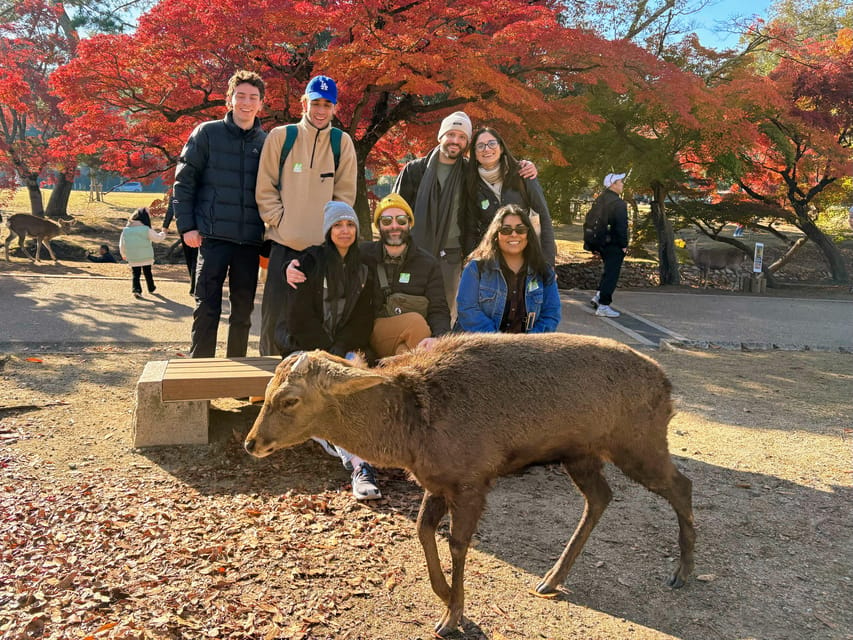
- Deer up close: Feed Nara’s wild deer with rice crackers, while keeping your fingers clear of eager mouths.
- Uji’s tea tradition: Learn how matcha is made and prepare your own finely ground green tea.
- Comfortable long-distance touring: Ride an air-conditioned coach with free Wi-Fi, regular ventilation, and multilingual audio support.
- A guide-led cultural day: Expect English commentary, some Japanese language practice, and free time for photos, food, and shopping.
One Day, Three Big Sights, and a Bowl of Matcha
This is a strong choice if you have only one free day for Nara and Uji. The tour leaves Kyoto Station at 8:00 AM and returns to the same area after about 510 minutes, or eight and a half hours. Along the way, you see major religious sites, a famous deer park, and one of Japan’s best-known tea regions.
The route also makes practical sense. Nara and Uji sit south of Kyoto, but visiting both on your own takes planning and several transport connections. A coach removes that work. You can listen to the guide, rest between stops, and avoid figuring out local buses while watching the clock.
The tradeoff is that this is a survey day, not a slow cultural retreat. Each stop has a set time, and traffic can change the order. You will see a lot, but you will not have unlimited time inside every temple or shrine.
A few more Kyoto tours and experiences worth a look
Meeting at Kyoto Station Before 8 AM
The meeting point is in front of Tully’s Coffee at the Kyoto Avanti Store, 31 Higashikujo Nishisannocho. Check-in is at 7:50 AM, with departure scheduled for 8:00 AM. Look for the green and white Japan Panoramic Tours flag.
Give yourself extra time to find the spot. Kyoto Station is large, and the meeting point requires crossing through the station area toward Kyoto Avanti. A late arrival is a serious problem because there are no refunds or changes for latecomers and no-shows.
Once aboard, the air-conditioned coach is a real advantage. The tour includes free Wi-Fi, regular ventilation, and antibacterial coating. The long rides are not wasted time, either. Guides often use them for cultural explanations, basic Japanese words, counting practice, and tips for the rest of your Japan trip.
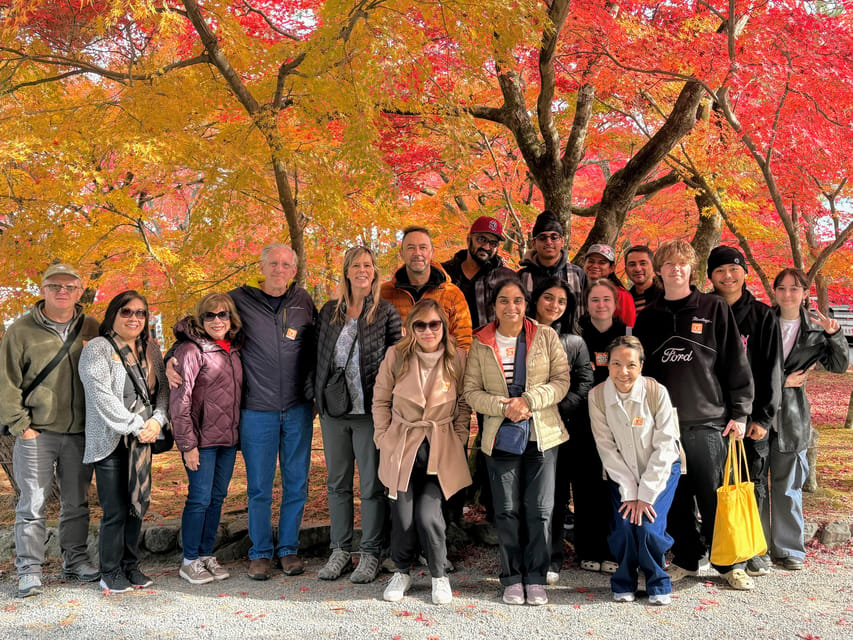
At-chan, Mai, Tsubasa, Yuta, Nanami, Rina, and other guides have received especially warm praise for this part of the day. Their approach appears to be lively rather than lecture-heavy, with handmade visual aids, simple language lessons, and practical help when someone gets separated or needs directions.
Kasuga Taisha and Nara’s Lantern-Lined Paths
The Nara portion usually includes Kasuga Taisha, Nara Park, and Todaiji, although traffic and operating conditions can change the order. The listed visit at Kasuga Taisha is about 30 minutes, enough for a focused introduction rather than a full exploration of every path.
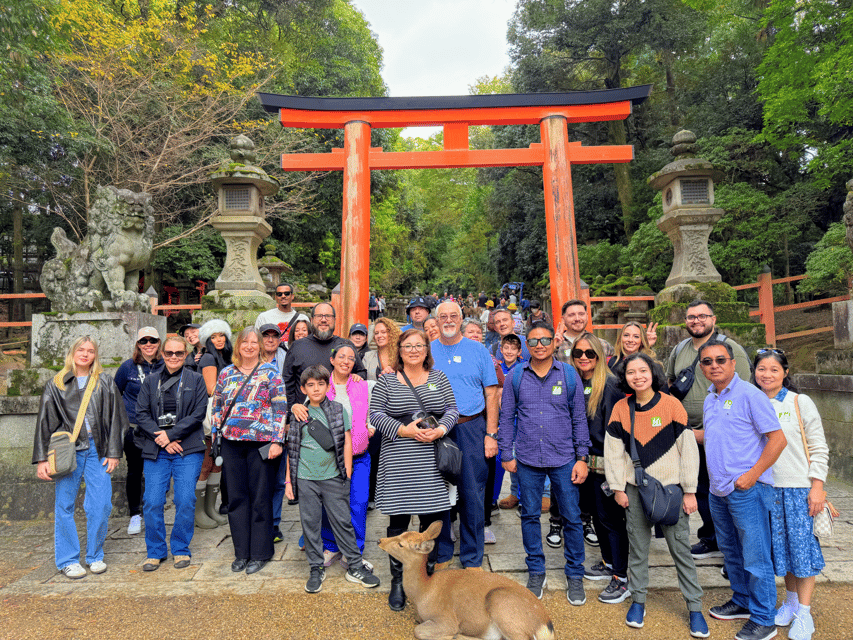
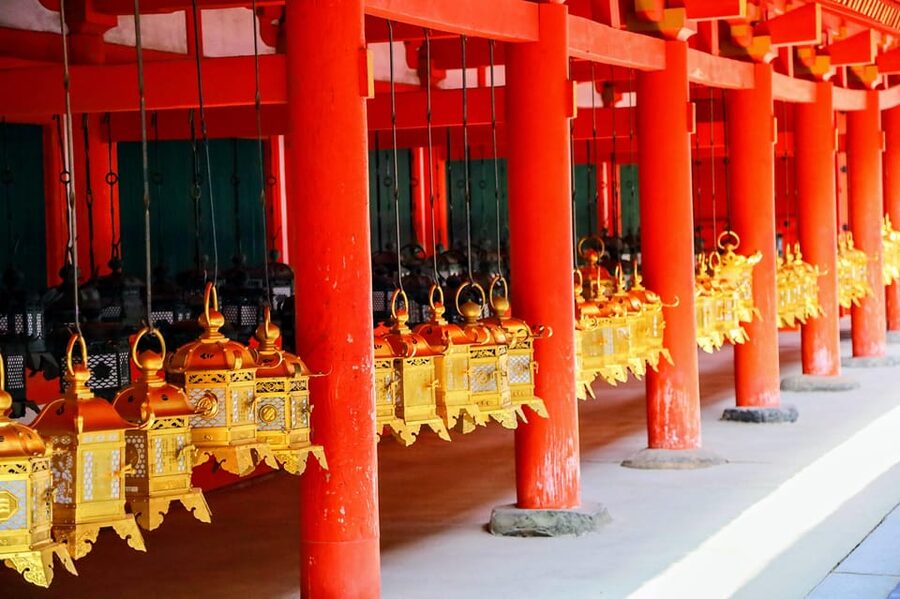
Kasuga Taisha is known for its rows of stone lanterns, with around 3,000 associated with the shrine. The lanterns give the approach a quiet, almost storybook quality. Your guide can also explain the difference between a Shinto shrine and a Buddhist temple, a useful bit of context when several sacred sites appear in one day.
Thirty minutes goes quickly here. You will want to stay with the group, take photographs, and listen for the meeting instructions. If your personal priority is exploring every lantern-lined path, this stop may feel short. If your goal is to understand why the shrine matters and see its most memorable features, the time is workable.
Comfortable shoes matter. The tour information warns about stairs and hills, and the Nara stops involve walking between the coach, temple grounds, shrine approaches, and park areas.
Meeting Nara’s Deer in the Park
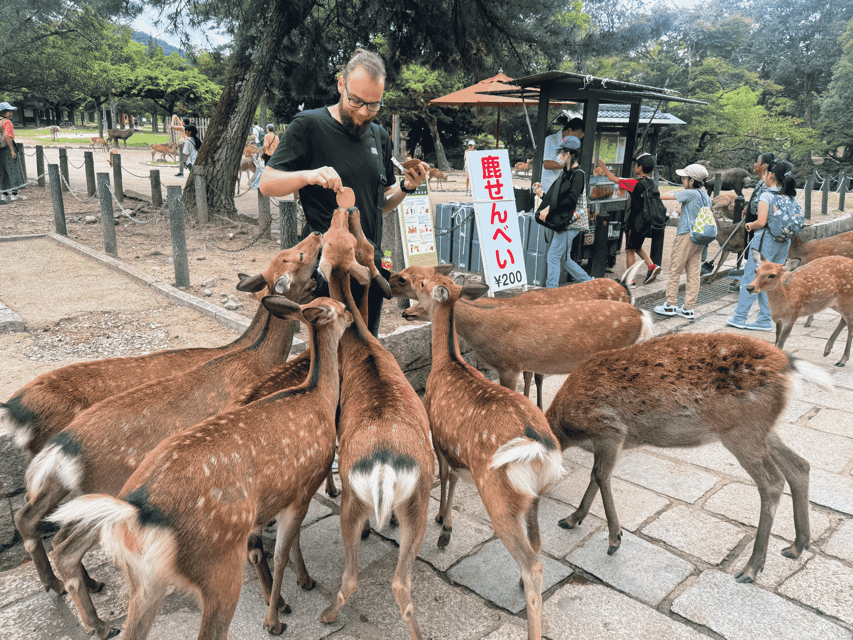
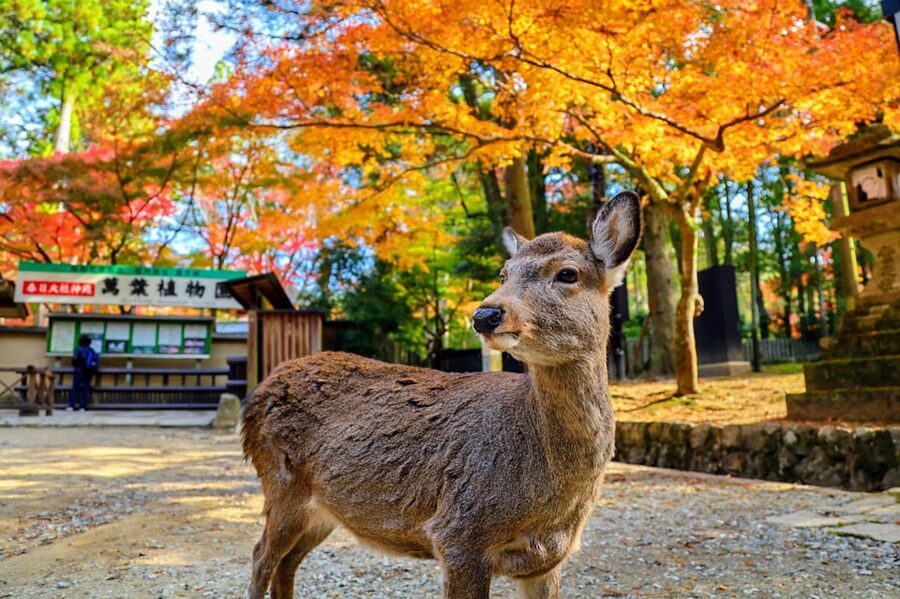
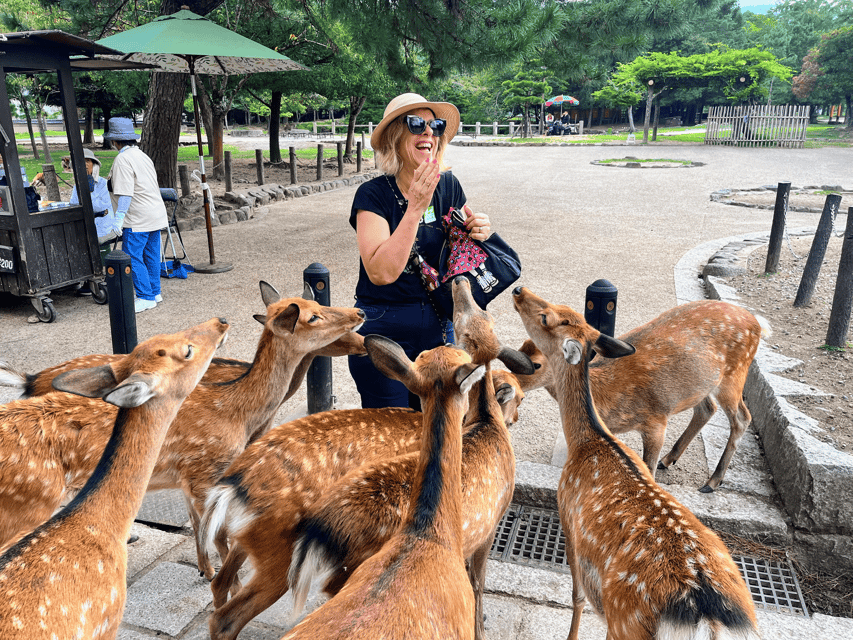
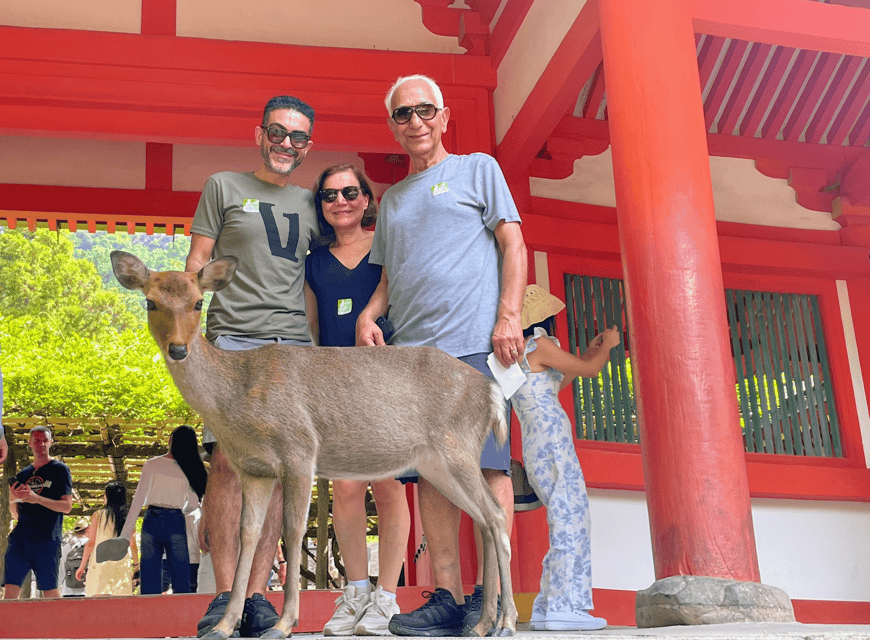
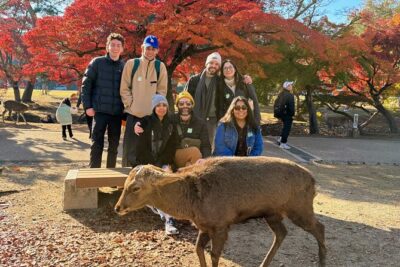
Nara Park is the most playful stop of the day. The deer are wild, accustomed to people, and free to wander around the park and temple grounds. You can buy rice crackers from roadside stalls and offer them by hand.
Some deer bow when they expect food. That charming behavior is part of the fun, but do not treat the animals like tame pets. One visitor specifically warned that they can bite, and an excited deer may crowd you quickly. Keep food controlled, feed carefully, and put it away when you are finished.
The scheduled park visit is around 30 minutes, so this is a brief encounter rather than a long nature walk. Still, it is enough time to approach the deer, take photographs, and enjoy the unusual sight of animals moving around a historic temple district.
I like this stop because it breaks up the formal sightseeing. After stone lanterns and religious architecture, the deer give you something immediate and funny to do. Families and first-time visitors usually get a lot from it, though anyone uncomfortable around animals should keep a little distance.
Todaiji Temple and the Great Buddha
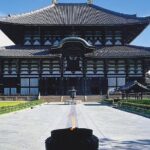
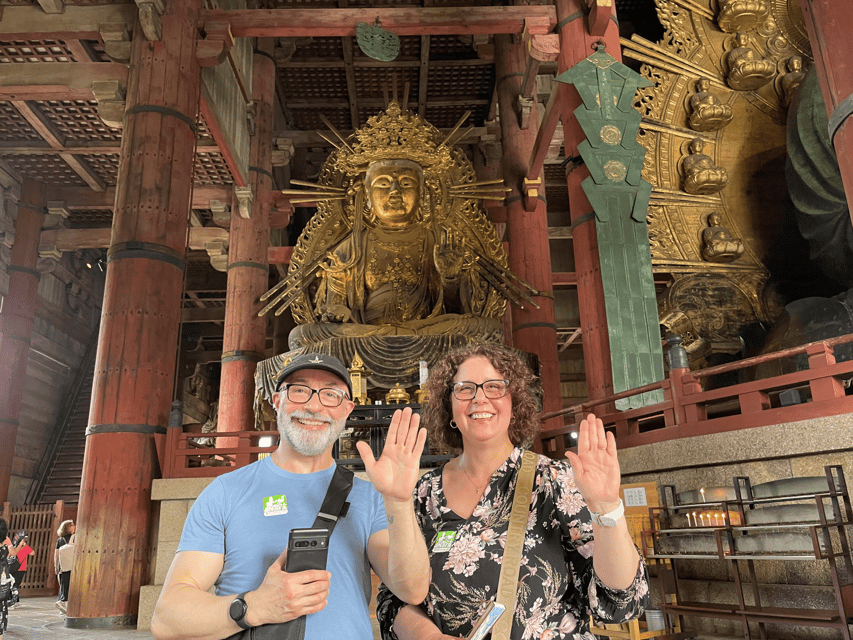
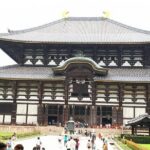
Todaiji is the day’s grandest sight. Its Daibutsuden, or Great Buddha Hall, houses the Great Buddha of Nara and is described as one of the world’s largest wooden buildings. Admission is included, so you do not need to buy a separate ticket at the temple.
The scheduled visit lasts about 50 minutes. That gives you time to enter the hall, see the immense Buddha statue, absorb the scale of the wooden structure, and hear the main points from your guide. The building is not impressive only because of its size. It also shows how religious centers shaped Nara’s role as an early capital of Japan.
This is where a good guide makes a clear difference. At-chan and other guides have been praised for explaining history in a friendly way and helping groups move efficiently. You will get more from the hall if you know what you are looking at instead of simply taking a quick photograph and leaving.
The time limit remains the key issue. Todaiji deserves a longer visit if you want to examine every detail, browse nearby grounds, or linger quietly. On this tour, the benefit is access and context within a larger day that also includes Kasuga Taisha and Uji.
A few more Kyoto tours and experiences worth a look

Lunch in Uji, With or Without the Meal Option
After Nara, the coach heads to the Uji area. The listed schedule allows about 50 minutes for lunch at a local restaurant. A Japanese lunch is available only if you select the lunch option when booking.
Several useful points are easy to miss. Additional food and drinks are not included, and vegetarian arrangements must be requested at least two days before the tour date. Last-minute bookings receive the regular meal, so do not wait until the final moment if you have dietary needs.
The meal option can add convenience to a tightly timed day. You will not need to search for a restaurant, check menus, or worry about returning to the coach. If you are particular about food or want to use the break for independent exploration, skipping the meal may give you more control, but you will need to arrange your own lunch within the available time.
Byodoin Temple and the Phoenix Hall
Byodoin is the central sight in Uji. Its Phoenix Hall appears on the Japanese 10-yen coin, making this one of those places you may already recognize without realizing it. The temple is part of the UNESCO-listed Historic Monuments of Ancient Kyoto, and admission is included.
The visit lasts about one hour. That is more generous than the time at Kasuga Taisha or Nara Park and should allow you to take in the temple grounds, see the Phoenix Hall, and listen to the guide’s explanation of its place in Japanese history and art.
Byodoin also changes the mood of the day. Todaiji is massive and imposing. Byodoin is famous for its graceful form and its connection to Uji’s tea culture. Seeing both in one day gives you useful contrast between Nara’s monumental Buddhist center and Uji’s more refined temple and tea setting.
If the temple is closed for operational reasons, the tour may substitute another site. The order can also change because of weather or traffic, so treat the schedule as a framework rather than a guarantee of exact timing.
Making Matcha From Scratch in Uji
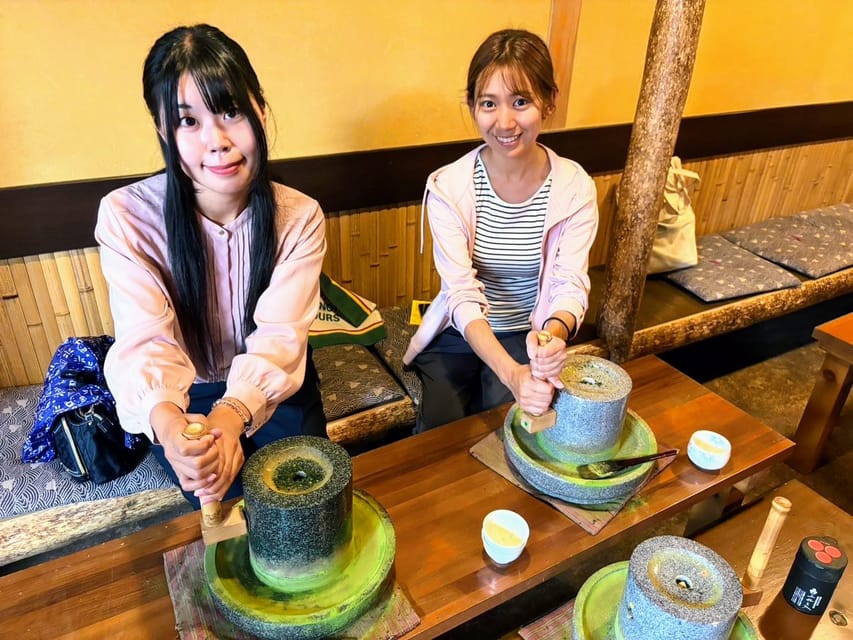
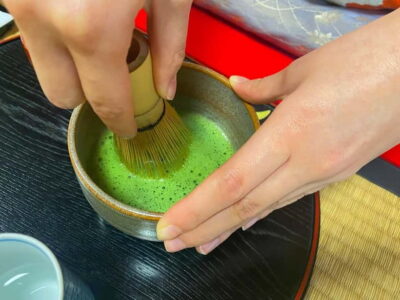
The matcha lesson is the tour’s most distinctive activity. Uji is one of Japan’s best-known tea areas, and here you learn that matcha is not simply ordinary green tea served in a different cup. It is a powder made from finely ground green tea leaves and is used in tea preparation, sweets, and cooking.
You get to make the matcha yourself. That hands-on step gives the visit more meaning than simply buying a tin in a shop. The tea you prepare may taste especially memorable because you took part in the process, not because the activity turns you into a tea master in 20 minutes.
The scheduled Uji portion, including free time and the tea experience, lasts about 70 minutes. That is enough for the lesson and a little browsing, but do not expect a long, formal tea ceremony with every possible ritual detail.
The experience has received some of the strongest praise attached to this tour. Guides have been described as making the activity clear, fun, and connected to local culture. One account specifically called it a historical matcha experience with a matcha champion, but the exact instructor or format may vary by departure.
After the lesson, Uji offers small shops, restaurants, and places to buy tea and souvenirs. Keep an eye on the clock. Shopping is pleasant here, but missing the coach is not.
What the Coach and Guides Add
The bus is more than a way to get from one stop to another. Nara and Uji are close enough to combine but far enough apart that public transport would take effort. The coach lets you cover both in one day while keeping your luggage and route simple.
The tour includes an English-speaking guide. Multilingual audio support is available in French, German, Italian, Portuguese, Spanish, and Ukrainian. English commentary comes from the live guide, while the audio system gives other language options.
Guide quality is a major part of the experience. Names frequently praised include At-chan, Nanami, Mai, Rina, Yuta, Tsubasa, Aoi, Den, Harry, and Sakura. You cannot choose a particular guide from the information provided, but the repeated pattern is useful: expect the guide to handle timing, explain customs, teach simple Japanese phrases, and help with practical questions.
Several guides have also been praised for looking after people who needed extra help. One helped a participant find a tea shop during free time, another helped someone who went off track, and one lent a neck fan during a hot day. These details suggest an attentive style, though the exact support depends on the guide and the circumstances.
Is the $122 Price Fair?
At $122 per person, this is not the cheapest way to see Nara. You could reach Nara by train and pay for individual admissions yourself. But the comparison should include the full package: air-conditioned coach transport, an English-speaking guide, Todaiji admission, Byodoin admission, the matcha activity, and optional lunch.
The value is strongest if you want structure. You get three major heritage sites, Nara Park, Uji, and a cultural activity without having to build the route. The free Wi-Fi and guided bus commentary make the long transfers more useful, too.
The value is weaker if you already know Nara well, dislike fixed schedules, or want to spend half a day at one temple. You also need to budget for drinks, snacks, souvenirs, and any meal you do not select in advance.
Free cancellation up to 24 hours before departure and reserve-now-pay-later booking add flexibility. The main financial risk is arriving late, since latecomers and no-shows are not refunded.
Who Should Book This Day Tour?
I would recommend it to first-time visitors based in Kyoto who want a broad introduction to Nara and Uji. It is also a good fit for families and mixed-age groups that would rather have a guide, a reserved coach, and clear meeting points than manage several train connections.
It suits people who enjoy variety: temples, shrines, animals, food, tea, shopping, and short language lessons. The repeated praise for guide energy and organization also matters if you want cultural explanation instead of a silent transfer between photo stops.
I would be cautious if you have a mobility impairment or use a wheelchair. The tour is specifically not suitable for wheelchair users, and you should expect stairs, hills, and substantial walking. Anyone seeking a quiet, unhurried temple day should also consider visiting Nara independently.
Bring comfortable shoes, water, and cash for deer crackers, food, or shopping. Keep the early meeting time in mind, and request a vegetarian meal no later than two days before the tour.
Should You Book the Nara and Uji Tour?
Book it if you want to pack two excellent day-trip destinations into one organized outing and value a guide who adds context, humor, and practical help. The deer and Great Buddha provide the big Nara moments, while Byodoin and the matcha lesson give Uji its own identity.
Skip it if your ideal day means lingering at one site, choosing every meal yourself, or avoiding stairs and timed departures. For most first-time visitors, though, the combination is unusually well balanced. You see the essentials, try something with your hands, and return to Kyoto without spending the evening solving transport problems.
FAQ
Where does the tour meet?
The meeting point is in front of Tully’s Coffee at the Kyoto Avanti Store, 31 Higashikujo Nishisannocho, Minami Ward, Kyoto. Look for the green and white Japan Panoramic Tours flag.
What time does the tour depart?
Check-in is at 7:50 AM, and the coach departs at 8:00 AM.
How long does the tour last?
The listed duration is 510 minutes, or about eight and a half hours.
Is hotel pickup included?
No. Hotel pickup and drop-off are not included.
Is lunch included?
Lunch is included only if you choose the lunch option. Additional food and drinks are not included.
Can vegetarian meals be arranged?
Yes. Vegetarian arrangements can be made up to two days before the tour date. Last-minute bookings receive the regular meal.
Which admissions are included?
Admission to Todaiji Temple and Byodoin Temple is included, along with the matcha experience.
Is the tour offered in English?
The live tour guide provides English commentary. Audio guides are available in French, German, Italian, Portuguese, Spanish, and Ukrainian.
Can I feed the deer at Nara Park?
Yes. Rice crackers are sold at roadside stalls, and you can offer them to the deer. Feed carefully because the deer may bite.
Is the tour suitable for wheelchair users?
No. The activity is not suitable for wheelchair users or people with mobility impairments. You will also need to manage stairs and hills.
More Kyoto Bus Tours in Kyoto

More Nara Day Trips in Kyoto
More Tea Ceremony Experiences in Kyoto
More tours in Kyoto we've reviewed





Tea Ceremony Experiences, compared.
 ★ 4.9Kyoto: Tea Ceremony in a Traditional Tea House in KiyomizuFrom $4945 min
 ★ 4.9Kyoto: Tea Ceremony Ju-An at Jotokuji TempleFrom $291h 10m
 ★ 4.3Kyoto: 45-Minute Tea Ceremony Lesson ExperienceFrom $2245 min
 ★ 5.0World Heritage Kyoto & Nara Uji Authentic Matcha ExperienceFrom $129
 ★ 4.9Kyoto: Table-Style Tea Ceremony at a Kyo-MachiyaFrom $451h 30m
 ★ 5.0Kimono Tea Ceremony at Kyoto Maikoya, NISHIKIFrom $65